One-Year Tumor Volume Regression as a Predictor of Survival in I-125 Plaque Brachytherapy for Posterior Uveal Melanoma
Highlight
One-year tumor volume regression (TVR) after low-dose-rate iodine-125 plaque brachytherapy predicts overall survival in patients with uveal melanoma.
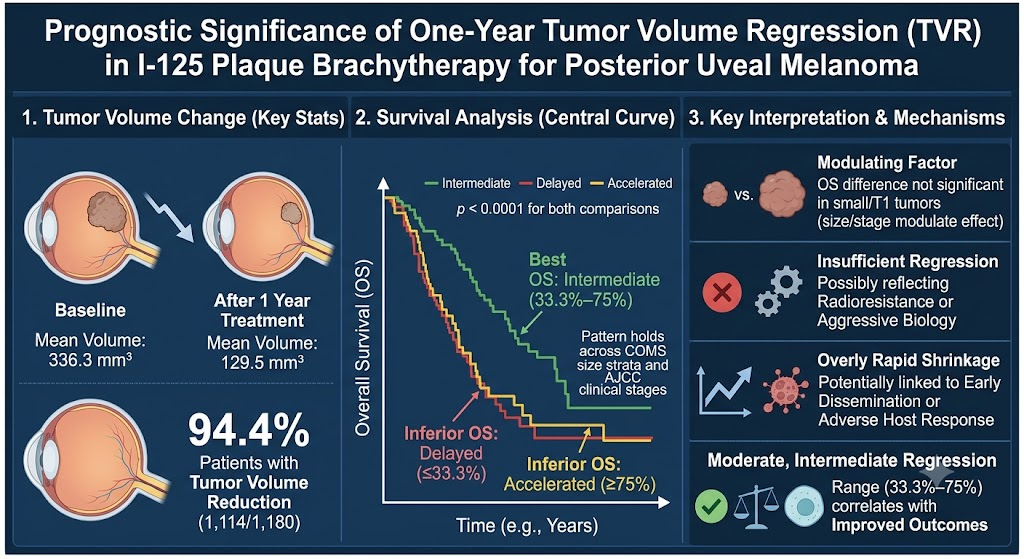
Intermediate tumor regression (33.3% to 75% volume reduction) associates with the best survival outcomes compared to delayed or accelerated regression.
TVR measurement using ultrasound-derived ellipsoid modeling provides a practical biomarker for risk stratification and patient counseling.
Study Background
Uveal melanoma (UM) is the most common primary intraocular malignancy in adults, with a high risk of metastasis and consequent mortality. Local tumor control is paramount to preserve the eye, but even with successful treatment, survival varies widely. Episcleral plaque brachytherapy (EPBT) using iodine-125 seeds is a well-established globe-sparing treatment for posterior UM, delivering targeted radiation over several days. Despite this, identifying reliable prognostic biomarkers that predict overall survival (OS) remains an unmet clinical need to guide individualized patient management and surveillance strategies. Traditional risk factors include tumor size, location, and clinical stage, but dynamic, post-treatment metrics such as tumor volume regression may provide additional, actionable information.
This retrospective cohort study aimed to evaluate the prognostic significance of one-year tumor volume regression measured by ultrasound following low-dose-rate I-125 EPBT in a large single-center population with UM, thereby potentially identifying a clinically useful biomarker for survival risk stratification.
Study Design
This retrospective analysis included 1,180 patients diagnosed with uveal melanoma treated at a tertiary academic ocular oncology center between 1984 and 2022. All patients underwent low-dose-rate iodine-125 plaque brachytherapy delivered at a dose rate of 52.8 cGy/h over 168 hours (7 days). Inclusion criteria required complete tumor ultrasound measurements at baseline (diagnosis) and one-year post-treatment, as well as full survival follow-up data. Patients lacking these measurements or survival data were excluded.
The primary measure was tumor volume regression (TVR) calculated at one year using ultrasound-based ellipsoid volume modeling. TVR was expressed as the percentage reduction from baseline tumor volume. Patients were stratified into three regression groups based on TVR thresholds identified through statistical methods (log-rank test sweep and LOWESS analysis): delayed regression (≤33.3% volume reduction), intermediate regression (33.3%–75%), and accelerated regression (≥75%). The main endpoint was overall survival (OS), analyzed using Kaplan-Meier survival curves and log-rank tests. Analyses were further stratified by Collaborative Ocular Melanoma Study (COMS) tumor size and American Joint Committee on Cancer (AJCC) clinical staging.
Key Findings
The mean baseline tumor volume was 336.3 mm³, which decreased significantly to 129.5 mm³ after one year of treatment. Notably, 94.4% of patients (1,114/1,180) showed some degree of tumor volume reduction.
Survival analysis revealed a striking non-linear association between TVR and OS. Patients achieving intermediate volume regression (33.3%–75%) experienced the best overall survival, significantly superior to both delayed (≤33.3%) and accelerated (≥75%) regression groups (p<0.0001 for both comparisons). This pattern held true across COMS tumor size strata and AJCC clinical stages, underscoring the robustness of TVR as a prognostic marker.
Interestingly, no significant difference in OS was observed between intermediate and accelerated regression groups among patients with COMS small or cT1 tumors, indicating that regression rate’s prognostic impact might be modulated by tumor size and stage.
These findings suggest that both insufficient tumor regression (possibly reflecting radioresistance or aggressive tumor biology) and overly rapid tumor shrinkage (potentially indicative of biological mechanisms linked to early dissemination or adverse host response) associate with inferior survival, whereas a moderate, intermediate regression range correlates with improved outcomes.
Expert Commentary
This study represents one of the largest and most comprehensive evaluations of post-EPBT tumor volume kinetics in uveal melanoma, providing valuable prognostic data with direct clinical applicability. The use of ultrasound-derived ellipsoid modeling of tumor volume at baseline and one-year enables a relatively straightforward, non-invasive biomarker accessible in routine practice.
The findings challenge the simplistic notion that faster tumor regression necessarily predicts better outcomes, instead proposing a nuanced, biphasic relationship between regression magnitude and survival. This might reflect underlying tumor biology or host-tumor interactions that warrant further investigation.
Limitations include the retrospective design and the single-center setting, which might impact generalizability. Additionally, the study did not include molecular or cytogenetic tumor markers (e.g., monosomy 3 or gene expression profiling), which are known independent prognostic factors but may be less widely available. Future prospective studies integrating volumetric regression with molecular profiles could refine risk stratification.
Importantly, this study supports the integration of volumetric regression assessment into routine post-treatment surveillance, allowing clinicians to identify high-risk patients potentially benefiting from intensified systemic monitoring or adjuvant therapy trials.
Conclusion
One-year tumor volume regression after iodine-125 plaque brachytherapy is a significant independent predictor of overall survival in patients with posterior uveal melanoma. An intermediate range of tumor regression (33.3% to 75%) confers the highest survival benefit, while both delayed and accelerated regression associate with poorer outcomes. This simple, ultrasound-based volumetric biomarker offers a practical tool for post-treatment risk stratification, patient counseling, and potentially guiding personalized surveillance and therapeutic interventions. Further prospective validation and integration with molecular prognostic factors are warranted to maximize clinical utility.
References
1. Davé N, Gonzalez DJT, Cernichiaro-Espinosa LA, King BA, Wilson MW. One-Year Tumor Volume Regression Predicts Survival After I-125 Plaque Brachytherapy for Posterior Uveal Melanoma. Am J Ophthalmol. 2026 May 12;288:305-314. doi: 10.1016/j.ajo.2026.02.001. PMID: 42128079.
2. Collaborative Ocular Melanoma Study Group. The COMS randomized trial of iodine 125 brachytherapy for choroidal melanoma. Arch Ophthalmol. 2001 Aug;119(8):969-82.
3. Kujala E, Damato B, Kivela T. Staging of uveal melanoma: the American Joint Committee on Cancer and beyond. Eye (Lond). 2020 Sep;34(9):1704-1713.
4. Shields CL, Kaliki S, Furuta M, et al. Uveal melanoma: clinical factors predictive of metastasis. Ophthalmology. 2013 Apr;120(4):807-11.
5. Naseripour M, Finger PT, Chin KJ, et al. Prognostic significance of tumor regression rate following plaque radiotherapy for choroidal melanoma. Ophthalmology. 2006 Nov;113(11):2060-2065.
This article was created using several editorial tools, including AI, as part of the process. Human editors reviewed this content before publication.