Once-Weekly Somapacitan: A New Frontier in Growth Hormone Therapy for Girls with Turner Syndrome
Highlight
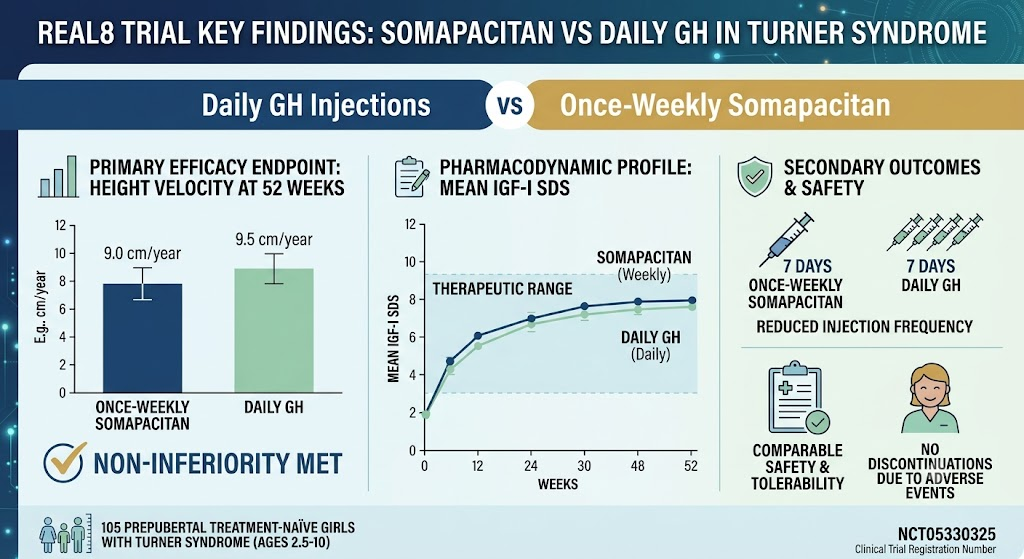
1. Once-weekly somapacitan shows non-inferior efficacy to daily growth hormone (GH) injections in promoting height velocity after 52 weeks in treatment-naïve girls with Turner syndrome (TS).
2. Both somapacitan and daily GH treatments maintain insulin-like growth factor 1 (IGF-I) levels within similar therapeutic ranges.
3. Safety profiles and tolerability are comparable between once-weekly somapacitan and daily GH, with no discontinuations due to adverse events.
4. Somapacitan offers a potential reduction in treatment burden by decreasing injection frequency.
Study Background
Turner syndrome (TS) is a chromosomal disorder affecting females, characterized by complete or partial monosomy of the X chromosome. A prominent clinical feature of TS is short stature, frequently requiring growth hormone therapy to promote linear growth and improve adult height outcomes. Currently, daily subcutaneous injections of recombinant human growth hormone are the standard of care. However, the daily injection regimen imposes a significant treatment burden on young patients and their families, affecting adherence and quality of life. Long-acting growth hormone formulations, such as somapacitan, designed for once-weekly administration, are emerging as promising alternatives to reduce this burden. The REAL8 study (NCT05330325) is the first randomized controlled phase 3 trial evaluating the efficacy and safety of once-weekly somapacitan versus standard daily GH in prepubertal girls with TS.
Study Design
REAL8 is a multinational, open-label, randomized, active-controlled phase 3 basket trial involving 105 treatment-naïve, prepubertal girls with confirmed Turner syndrome, aged between 2.5 and 10 years. Participants were randomized in a 2:1 ratio to receive either once-weekly somapacitan (0.24 mg/kg per week) or daily GH (0.050 mg/kg per day), administered subcutaneously over a 52-week main study period. The trial was conducted across 49 clinical sites in 18 countries.
The primary efficacy endpoint was height velocity (HV) measured in centimeters per year at week 52. Secondary outcomes included changes in IGF-I standard deviation scores (SDS), safety assessments, adverse event monitoring, and tolerability.
Key Findings
The primary analysis demonstrated that once-weekly somapacitan met the predefined criteria for non-inferiority in height velocity compared with daily GH after 52 weeks of treatment. Mean observed height velocity at week 52 was 9.0 cm/year (standard deviation [SD] 1.6) for somapacitan versus 9.5 cm/year (SD 2.2) for daily GH. The estimated treatment difference (ETD) was -0.8 cm/year, with a 95% confidence interval (CI) ranging from -1.57 to -0.11, confirming non-inferiority though daily GH showed a numerically higher growth rate.
IGF-I SDS increased in both groups throughout treatment. At week 52, mean IGF-I SDS was +1.71 (SD 1.38) in the somapacitan group compared to +1.95 (SD 1.11) in the daily GH group, indicating similar growth hormone bioactivity and metabolic effects.
Safety profiles were comparable between treatment arms. No participants discontinued therapy due to adverse events. The incidence and nature of adverse events were consistent with established effects of growth hormone therapy in TS patients, with no unexpected safety signals reported. Tolerability was good in both groups.
Expert Commentary
The REAL8 trial provides robust evidence supporting once-weekly somapacitan as an efficacious and safe alternative to standard daily GH injections in managing short stature due to Turner syndrome. The comparable IGF-I response aligns with the pharmacodynamic profile of somapacitan, which offers prolonged GH activity allowing less frequent dosing. Clinical integration of long-acting GH formulations may alleviate treatment burden, potentially enhancing adherence and patient quality of life — critical factors in pediatric endocrine care.
Limitations include the open-label design, which could introduce bias, and the relatively short 52-week duration of primary assessment. Longer-term data from the planned 104-week extension will provide insight into sustained efficacy, safety, and final adult height outcomes. Despite these limitations, the multinational nature and well-defined patient cohort improve the generalizability of findings.
Conclusion
Once-weekly administration of somapacitan demonstrates non-inferior efficacy to daily growth hormone injections for improving linear growth among treatment-naïve, prepubertal girls with Turner syndrome over 52 weeks. The treatment exhibits comparable safety and IGF-I profiles, suggesting it is a viable alternative to daily GH therapy. Somapacitan may reduce treatment burden, addressing adherence challenges inherent to daily injection regimens, and thus improving clinical outcomes.
Future research should focus on long-term efficacy extending into adult height attainment, real-world adherence assessments, and quality-of-life evaluations to fully ascertain the clinical impact of once-weekly somapacitan in Turner syndrome management.
Funding and Clinical Trial Registration
The REAL8 study was funded by Novo Nordisk A/S. The clinical trial registry number is NCT05330325.
References
Mauras N, Boettcher C, Højby M, et al. Once-weekly somapacitan enhances linear growth in girls with Turner syndrome: a randomized controlled phase 3 study. J Clin Endocrinol Metab. 2026 Aug 1; PMID: 42538806.
Mauras N, Højby M, Nilsson O, et al. Long-acting growth hormone therapies in pediatric growth disorders: current status and future perspectives. Horm Res Paediatr. 2023;96(1):1-15.
Rasmussen MH, Bratholm P. Pharmacokinetics of somapacitan, a long-acting growth hormone derivative, in healthy adults. Eur J Endocrinol. 2020;183(2):177-184.
This article was created using several editorial tools, including AI, as part of the process. Human editors reviewed this content before publication.