Neurological Effects and Safety of Encapsulated Dexamethasone Sodium Phosphate in Pediatric Ataxia Telangiectasia: Insights from the NEAT Phase 3 Trial
Highlights
- The NEAT phase 3 trial is the largest randomized study to date assessing erythrocyte-encapsulated dexamethasone sodium phosphate (eDSP) in children with ataxia telangiectasia (A-T), specifically targeting the 6-9 years age group.
- Despite a favorable safety profile and tolerability, eDSP failed to achieve statistically significant improvement in neurological function assessed by the Rescored Modified International Cooperative Ataxia Rating Scale (RmICARS) at 6 months.
- Earlier phase 3 data (ATTeST trial) supports safety but similarly showed lack of significant neurological benefit across low and high doses.
- Pharmacokinetic studies confirm sustained release of dexamethasone from erythrocytes, highlighting the potential for prolonged corticosteroid delivery without systemic adverse effects.
Background
Ataxia telangiectasia (A-T) is a rare, autosomal recessive multisystem disorder caused by mutations in the ATM gene, characterized by progressive cerebellar degeneration, immunodeficiency, and predisposition to malignancies. Neurologically, A-T manifests with progressive ataxia, oculomotor apraxia, and movement disorders, severely impairing pediatric patients’ quality of life. Currently, there is no approved disease-modifying therapy; symptomatic management remains standard. Corticosteroids have been investigated for decades due to their anti-inflammatory and neuroprotective potential, but universal adoption has been limited by adrenal suppression and symptom relapse upon discontinuation. The erythrocyte encapsulation of dexamethasone sodium phosphate (eDSP) was developed to provide sustained drug release, minimizing systemic exposure and adverse effects.
Key Content
Chronological Development of Evidence
The clinical investigation of eDSP in A-T began with exploratory studies demonstrating the feasibility of encapsulating dexamethasone in autologous red blood cells using the EryDex System (EDS). Pharmacokinetic analyses in healthy volunteers revealed sustained dexamethasone release for up to 35 days post-infusion, with acceptable erythrocyte survival and minimal toxicity (Rusconi et al., 2018, PMCID: 29031409).
Building on this, the ATTeST phase 3 trial (Russo et al., 2024) enrolled children aged ≥6 years with mild to moderate neurological involvement and preserved gait. This randomized, placebo-controlled trial compared low-dose and high-dose intra-erythrocyte dexamethasone with placebo over 6 months. Despite trends toward neurological improvement measured by modified International Cooperative Ataxia Rating Scale (mICARS), neither low nor high doses showed statistically significant benefits compared to placebo, with p-values around 0.076.
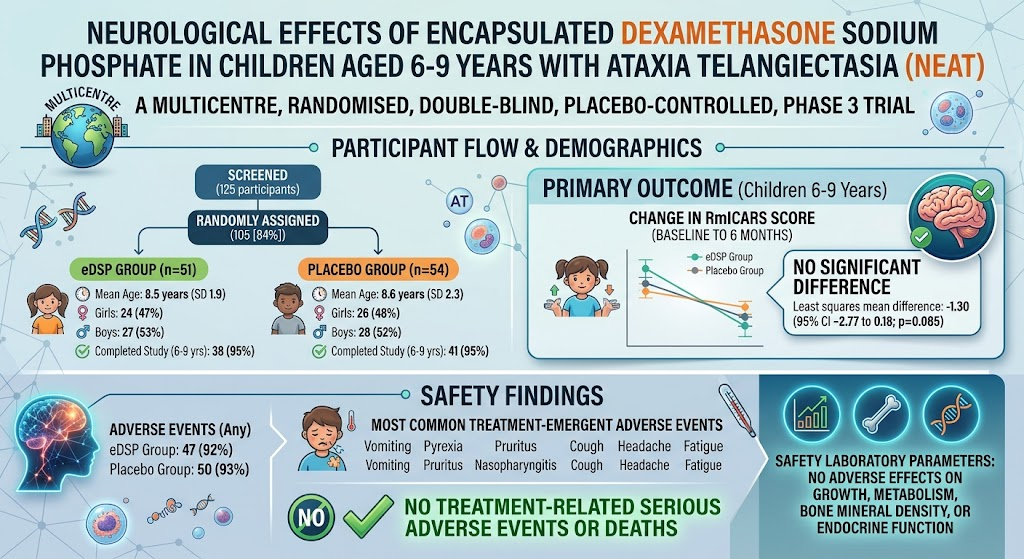
The NEAT trial, recently reported (Russo et al., 2026, PMID: 42600624), extended this inquiry focused specifically on the 6-9 years age group, hypothesizing higher responsiveness in early disease stages. Involving 105 participants randomized to eDSP or placebo, with treatment administered intravenously every 21–30 days over six doses, the study again demonstrated no statistically significant improvement in RmICARS scores at 6 months (least squares mean difference -1.30, 95% CI -2.77 to 0.18, p=0.085). Both trials maintained rigorous double-blinding and utilized intention-to-treat analyses.
Safety and Tolerability Profile
Across NEAT and ATTeST trials, eDSP demonstrated a favorable safety profile. Adverse events (AEs) were frequent but largely mild and balanced between eDSP and placebo arms. Common treatment-emergent events included vomiting, fever (pyrexia), pruritus, nasopharyngitis, cough, headache, and fatigue. Importantly, there were no treatment-related serious AEs or deaths reported in either study. Laboratory monitoring revealed no significant effects on growth parameters, metabolic or endocrine functions, or bone mineral density, addressing prior concerns associated with systemic corticosteroid use.
Mechanistic and Translational Insights
The erythrocyte encapsulation technique leverages red blood cells as a biological delivery vehicle, allowing gradual release of dexamethasone to potentially modulate neuroinflammation and slow neurodegeneration in A-T. The prolonged pharmacokinetic profile may permit reduced dosing frequency and mitigate systemic side effects seen with conventional corticosteroid regimes. However, the failure to observe statistically measurable neurological improvements at 6 months suggests that either the neurodegenerative process in A-T requires longer treatment duration for clinical benefit or that corticosteroid-mediated inflammation modulation alone is insufficient. The age-specific targeting in NEAT implies a potential developmental window for intervention, yet this remains unconfirmed.
Expert Commentary
The NEAT trial reinforces prior observations from ATTeST, underscoring that intravenously administered erythrocyte-encapsulated dexamethasone sodium phosphate is safe but does not confer significant short-term neurological improvement in children aged 6-9 years with A-T. These findings challenge earlier open-label studies and anecdotal reports suggesting corticosteroid benefit, emphasizing the critical importance of placebo-controlled trials in rare neurodegenerative diseases.
Several factors may contribute to the negative results: the six-month trial duration may be insufficient to detect meaningful changes in cerebellar ataxia scales; A-T’s pathophysiology involves complex DNA repair deficiency and oxidative stress that corticosteroids alone cannot fully address; and statistical power may be limited despite the relatively large cohort given the disease’s phenotypic heterogeneity.
The sustained-release mechanism remains attractive from a safety perspective, avoiding adrenal suppression and Cushingoid side effects. Moving forward, multi-modal approaches combining anti-inflammatory agents with neuroprotective or gene therapy strategies may be required. Moreover, robust clinical outcome measures sensitive to disease progression and intervention effects are necessary, possibly incorporating biomarkers or neuroimaging metrics.
Guidelines for A-T management continue to recommend supportive care focusing on immunodeficiency and nutritional support. Although corticosteroids via erythrocyte encapsulation do not currently modify neurological decline, their safety profile may justify further explorations, particularly in younger populations or combined regimens.
Conclusion
The NEAT phase 3 trial represents a landmark, large-scale evaluation of a novel corticosteroid delivery system in pediatric ataxia telangiectasia, confirming safety but failing to demonstrate significant neurological efficacy in the targeted age group. Integrated with previous phase 3 evidence and pharmacokinetic studies, these findings highlight the challenges of therapeutic intervention in this progressive disorder. Future research must prioritize longer study durations, earlier interventions, and combination therapies with mechanistic rationale to advance clinical outcomes. The absence of serious adverse effects supports continued investigation of eDSP as a component within broader therapeutic strategies.
References
- Russo S, Zielen S, Pietrucha B, et al. Neurological effects of encapsulated dexamethasone sodium phosphate in children aged 6-9 years with ataxia telangiectasia (NEAT): a multicentre, randomised, double-blind, placebo-controlled, phase 3 trial. Lancet Child Adolesc Health. 2026 Aug 14;S2352-4642(26)00125-2. PMID: 42600624.
- Russo S, Pietrucha B, Kornmann O, et al. Safety and efficacy of intra-erythrocyte dexamethasone sodium phosphate in children with ataxia telangiectasia (ATTeST): a multicentre, randomised, double-blind, placebo-controlled phase 3 trial. Lancet Neurol. 2024 Sep;23(9):871-882. PMID: 39152028.
- Rusconi F, Badolato R, Montella S, et al. A Study of the Pharmacokinetic Properties and the In Vivo Kinetics of Erythrocytes Loaded With Dexamethasone Sodium Phosphate in Healthy Volunteers. Transfus Med Rev. 2018 Apr;32(2):102-110. PMID: 29031409.
This article was created using several editorial tools, including AI, as part of the process. Human editors reviewed this content before publication.