Neoadjuvant Chemotherapy with or without Radiotherapy in Resected Pancreatic Ductal Adenocarcinoma: Impact on Outcomes
Highlight
1. Addition of radiotherapy to neoadjuvant chemotherapy in pancreatic ductal adenocarcinoma (PDAC) improves pathologic response rates including higher rates of pathologic complete response, node-negative disease, and R0 resection.
2. Despite improved local pathological outcomes, radiotherapy did not confer any survival benefit or reduce locoregional or distant recurrence compared to chemotherapy alone.
3. Patterns of recurrence predominantly involve distant metastases irrespective of radiotherapy use.
4. The findings underscore that systemic disease progression drives outcomes in resectable and borderline-resectable PDAC more than locoregional control.
Study Background
Pancreatic ductal adenocarcinoma (PDAC) represents a highly lethal malignancy characterized by aggressive behavior and poor prognosis. Surgical resection remains the only curative option, yet many patients present with borderline or locally advanced tumors. Neoadjuvant therapy, principally systemic chemotherapy regimens such as FOLFIRINOX or gemcitabine/nab-paclitaxel, is widely employed to improve resectability, treat micrometastatic disease early, and improve survival outcomes.
The role of adding preoperative radiotherapy to neoadjuvant chemotherapy in resectable or borderline resectable PDAC remains controversial. Radiotherapy aims to enhance locoregional tumor control by eradicating residual tumor cells and improving margin-negative (R0) resection rates. However, pancreatic cancer has a notorious tendency for systemic dissemination, and the incremental benefit of radiotherapy beyond systemic chemotherapy is unclear. Prior studies offer conflicting data regarding survival benefits and recurrence patterns.
Study Design
This retrospective, propensity score-matched cohort study included patients undergoing pancreatectomy for PDAC after neoadjuvant treatment in two high-volume referral centers between 2015 and 2023. Eligible patients received neoadjuvant chemotherapy with FOLFIRINOX or gemcitabine/nab-paclitaxel, with or without preoperative radiotherapy. Patients with metastatic disease at diagnosis, surgery-related mortality, or insufficient follow-up (less than 12 months) were excluded.
The main comparison was between patients receiving chemotherapy alone and those who received combined chemotherapy and radiotherapy prior to surgery. Matching was performed 1:1 based on clinical and tumor-related factors such as age, sex, comorbidities, tumor size and stage, CA 19-9 levels, resectability status, and chemotherapy regimen to reduce selection bias.
Primary endpoints included event-free survival and overall survival. Secondary outcomes assessed were pathologic response, margin status, node negativity, recurrence patterns, and locoregional versus distant disease recurrence.
Key Findings
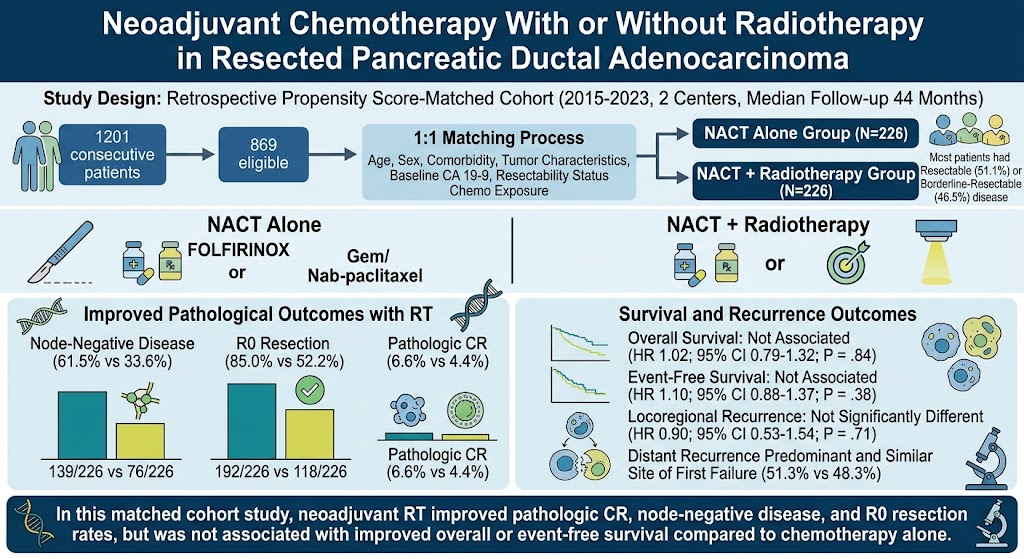
Out of 1201 patients undergoing pancreatectomy following neoadjuvant treatment, 869 met inclusion criteria; 438 had chemotherapy plus radiotherapy, and 362 had chemotherapy alone. After propensity score matching, 226 patients were analyzed in each treatment group.
The majority had resectable (51.1%) or borderline-resectable (46.5%) disease. The addition of radiotherapy was significantly associated with improved pathologic responses:
- Pathologic complete response: 6.6% in radiotherapy group vs 4.4% chemotherapy alone
- Node-negative disease: 61.5% vs 33.6%
- R0 resection rates: 85.0% vs 52.2%
Despite these superior pathological outcomes, there were no statistically significant differences in:
- Event-free survival (HR 1.10, 95% CI 0.88–1.37, P=0.38)
- Overall survival (HR 1.02, 95% CI 0.79–1.32, P=0.84)
- Cumulative incidence of locoregional recurrence (subdistribution HR 0.90, 95% CI 0.53–1.54, P=0.71)
Patterns of recurrence were predominately distant metastases in both groups, approximately 50% as the first site of failure. The rate of locoregional recurrence did not differ significantly between groups.
Expert Commentary
This well-designed, large propensity-matched cohort study provides important real-world insight into the clinical utility of neoadjuvant radiotherapy in PDAC. It confirms that while radiotherapy improves local pathological endpoints such as margin-negative resection and nodal clearance, these improvements do not translate into meaningful survival benefits.
These findings are consistent with the biologic nature of PDAC, where systemic micrometastatic disease predominates and drives relapse more than local progression. Locoregional control alone appears insufficient without effective systemic therapy advancement. Furthermore, the study’s rigorous matching on confounders strengthens the validity of conclusions, although inherent limitations of retrospective cohorts remain.
Prior randomized controlled trials have shown mixed results regarding preoperative chemoradiotherapy. The Alliance A021501 trial showed no improvement in overall survival with added radiotherapy in borderline resectable PDAC. The present study adds to this body of evidence supporting the prioritization of optimizing systemic chemotherapy.
In practice, decisions on radiotherapy use should be individualized, considering tumor characteristics, patient performance status, and multidisciplinary team input. Future research should explore better systemic agents and biomarkers to select patients who might benefit from intensified local therapies.
Conclusion
In patients undergoing resection for resectable and borderline resectable PDAC, the addition of neoadjuvant radiotherapy to chemotherapy improves pathologic response characteristics but does not confer survival or recurrence advantages. The predominant failure pattern remains distant metastasis, highlighting systemic disease control as the principal therapeutic target. These findings emphasize the limited incremental benefit of locoregional radiotherapy in the current neoadjuvant treatment paradigm for PDAC.
Funding and ClinicalTrials.gov
The original study was supported by institutional research funding at two high-volume pancreatic cancer centers. There was no industry sponsorship reported. Clinical trial registration is not applicable as this was a retrospective observational study.
References
1. De Stefano F, Wu NF, Belfiori G, et al. Neoadjuvant Chemotherapy With or Without Radiotherapy in Resected Pancreatic Ductal Adenocarcinoma. JAMA Surg. 2026 Aug 26. doi:10.1001/jamasurg.2026.2341. PMID: 42647021.
2. Versteijne E, Suker M, Groothuis K, et al. Preoperative Chemoradiotherapy Versus Immediate Surgery for Resectable and Borderline Resectable Pancreatic Cancer: Results of the Dutch Randomized Phase III PREOPANC Trial. J Clin Oncol. 2020;38(16):1763-1773.
3. Katz MH, Shi Q, Ahmad SA, et al. Alliance A021501: Preoperative Extended Chemotherapy vs Chemoradiotherapy in Borderline Resectable Pancreatic Cancer. J Clin Oncol. 2021;39(30):3388-3398.
4. Tempero MA, Malafa MP, Al-Hawary M, et al. Pancreatic Adenocarcinoma, Version 2.2021, NCCN Clinical Practice Guidelines in Oncology. J Natl Compr Canc Netw. 2021;19(4):439-457.
This article was created using several editorial tools, including AI, as part of the process. Human editors reviewed this content before publication.