We use cookies

Our website uses essential cookies and, with your consent, additional cookies to measure performance and improve our services. Cookie Policy.

You can change your choice at any time.

MMedXYNews
HomeVideos
MedXY AI/MedXY News/Section: Diabetes & Endocrinology

Navigating Ethical Challenges in Pediatric Endocrinology: Case-Based Approaches and Principles
MedXY Editorial Team•Aug 28, 2026•Diabetes & Endocrinology
growth hormone therapymedical ethicsGLP-1/胰高血糖素激动剂Diabetes TechnologyNội Tiết Học Nhi Khoa

Introduction

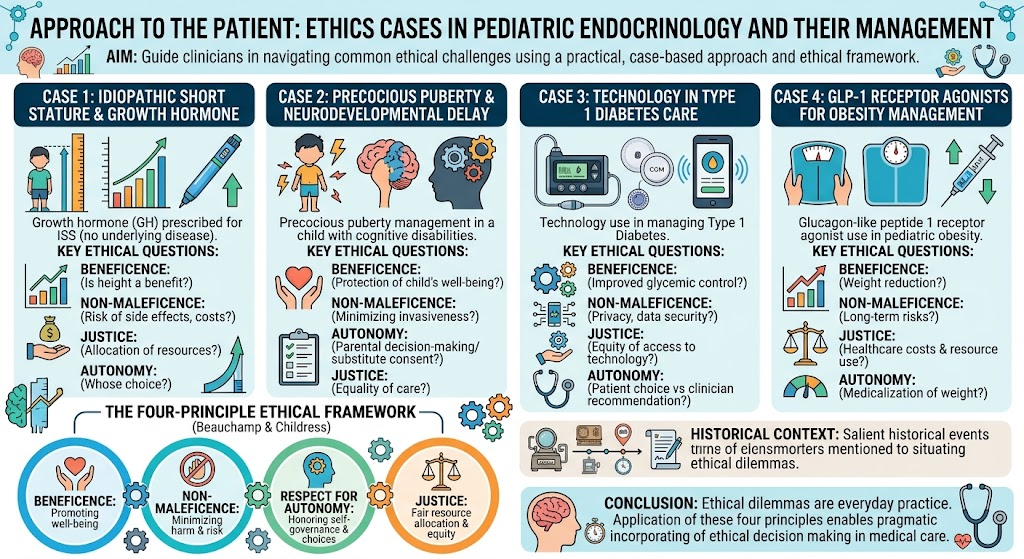
Pediatric endocrinology is an evolving field characterized by rapid advancements in diagnostic technologies and therapeutic interventions. These innovations, while beneficial, often present ethical dilemmas that challenge clinicians’ decision-making processes. The balancing act involves optimizing patient outcomes, respecting patient and family autonomy, and navigating resource limitations and societal values. This article reviews four common ethical scenarios in pediatric endocrinology, emphasizing the pragmatic application of Beauchamp and Childress’s four-principle ethical framework: beneficence, non-maleficence, respect for autonomy, and justice.

Highlights

MedXY registered readers

Sign in free to continue reading

Create or use your MedXY account to unlock the complete article.

This article was created using several editorial tools, including AI, as part of the process. Human editors reviewed this content before publication.

Related articles

Open language-specific specialty feeds and department pages.

Machine Learning-enhanced Steroid Profiling for Rapid Diagnosis of Congenital Adrenal Steroidogenesis DisordersThis article reviews a validated machine learning decision-tree model using LC-MS/MS steroid profiles to accurately and rapidly diagnose congenital disorders of adrenal steroidogenesis (CDAS), enhancing clinical decision-making and patientSep 19, 2026Teplizumab Preserves Beta Cell Function in Youth with Newly Diagnosed Type 1 Diabetes: Insights from the PROTECT Trial Per-Protocol AnalysisThe PROTECT trial’s per-protocol analysis confirms teplizumab’s efficacy in preserving beta cell function, reducing insulin needs, and improving glycemic control in children and adolescents newly diagnosed with stage 3 type 1 diSep 13, 2026Disentangling Fear and Hypoglycemia Metrics in Type 1 Diabetes: Insights from a 12-Month Diabetes Technology StudyThis 12-month analysis in adults with type 1 diabetes using advanced diabetes technology reveals that fear and perceived hypoglycemia frequency do not straightforwardly relate to continuous glucose monitoring metrics, highlighting complex dSep 9, 2026
Loading comments...
MedXY briefing

Get the free newsletter

Evidence-led clinical news, trends, and analysis—delivered to your inbox.

Ask MedXY AI

Most popular

Intimate Health
Five Benefits for Women Continuing Sexual Activity After Menopause
Intimate Health
Why Some Women Have a Strong Sex Drive—And Why Men Shouldn't Worry About It
Nursing & care
How often should a couple have sex?
Intimate Health
Classic Intimacy Recommendations: How to Help Women Reach Orgasm and Enjoy Mutual Pleasure
Intimate Health
What Makes a Woman "Physiologically Addicted" Is Never Money, But These Two Relationship Qualities
© 2026 MedXY
Contact usAbout usPrivacy PolicyMedXY story
Autoantibody Screening in Sibling-Dominant Pediatric Relatives of Type 1 Diabetes Patients: Prevalence, Determinants, and Psychological Impact
This multicentre Turkish study identifies ZnT8 autoantibodies as predominant in young siblings at risk for type 1 diabetes and highlights gestational age as a protective factor, while revealing significant anxiety changes in children and pa
Sep 6, 2026
Impact of Elexacaftor/Tezacaftor/Ivacaftor Therapy on Glucose Metabolism in Youths with Cystic Fibrosis: Insights from Continuous Glucose MonitoringThis study demonstrates that initiation of elexacaftor/tezacaftor/ivacaftor (ETI) therapy in children and adolescents with cystic fibrosis improves continuous glucose monitoring (CGM) metrics, correlating with better clinical outcomes.Sep 5, 2026
Temple Syndrome: Unveiling a Hidden Multi-System Growth Disorder and Introducing a New Diagnostic ScoreTemple syndrome is an under-recognised imprinting disorder with complex endocrine and growth abnormalities. This large-cohort study clarifies its phenotype, highlights growth hormone therapy benefits, and proposes a novel clinical scoring sAug 11, 2026