MRI-Based Brain Network Disruption Predicts Long-Term Seizure Recurrence in Temporal Lobe Epilepsy Surgery
Highlight
- Multi-center study identifies brain hub disruption patterns predictive of long-term seizure recurrence after temporal lobe epilepsy (TLE) surgery.
- A novel multimodal machine learning model incorporating structural and functional MRI-derived connectomes outperforms clinical predictors in forecasting seizure freedom.
- Disruption of hippocampal and dorsal attention network hubs, areas not routinely targeted in surgery, associates with seizure recurrence.
- High specificity of the model suggests its value for postoperative counseling and risk stratification rather than excluding candidates from surgery.
Study Background
Temporal lobe epilepsy (TLE) is the most common focal epilepsy syndrome in adults, often resistant to antiepileptic drugs. Surgical resection or laser ablation of the epileptogenic zone offers potential cure or significant seizure reduction. While many patients attain early postoperative seizure freedom, approximately 30–50% experience long-term seizure recurrence within years. Current prognostic markers, primarily clinical variables and standard imaging, provide limited accuracy in predicting which patients will relapse.
Recent advances in brain network neuroscience have highlighted the role of highly connected regions known as “hubs” in maintaining brain functional integration. Disruption of these hubs might underlie epileptogenic networks beyond the surgical lesion. Characterizing hub integrity through structural and functional MRI connectomics offers an avenue to improve prognostication.
Study Design
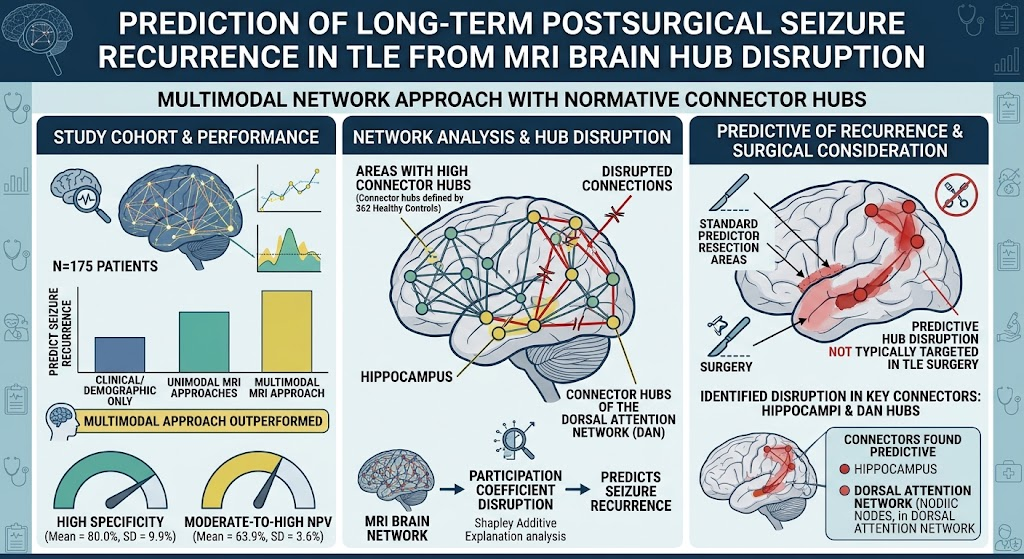
This prospective, multi-center cohort study enrolled 175 patients with drug-resistant TLE undergoing resective or laser ablation surgery across six centers. Inclusion required minimum postoperative follow-up of two years (mean follow-up 5.4 years). Preoperative neuroimaging included diffusion-weighted MRI and resting-state functional MRI to derive individual structural and functional brain connectomes.
A normative dataset comprising 362 healthy controls was used to define standard brain connector hubs using graph-theory metrics, specifically the participation coefficient, which measures how a brain region connects across multiple subnetworks. The study quantified patient-specific disruption of these hubs by comparing their participation coefficients to normative values.
Machine learning classifiers were trained on these patient-specific disruption metrics from structural, functional, and combined multimodal data to predict seizure outcomes dichotomized as seizure-free or not after surgery. Models additionally incorporated clinical and demographic information, gray and white matter volumes. An independent cohort was used to validate model performance.
Key Findings
The multimodal approach combining structural and functional connectome data yielded superior predictive performance compared to models using only clinical/demographic data or unimodal imaging data. Specifically, the composite model achieved a mean specificity of 80.0% (SD 9.9%) and a moderate-to-high negative predictive value of 63.9% (SD 3.6%) across validation cohorts.
Shapley Additive Explanation (SHAP) analyses identified key predictors of long-term seizure recurrence: impairments in the participation coefficient of the hippocampi and connector hubs within the dorsal attention network. These regions are not conventionally targeted during standard TLE surgery, suggesting that residual network disruption beyond the resected zones may facilitate seizure relapse.
The high specificity indicates that the model is particularly effective at correctly identifying patients likely to maintain seizure freedom, an essential aspect for postoperative management and counseling. Although sensitivity was moderate, the negative predictive value supports the model’s use as a complementary tool rather than a definitive exclusion criterion for surgery.
Expert Commentary
This work represents an important advance in applying brain network science to the clinical management of TLE. By operationalizing normative hub disruption metrics from MRI connectomes and integrating them via machine learning, the study provides biologically plausible biomarkers that reflect the network-wide impact of epilepsy beyond focal lesions.
The identification of hub disruption in areas like the dorsal attention network extends understanding of epileptogenic processes as involving distributed network dysfunction, consistent with conceptual models of epilepsy as a network disease. This may inform future surgical planning or adjunctive therapies targeting network-level abnormalities.
Model validation in an independent cohort enhances generalizability, addressing limitations of prior predictive studies confined to single centers and small samples. However, moderate sensitivity highlights the current model’s limitation for frontline surgical candidate selection, emphasizing its role in postoperative risk stratification and counseling.
Further research should explore integration with electrophysiological data and validation across diverse epilepsy subtypes. Understanding whether modifying hub disruption postoperatively can alter outcomes may also open new therapeutic avenues.
Conclusion
Disruption of normative brain hubs identified through multimodal MRI connectomics is a promising biomarker for predicting long-term seizure recurrence in patients undergoing surgery for temporal lobe epilepsy.
The model’s high specificity and biological interpretability support its clinical utility for postoperative prognostication and individualized patient counseling. This work exemplifies the translational potential of advanced neuroimaging and network neuroscience to complement traditional clinical predictors and improve personalized epilepsy care. Ongoing validation and refinement of network-based biomarkers could ultimately inform surgical planning and development of targeted adjunctive treatments to improve long-term seizure control.
Funding and Clinical Trial Registration
The study was supported by grants from relevant epilepsy research foundations and NIH/NINDS. Full details are available in the original publication. No clinical trial registration number was reported.
References
1. Karpychev V, Roth RW, Yun W, et al. Prediction of Long-Term Postsurgical Seizure Recurrence From MRI Brain Hub Disruption in Patients With Temporal Lobe Epilepsy. Neurology. 2026;107(5):e218416. doi:10.1212/WNL.0000000000008416
2. Bernhardt BC, Bonilha L, Gross DW. Network analysis for epilepsy: insights from neuroimaging. Nat Rev Neurol. 2015;11(3):146–159. doi:10.1038/nrneurol.2015.3
3. Bonilha L, Nesvick CL, Suarez RO, et al. Presurgical connectome and postsurgical seizure control in temporal lobe epilepsy. Neurology. 2015;84(18):1846-1853. doi:10.1212/WNL.0000000000001532
4. Liao W, Zhang Z, Pan Z, et al. Altered functional connectivity and small-world in mesial temporal lobe epilepsy. PLoS One. 2010;5(1):e8525. doi:10.1371/journal.pone.0008525
This article was created using several editorial tools, including AI, as part of the process. Human editors reviewed this content before publication.