Mathematical Biomarkers From First-Cycle PSA Dynamics May Predict Adaptive Therapy Outcomes in Prostate Cancer
For men with prostate cancer treated with adaptive therapy, the first cycle of treatment may contain enough information to forecast how long the benefit will last. In a modeling study published in JAMA Oncology, researchers report that mechanism-based mathematical biomarkers extracted from early prostate-specific antigen (PSA) dynamics outperformed conventional PSA measures in predicting time to progression and survival.
Adaptive therapy uses treatment breaks to control tumor burden rather than eliminate it, aiming to delay drug resistance.
Using first-cycle PSA trajectories, investigators derived mathematical biomarkers from a two-population tumor-growth model.
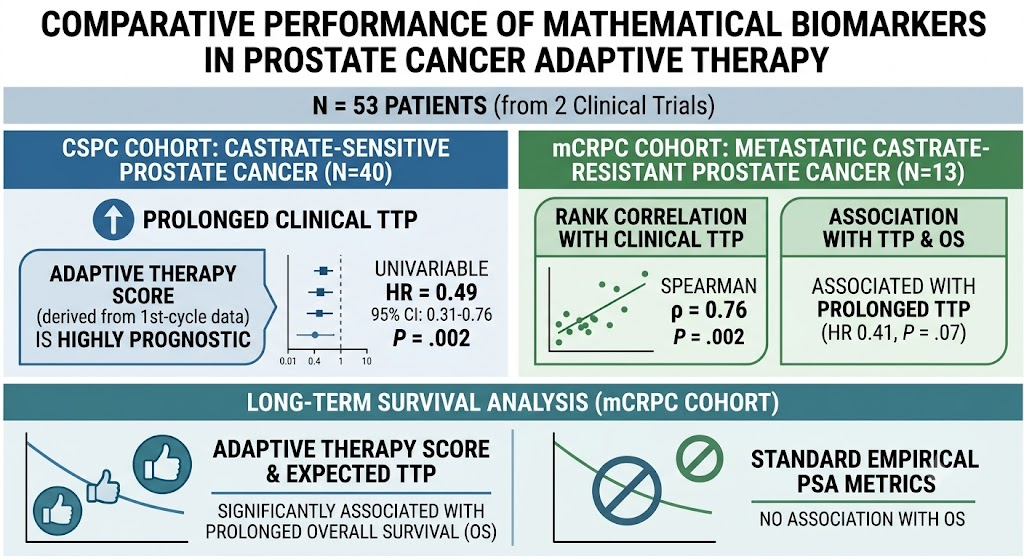
In 40 men with castrate-sensitive prostate cancer, the adaptive therapy score was associated with prolonged time to progression (HR 0.49; 95% CI, 0.31-0.76; P=.002).
In 13 men with metastatic castrate-resistant prostate cancer, the score correlated strongly with time to progression (Spearman ρ=0.76; P=.002).
Both the adaptive therapy score and expected time to progression were associated with longer overall survival in the resistant-disease cohort, while standard PSA metrics were not.
These biomarkers are candidate decision-support tools and require prospective validation before clinical adoption.
Study type: Retrospective modeling and validation study
Cohorts: 2 independent nonrandomized clinical trial cohorts; 40 CSPC and 13 mCRPC patients
Data periods: June 1996–September 2006 (CSPC); April 2015–January 2022 (mCRPC)
Exposure: First treatment cycle (intermittent androgen deprivation therapy for CSPC; adaptive abiraterone acetate for mCRPC)
Outcomes: Time to progression (TTP), mean daily dose, overall survival (OS), and in silico benchmarking
Why This Study Matters
Prostate cancer treatment has traditionally aimed to suppress PSA as deeply and continuously as possible. Adaptive therapy is a different evolution-based strategy: by pausing treatment when the tumor shrinks, it preserves drug-sensitive cells that compete with resistant ones, potentially delaying the emergence of resistance. The approach has been shown to delay resistance in prostate cancer, but patient responses are highly heterogeneous, and there is a clear need for biomarkers to personalize treatment scheduling.
Standard PSA metrics such as nadir, time to nadir, and doubling time summarize the trajectory but do not capture the underlying competition between drug-sensitive and drug-resistant clones. The new study tested whether a mechanism-based mathematical model could extract more useful prognostic information from first-cycle PSA kinetics.
How the Study Was Conducted
The investigators used a two-population differential equation model to describe overall tumor growth as the net result of drug-sensitive and drug-resistant cell populations. By fitting the model to PSA measurements from the first treatment cycle, they derived three mechanism-based biomarkers: an adaptive therapy score, expected time to progression, and expected mean daily dose. They then benchmarked these biomarkers against standard empirical PSA metrics.
The validation used longitudinal data from two independent nonrandomized clinical trial cohorts: 40 patients with castrate-sensitive prostate cancer (CSPC) treated with intermittent androgen deprivation therapy between June 1996 and September 2006, and 13 patients with metastatic castrate-resistant prostate cancer (mCRPC) treated with adaptive abiraterone acetate between April 2015 and January 2022. The statistical analysis was conducted from January 2025 to May 2026.
Main outcomes included clinical time to progression, overall survival, and predicted mean daily dose. The authors also performed in silico benchmarking experiments comparing the mechanism-based biomarkers with phenomenological PSA metrics.
What the Researchers Found
In the CSPC cohort of 40 patients, the adaptive therapy score derived from first-cycle data was highly prognostic for prolonged clinical time to progression, with a univariable hazard ratio of 0.49 (95% CI, 0.31-0.76; P=.002).
In the mCRPC cohort of 13 patients, the adaptive therapy score showed a strong rank correlation with clinical time to progression (Spearman ρ=0.76; P=.002) and was associated with prolonged time to progression, although the hazard ratio did not reach conventional statistical significance (HR, 0.41; 95% CI, 0.16-1.07; P=.07).
Analysis of long-term survival data in the mCRPC cohort demonstrated that both the adaptive therapy score and expected time to progression were significantly associated with prolonged overall survival, whereas standard empirical PSA metrics displayed no association with overall survival.
Overall, the mechanism-based biomarkers outperformed traditional phenomenological PSA monitoring in predicting patient-specific outcomes.
Cohort | Treatment exposure | Biomarker association with time to progression |
|---|---|---|
CSPC (n=40) | Intermittent androgen deprivation therapy | HR 0.49 (95% CI, 0.31-0.76; P=.002) |
mCRPC (n=13) | Adaptive abiraterone acetate | Spearman ρ=0.76 (P=.002); HR 0.41 (95% CI, 0.16-1.07; P=.07) |
What the Findings May Mean
If confirmed, these biomarkers could provide an accessible way to estimate early whether a patient is likely to benefit from continued adaptive therapy. Because the inputs are routine PSA values, the approach would not require additional invasive testing or imaging. The model’s biological basis distinguishes it from purely empirical PSA metrics: it explicitly accounts for the presumed coexistence of drug-sensitive and drug-resistant populations driving resistance.
The authors describe the metrics as a mathematically informed decision support framework to help stratify patients into personalized treatment protocols. That is a research-stage claim rather than a current practice recommendation.
Strengths and Limitations
Strengths include the use of two independent nonrandomized cohorts with different disease states and treatments, mechanistic model fitting, and long-term survival data in the mCRPC cohort. The approach was also compared head-to-head with standard PSA metrics.
The source abstract does not report detailed limitations. Important design-based caveats include the retrospective nonrandomized nature of the data, the small mCRPC sample, the univariable hazard ratio in the CSPC analysis, and the in silico component of the benchmarking. As with any modeling study, results depend on model assumptions, and the absence of prospective validation means the biomarkers should not yet be used to make irreversible treatment decisions.
Implications for Practice and Research
The study supports a shift from treating PSA numbers alone toward using PSA dynamics to infer tumor evolutionary state. Next steps include prospective validation in larger adaptive therapy trials, standardized definitions of the adaptive therapy score and expected time to progression, and testing whether biomarker-guided scheduling improves time to progression and overall survival compared with standard adaptive therapy protocols.
Funding, Disclosures, and Registration
The source abstract did not report funding sources, conflicts of interest, or trial registration details. The original article should be consulted for full disclosures.
References
Gallagher K, Strobl MA, Gatenby RA, Zhang J, Maini PK, Anderson AR. Mathematical Biomarkers of Adaptive Therapy Outcomes in Prostate Cancer. JAMA Oncology. Published online August 6, 2026. PMID: 42560686. https://pubmed.ncbi.nlm.nih.gov/42560686/
This article was created using several editorial tools, including AI, as part of the process. Human editors reviewed this content before publication.