Predictive Mathematical Biomarkers Transform Personalized Adaptive Therapy in Prostate Cancer
Highlight
This study demonstrates that mechanism-based mathematical biomarkers, derived from first-cycle PSA kinetics, can accurately predict time to progression, mean drug dose, and overall survival in prostate cancer patients undergoing adaptive therapy. This approach surpasses traditional PSA-based metrics and offers a promising framework for personalized treatment scheduling.
Study Background
Prostate cancer remains one of the most common malignancies worldwide, presenting a significant clinical and public health challenge. Standard androgen deprivation therapy (ADT) and its intermittent administration have been central pillars in managing castrate-sensitive prostate cancer (CSPC). For metastatic castrate-resistant prostate cancer (mCRPC), agents like abiraterone acetate have extended survival. However, therapeutic resistance frequently develops, limiting long-term efficacy.
Adaptive therapy, an evolutionarily informed treatment strategy, modulates therapeutic intensity to maintain tumor control by deliberately preserving drug-sensitive cancer cells. This delays the outgrowth of resistant clones and prolongs patient benefit. Nonetheless, clinical responses to adaptive therapy exhibit notable heterogeneity, underscoring an unmet need for predictive biomarkers to optimize and personalize treatment scheduling effectively.
Study Design
This retrospective modeling and validation study utilized longitudinal data from two independent clinical cohorts: 40 patients with castrate-sensitive prostate cancer treated from 1996 to 2006 and 13 patients with metastatic castrate-resistant prostate cancer treated from 2015 to 2022. Patients with CSPC were managed by intermittent androgen deprivation therapy, while those with mCRPC received adaptive abiraterone acetate therapy.
A two-population differential equation model was employed to capture the tumor dynamics driven by competing populations of drug-sensitive and drug-resistant cancer cells. Mathematical biomarkers—including an adaptive therapy score, expected time to progression (TTP), and expected mean daily dose—were computed from prostate-specific antigen (PSA) kinetics recorded during the initial treatment cycle.
The study’s primary endpoints included clinical time to progression and overall survival, with model-derived predictions benchmarked against actual outcomes and traditional phenomenological PSA metrics, such as PSA nadir, time to nadir, and doubling time.
Key Findings
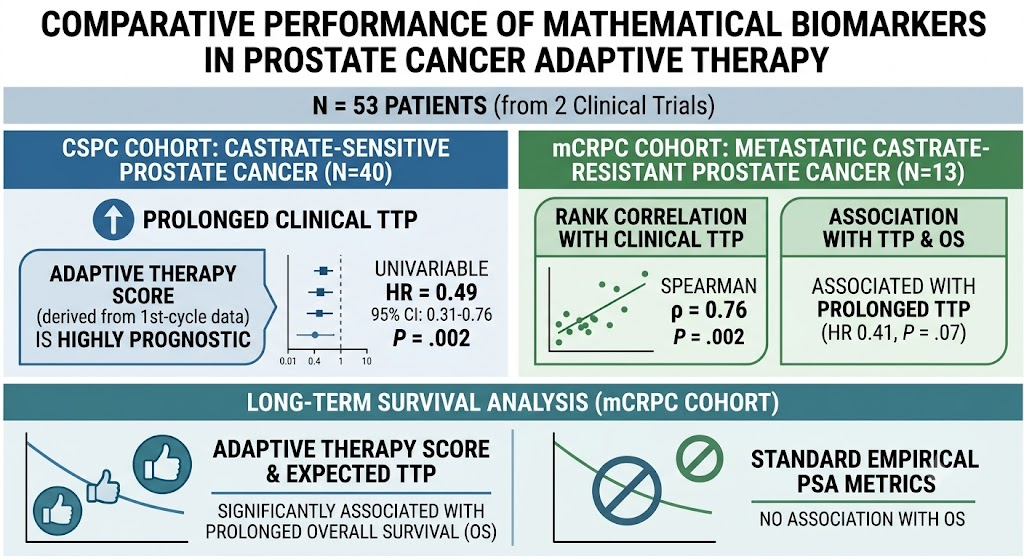
Data from 53 patients across two clinical trials were analyzed. In the CSPC cohort, the adaptive therapy score based on first-cycle PSA kinetics was a strong predictor of prolonged clinical TTP, with a univariable hazard ratio (HR) of 0.49 (95% CI, 0.31-0.76; P = .002), indicating nearly 50% reduction in progression risk per unit increase in the score.
For the mCRPC cohort, the adaptive therapy score correlated strongly with clinical TTP (Spearman ρ = 0.76; P = .002) and tended towards association with improved TTP (HR, 0.41; 95% CI, 0.16-1.07; P = .07). Importantly, the score and the expected TTP also demonstrated significant associations with prolonged overall survival, with standard PSA metrics failing to predict survival outcomes effectively.
These findings highlight the superior prognostic value of mechanism-based biomarkers over conventional PSA measures. Moreover, in silico benchmarking validated the robustness and predictive capacity of these mathematical biomarkers, providing a scientifically rigorous foundation for their clinical application.
Expert Commentary
Adaptive therapy represents a paradigm shift from maximal tumor eradication to dynamic tumor control, making predictive tools crucial for individualizing treatment. This study provides compelling evidence that integrating evolutionary modeling with routinely collected PSA data can yield actionable biomarkers. By quantifying the interplay between drug-sensitive and resistant clones early in therapy, clinicians can tailor treatment schedules to balance efficacy and toxicity.
Limitations include the retrospective nature of the study and relatively small sample sizes, particularly the mCRPC cohort, which may affect generalizability. Prospective trials are warranted to confirm clinical utility and to integrate these biomarkers into real-time therapeutic decision-making.
Conclusion
Mechanism-based mathematical biomarkers derived from early therapy PSA kinetics hold promise as powerful tools to predict adaptive therapy outcomes in prostate cancer. Their implementation could facilitate personalized treatment regimens, optimize drug dosing, delay resistance, and ultimately improve survival. This approach exemplifies the translational potential of mathematical oncology in advancing precision medicine.
Funding and Clinical Trial Registration
Details regarding the funding sources and clinical trial registrations are available in the original publication by Gallagher et al., 2026 (PMID: 42560686).
This article was created using several editorial tools, including AI, as part of the process. Human editors reviewed this content before publication.