Low Faecal Elastase in Type 1 Diabetes: Implications of Exocrine Pancreatic Insufficiency Linked to Disease Duration
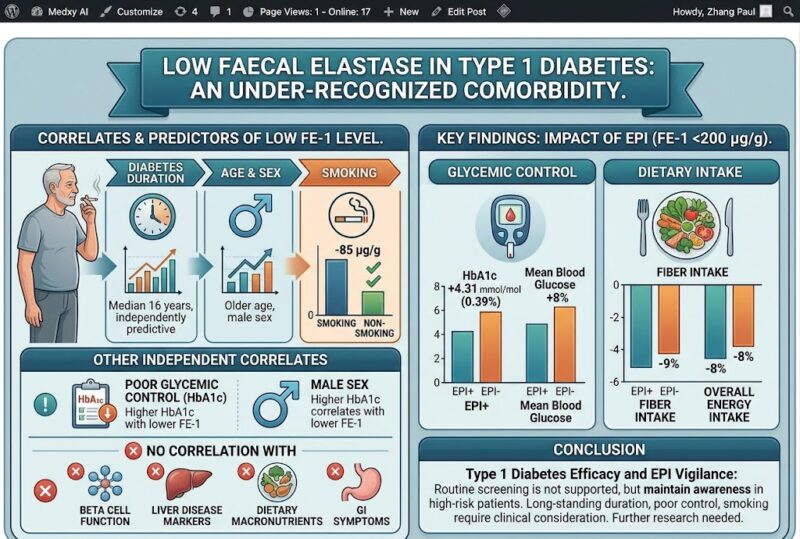
Highlight
- Approximately 17% of individuals with type 1 diabetes have low faecal elastase levels, indicating exocrine pancreatic insufficiency (EPI).
- Lower faecal elastase levels correlate independently with longer diabetes duration, older age, male sex, smoking, and higher HbA1c.
- No strong associations were found between faecal elastase levels and residual beta cell function, liver disease, dietary macronutrient intake, or gastrointestinal symptoms.
- Despite the absence of notable clinical symptoms, EPI in type 1 diabetes correlates with higher blood glucose levels and reduced dietary intake, warranting clinical awareness especially in long-standing disease.
Study Background
Exocrine pancreatic insufficiency (EPI) manifests as insufficient secretion of pancreatic enzymes essential for digestion, often leading to malabsorption and associated complications such as malnutrition and osteoporosis. It is recognized that patients with type 1 diabetes may have impaired exocrine pancreatic function, but the prevalence, clinical significance, and relationship with disease parameters remain poorly characterized. Understanding the prevalence and clinical correlates of EPI in type 1 diabetes could aid earlier recognition and management, potentially mitigating downstream complications.
Study Design
This was a cross-sectional cohort study involving 443 individuals diagnosed with type 1 diabetes. Participants had a median age of 42 years and median diabetes duration of 16 years, with a majority being female (62%) and an average BMI of 25 ± 4 kg/m2. Faecal elastase (FE) levels, a non-invasive marker for EPI, were measured and analyzed in relation to diabetes-specific parameters, clinical features, dietary intake, and gastrointestinal complaints. The study employed linear and Poisson regression models to evaluate associations independently.
Key Findings
The overall mean faecal elastase concentration was 349.5 ±146.8 µg/g of faeces. Key independent predictors of lower FE levels included:
- Older age (decrease of 10.97 µg/g per 10 years; 95% CI: -21.02 to -0.92)
- Longer diabetes duration (decrease of 13.09 µg/g per 10 years; 95% CI: -23.54 to -2.64)
- Higher HbA1c (decline of 1.44 mmol/mol per SD increase; 95% CI: -2.59 to -0.30)
- Male sex (mean difference of -54.07 µg/g; 95% CI: -81.41 to -26.73)
- Smoking (mean difference of -85.06 µg/g; 95% CI: -128.52 to -41.60)
Using a standard clinical cut-off of 200 µg/g faeces, 76 individuals (17%) were classified as having EPI. Those with EPI had a statistically significant higher HbA1c by 4.31 mmol/mol (0.39%) and an 8% higher mean blood glucose level. Diet analysis revealed an approximately 9% lower fiber intake and 8% lower overall energy intake compared to those without EPI. Contrary to expectations, FE levels were not associated with residual beta cell function, liver disease markers, macronutrient consumption, or self-reported gastrointestinal symptoms.
Expert Commentary
The study robustly demonstrates a high prevalence of low faecal elastase in type 1 diabetes, tightly linked to disease duration and modifiable risk factors such as smoking. The lack of overt clinical symptoms or distinct dietary changes among those with EPI underscores the challenge in routine diagnosis. Elevated HbA1c and glucose levels in EPI-positive individuals suggest that exocrine insufficiency may subtly impair glycemic control, plausibly through malabsorption or digestive inefficiency, though mechanisms warrant further exploration.
These findings suggest that routine FE screening in all type 1 diabetes patients may not be pragmatic or yield significant clinical benefit, given the subtle symptomatology and lack of impact on dietary patterns. However, clinicians should maintain heightened awareness of EPI in patients with long diabetes duration, poor glycemic control, or risk factors like smoking. Future longitudinal studies are needed to clarify whether EPI contributes causally to metabolic derangement and if pancreatic enzyme replacement therapy improves outcomes.
Conclusion
This study highlights that almost one-fifth of individuals with type 1 diabetes exhibit low faecal elastase indicative of exocrine pancreatic insufficiency, strongly associated with longer diabetes duration but not accompanied by marked clinical symptoms or significant dietary changes. While universal screening is not currently supported, clinical vigilance for EPI is warranted in long-standing type 1 diabetes to potentially prevent malabsorption-related complications and optimize glucose management. Further research is necessary to establish therapeutic strategies and clarify the biological interplay between exocrine and endocrine pancreatic dysfunction in this population.
Funding and Trial Registration
The original study’s funding sources and clinical trial registration identifiers were not provided in the abstract.
References
de Wit DF, Fuhri Snethlage CM, Levels JHM, Rampanelli E, Meijnikman AS, Nieuwdorp M, Hanssen NMJ. High prevalence of low faecal elastase levels in individuals with type 1 diabetes is associated with diabetes duration but not with marked alterations in food intake or clinical symptoms. Diabetologia. 2026 Aug 8. PMID: 42570940.
Additional relevant literature on EPI and type 1 diabetes should be consulted for comprehensive clinical guidance.
This article was created using several editorial tools, including AI, as part of the process. Human editors reviewed this content before publication.