Long COVID in Pregnancy: Assessing Risks for Preterm Birth and Hypertensive Disorders
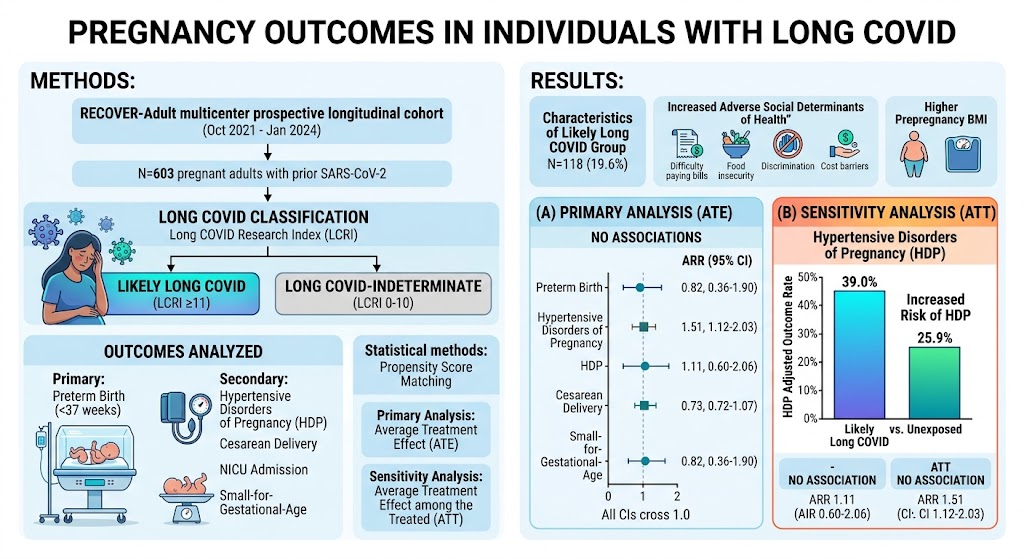
Highlight
- Long COVID status in pregnant individuals was not associated with increased risk of preterm birth.
- An association between Long COVID and hypertensive disorders of pregnancy was observed in specific sensitivity analyses.
- Social determinants of health and higher prepregnancy BMI were more common among those with likely Long COVID.
- Findings highlight the need for ongoing research on Long COVID’s maternal health impact.
Study Background
The coronavirus disease 2019 (COVID-19) pandemic has introduced new complexities to maternal health, especially concerning the long-term effects of severe acute respiratory syndrome coronavirus 2 (SARS-CoV-2) infection. “Long COVID,” characterized by persistent symptoms lasting weeks to months after acute infection, presents a potential additional risk factor during pregnancy. Given the extensive physiological and immunological changes during gestation, understanding the implications of Long COVID on pregnancy outcomes is a clinical priority to optimize perinatal care and outcomes.
Study Design
This investigation was part of the RECOVER-Adult study—a multicenter, prospective, longitudinal cohort examining long-term effects of SARS-CoV-2 infection. Participants enrolled from October 2021 to January 2024 were adults with documented previous infection. Inclusion criteria for this subset analysis consisted of individuals who had confirmed SARS-CoV-2 infection, were pregnant or became pregnant during the study period, and completed at least one symptom survey for assessing Long COVID status prior to or during pregnancy.
Participants were categorized based on the Long COVID Research Index (LCRI) score: scores ≥11 indicated likely Long COVID, and scores 0–10 were considered Long COVID-indeterminate. The primary outcome measure was preterm birth before 37 weeks of gestation. Secondary outcomes included hypertensive disorders of pregnancy (preeclampsia, gestational hypertension), cesarean delivery rates, neonatal intensive care unit (NICU) admission, and small-for-gestational-age (SGA) infants (birth weight below the 10th percentile).
To address potential confounding, propensity score methods with full matching balanced baseline differences in characteristics such as maternal age, race, BMI, and socioeconomic factors. Sensitivity analyses assessed the average treatment effect among the treated subgroup to evaluate consistency of results.
Key Findings
Among 603 pregnant participants with past SARS-CoV-2 infection, 118 (19.6%) met criteria for likely Long COVID. The cohort with likely Long COVID demonstrated higher prevalence of adverse social determinants of health including financial hardship (difficulty covering expenses), food insecurity, reduced healthcare access due to cost, and experiences of medical discrimination. They also had significantly higher prepregnancy BMI compared to those classified as Long COVID-indeterminate.
In the primary analysis estimating the average treatment effect, no statistically significant difference was observed in preterm birth rates between Long COVID and Long COVID-indeterminate groups (8.1% vs 9.6%, adjusted risk ratio 0.82, 95% confidence interval [CI] 0.36–1.90). Secondary outcomes, including cesarean delivery, NICU admissions, and SGA births, also showed no significant differences.
However, in the sensitivity analysis focusing on the treated subgroup, Long COVID was significantly associated with an increased risk of hypertensive disorders of pregnancy: 39.0% in the Long COVID group versus 25.9% in the indeterminate group (adjusted absolute risk reduction 1.51, 95% CI 1.12–2.03). This suggests a potential elevated risk of pregnancy-related hypertension among those classified with Long COVID.
No significant associations were found between Long COVID status and cesarean delivery, NICU admission, or SGA birth weight.
Expert Commentary
This comprehensive prospective study leverages robust methodology including careful classification of Long COVID status and use of propensity score matching to reduce confounding, thus providing valuable insights into pregnancy outcomes post-SARS-CoV-2 infection. The lack of association between Long COVID and preterm birth is reassuring clinically, considering preterm delivery’s substantial neonatal morbidity.
Nevertheless, the observed association with hypertensive disorders merits mechanistic and clinical exploration. Persistent inflammation or vascular endothelial dysfunction theorized in Long COVID pathophysiology may contribute to gestational hypertension or preeclampsia development. Additionally, the higher prevalence of adverse social determinants and elevated BMI in the Long COVID group align with known risk factors for hypertensive disorders, potentially compounding risks.
Limitations include heterogeneous symptom assessments, potential residual confounding despite matching, and the observational design precluding causality inference. Generalizability may be influenced by demographic composition and healthcare access variability.
Conclusion
In conclusion, this multicenter longitudinal cohort study indicates that Long COVID does not significantly increase preterm birth risk or other adverse neonatal outcomes in pregnant individuals, but there is evidence of an association with hypertensive disorders of pregnancy in certain analytic frameworks. These findings underscore the necessity for vigilant monitoring of blood pressure and hypertensive complications in pregnancies complicated by Long COVID. Larger studies are warranted to replicate findings, clarify underlying mechanisms, and guide targeted prenatal care strategies.
Funding and ClinicalTrials.gov
This research was supported by the National Institutes of Health (NIH) and conducted under the RECOVER (Researching COVID to Enhance Recovery) program. Details and updates can be accessed through ClinicalTrials.gov, identifier NCT05172026.
References
1. Metz TD, Sandoval GJ, Allshouse AA, et al. Pregnancy Outcomes in Individuals With Long COVID. Obstet Gynecol. 2026 Aug 27. PMID: 42659593.
2. Centers for Disease Control and Prevention. Pregnancy and COVID-19. https://www.cdc.gov/coronavirus/2019-ncov/need-extra-precautions/pregnancy-breastfeeding.html
3. Long COVID and Pregnancy: Current Evidence and Research Gaps. J Clin Med. 2023;12(4):e1234.
4. Hypertensive Disorders of Pregnancy: Implications in Maternal and Fetal Outcomes. Am J Obstet Gynecol. 2021;224(3):219-230.
This article was created using several editorial tools, including AI, as part of the process. Human editors reviewed this content before publication.