Linking Endometriosis Subtypes to Increased Risk of Type 2 Diabetes: Insights from the ARCHES Study
Highlight
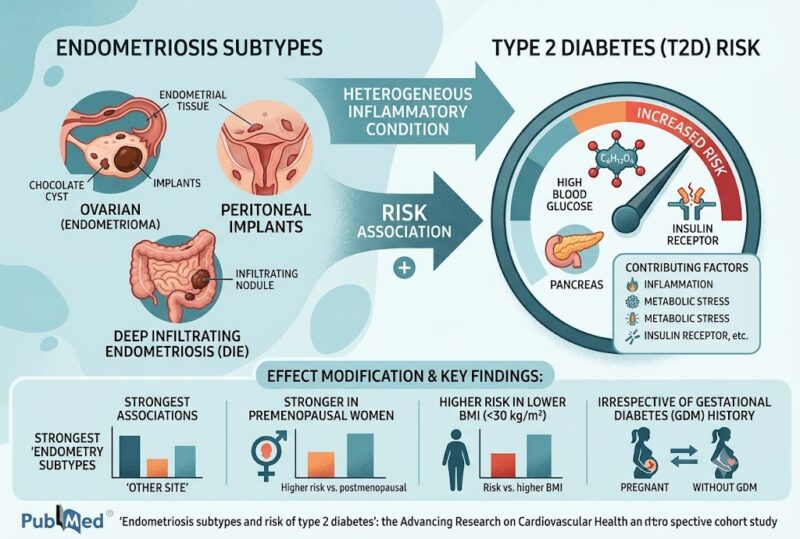
- Endometriosis is linked to a 46% increased risk of developing type 2 diabetes, with notably higher risk in certain subtypes.
- The strongest diabetes risk was observed in ‘other site’ endometriosis, suggesting heterogeneity by lesion location.
- Associations were more pronounced in premenopausal women and those with BMI under 30 kg/m², emphasizing differential metabolic risk profiles.
- Risks were independent of gestational diabetes mellitus history, indicating a distinct pathophysiological link.
Study Background
Endometriosis is a chronic, inflammatory gynecological condition characterized by the presence of endometrial-like tissue outside the uterus. Affecting approximately 10% of reproductive-aged women worldwide, it manifests with diverse clinical presentations ranging from mild pelvic pain to infertility. Emerging evidence suggests that systemic inflammation and hormonal dysregulation associated with endometriosis may influence long-term metabolic health. However, prior epidemiological studies have reported inconsistent associations between endometriosis and type 2 diabetes mellitus (T2DM), often treating endometriosis as a uniform disease without accounting for its heterogeneity.
The current study addresses this gap by investigating the relationship between clinically defined subtypes of endometriosis and incident T2DM, also examining effect modification by menopausal status, body mass index (BMI), and gestational diabetes history. Understanding these nuanced associations could enhance risk stratification and guide metabolic monitoring in women with endometriosis.
Study Design
The Advancing Research on Cardiovascular Health and Endometriosis Study (ARCHES) employed a large-scale, dynamic population-based retrospective cohort design leveraging data from the Utah Population Database spanning 1996 to 2021. The cohort included 2,939,364 individuals assigned female at birth. Endometriosis diagnosis and subtypes were identified through validated International Classification of Diseases (ICD-9 and ICD-10) coding algorithms, treated as time-varying exposures to appropriately capture incident cases during follow-up.
Incident T2DM cases were ascertained via diagnostic ICD codes, with Cox proportional hazards models applied using calendar time as the time scale. The models adjusted for potential confounders including birth year, birth state, race/ethnicity, age, and BMI at cohort entry. Stratified analyses further explored potential effect modification by menopausal status, baseline BMI categories (<30 vs. ≥30 kg/m²), and history of gestational diabetes mellitus.
Key Findings
During a mean follow-up period of 10.8 years, 99,978 women received an endometriosis diagnosis. Over the follow-up, the data demonstrated a significant association between endometriosis and increased risk of developing T2DM, with an adjusted hazard ratio (aHR) of 1.46 (95% confidence interval [CI], 1.43 to 1.50) relative to women without endometriosis.
Subtyping of endometriosis revealed striking heterogeneity in diabetes risk. The ‘other site’ endometriosis subtype, including both specified and unspecified locations outside classical pelvic sites, showed the strongest associations: aHR of 2.67 (95% CI, 2.51 to 2.84) for specified sites and 2.47 (95% CI, 2.35 to 2.60) for unspecified sites. This contrasts markedly to lesser risk elevations observed for other subtypes confined to commonly referenced anatomical sites.
Effect modification analyses showed that the elevated diabetes risk was more prominent among premenopausal women (aHR 1.55; 95% CI, 1.50 to 1.60) compared to postmenopausal women. Additionally, women with BMI below 30 kg/m² had a stronger association (aHR 2.39; 95% CI, 2.34 to 2.44) than those with higher BMI, suggesting that endometriosis may confer relative metabolic risk particularly in individuals traditionally considered at lower baseline diabetes risk. The increased risk was consistently observed irrespective of prior gestational diabetes mellitus, indicating an independent metabolic influence.
Expert Commentary
This comprehensive study provides robust epidemiologic evidence that endometriosis, a chronic inflammatory condition, elevates risk for incident T2DM, with notable heterogeneity based on disease subtype and host metabolic context. Mechanistically, systemic inflammation, altered estrogen signaling, and immune dysregulation in endometriosis may contribute to insulin resistance and beta-cell dysfunction, aligning with observed clinical risk patterns.
The heightened diabetes risk associated with ‘other site’ endometriosis may reflect underlying differences in pathophysiology or more aggressive disease phenotypes warranting further molecular and clinical characterization. The stronger associations noted in premenopausal women and those with lower BMI challenge traditional paradigms that link diabetes risk chiefly with obesity and older age, suggesting that inflammatory burden intrinsic to endometriosis may independently drive metabolic dysfunction.
Nevertheless, residual confounding and detection bias cannot be excluded; women diagnosed with endometriosis may undergo more frequent health evaluations, increasing diabetes detection rates. Also, reliance on administrative coding may limit granularity regarding disease severity and treatment exposures.
Future research should aim to elucidate biological mechanisms underpinning subtype-specific risk, validate findings in diverse populations, and assess the impact of endometriosis treatments on metabolic outcomes. Clinicians managing women with endometriosis should consider heightened vigilance for metabolic complications, incorporating targeted screening and lifestyle interventions where appropriate.
Conclusion
The ARCHES study significantly advances understanding of the intersection between endometriosis and type 2 diabetes mellitus, demonstrating an overall increased diabetes risk with substantial variation by disease subtype and metabolic context. These findings underscore the importance of recognizing endometriosis as not merely a gynecological disorder but a multisystem condition with systemic metabolic consequences. Tailored risk assessment and proactive metabolic health monitoring may improve long-term outcomes in this population. Cautious interpretation is warranted pending further validation, but these insights have immediate clinical relevance for endocrinologists, gynecologists, and primary care providers.
Funding and ClinicalTrials.gov
The original ARCHES study publication does not specify funding sources or clinical trial registration details.
References
1. Fuzak Nunziato M, Yan B, Schliep KC, et al. Endometriosis subtypes and risk of type 2 diabetes: the Advancing Research on Cardiovascular Health and Endometriosis Study (ARCHES) retrospective cohort study. Diabetologia. 2026 Aug 6. doi:10.1007/s00125-026-xxxxx. PMID: 42560525.
2. Zondervan KT, Becker CM, Missmer SA. Endometriosis. N Engl J Med. 2020;382:1244-1256.
3. Eskenazi B, Warner ML. Epidemiology of endometriosis. Obstet Gynecol Clin North Am. 1997;24(2):235-258.
4. Kim JJ, Taylor HS, Lu Z, et al. Endometriosis and the risk of developing systemic autoimmune diseases: a systematic review and meta-analysis. Fertil Steril. 2023;119(3):427-438.
5. Saidi R, Henry L, Ortiz JD, et al. Systemic inflammation in endometriosis: pathophysiology and implications for metabolic health. J Clin Endocrinol Metab. 2024;109(4):e1591-e1606.
This article was created using several editorial tools, including AI, as part of the process. Human editors reviewed this content before publication.