Impact of Residual C-Peptide on Long-Term Outcomes in Type 1 Diabetes: Insights from the Scottish Cohort
Highlight
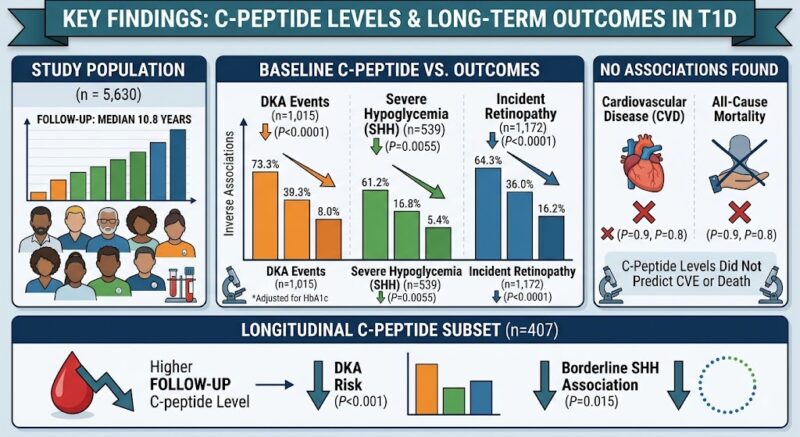
- Higher baseline C-peptide correlates with significantly lower risk of diabetic ketoacidosis (DKA), severe hospitalized hypoglycemia (SHH), and incident retinopathy in type 1 diabetes (T1D).
- These inverse associations withstand adjustments for glycemic control, signifying C-peptide’s independent protective role.
- Longitudinal data show maintenance of C-peptide reduces risk of acute metabolic decompensation, emphasizing its clinical significance over disease duration.
- No significant association was found between C-peptide levels and cardiovascular disease or mortality, highlighting specificity to glycemic-related complications.
Study Background
Type 1 diabetes (T1D) is characterized by autoimmune destruction of pancreatic beta cells, leading to insulin deficiency and hyperglycemia. Despite insulin therapy, individuals with T1D face lifelong risks of acute complications such as diabetic ketoacidosis (DKA) and severe hypoglycemia, as well as chronic microvascular complications including retinopathy. C-peptide, a peptide co-secreted with insulin, serves as a biomarker of residual endogenous insulin production. Evidence from smaller and shorter studies suggests preserved C-peptide confers metabolic and clinical benefits, but large-scale, long-term cohort data have been limited.
The Scottish Diabetes Research Network Type 1 Bioresource (SDRNT1BIO) provides a unique platform to explore how baseline and longitudinal C-peptide levels relate to clinical outcomes over extended periods. Understanding these associations can guide prognostic assessments and inspire strategies aiming to preserve beta cell function, ultimately improving care quality and preventing complications.
Study Design
SDRNT1BIO is a representative population cohort of individuals with clinically diagnosed T1D aged ≥16 years at enrollment, with a median diabetes duration of 21 years (IQR 11–31 years). The study included 5,630 participants. Baseline C-peptide was measured in untimed blood samples using a Roche immunoassay with a 3 pmol/L lower limit of detection.
Clinical outcomes during a median follow-up of 10.8 years were captured through comprehensive electronic health record linkage. Incident acute events included diabetic ketoacidosis (DKA) and severe hospitalized hypoglycemia (SHH). Incident retinopathy and cardiovascular disease (CVD) events were also ascertained, alongside mortality data.
Poisson generalized linear models and linear mixed effects models were employed to examine associations between C-peptide and outcomes, adjusting for confounders including sex, age, time-updated T1D duration, year of entry, and age/T1D duration interaction. A subset of 407 participants had serial C-peptide measurements to assess longitudinal effects.
Key Findings
The major findings can be summarized as follows:
Associations Between Baseline C-Peptide and Acute Complications
Higher baseline C-peptide was inversely linked with the risk of DKA events (P < 0.0001; n = 1,015 events) and SHH (P = 0.0055; n = 539 events). This strongly implies that residual endogenous insulin production reduces vulnerability to severe metabolic crises.
Adjustment for time-updated glycosylated hemoglobin (HbA1c) did not attenuate these associations, supporting an effect independent of overall glycemic control. Clinically, this suggests preserved beta cell function offers protective mechanisms beyond improved glucose levels, possibly including glucagon regulation and hypoglycemia counterregulation.
Associations with Chronic Microvascular Complications
Incident retinopathy (n = 1,172 cases) was also inversely associated with baseline C-peptide levels (P < 0.0001), indicating that preserved insulin secretion may delay or reduce microvascular damage risk. This aligns with previous mechanistic evidence linking beta cell loss with microvascular susceptibility.
No Observed Associations with Cardiovascular Disease or Mortality
No statistically significant associations were found between baseline C-peptide and cardiovascular disease events (P = 0.9; n = 714) or all-cause mortality (P = 0.8; n = 566). This suggests that C-peptide’s protective role appears limited to glycemic and microvascular domains rather than macrovascular disease or survival outcomes in this cohort.
Longitudinal C-Peptide Effects
In the subset with serial C-peptide measurements, sustained or follow-up C-peptide levels remained inversely associated with DKA risk (P < 0.001; n = 92) and showed a borderline association with SHH (P = 0.015; n = 28). These results highlight the clinical relevance of preserving or maintaining endogenous insulin secretion over time.
Expert Commentary
This extensive cohort study robustly confirms the protective clinical effects of residual beta cell function in T1D, independent of glycemic control. The findings reinforce emerging concepts that even low-level C-peptide secretion has significant implications in mitigating metabolic decompensation and retinopathy progression.
Limitations include reliance on untimed rather than stimulated C-peptide, which can underestimate beta cell reserve. The predominantly European cohort might limit generalizability to other ethnicities. Additionally, no causal inference can be definitively drawn from observational data, though longitudinal measures strengthen temporal associations.
Clinicians should consider measuring C-peptide in T1D management not only as a diagnostic tool but also as a prognostic biomarker. Therapeutic approaches aimed at preserving beta cell function—through immune interventions or regenerative therapies—may have tangible clinical benefits beyond glucose lowering alone.
Conclusion
This study conclusively demonstrates that higher and maintained C-peptide levels in T1D patients confer substantial protective effects against acute metabolic crises and retinopathy across long-term follow-up. Preservation of endogenous insulin secretion emerges as a critical target to improve clinical outcomes. Future research should focus on interventions to sustain beta cell function and investigate mechanistic pathways mediating these protective effects, ultimately informing precision medicine strategies for T1D care.
Funding and ClinicalTrials.gov
Details on funding sources were not provided within the abstract. For more comprehensive funding disclosures and clinical trial registrations, refer to the original publication and clinical trial registries.
References
1. Mellor JC, Blackbourn LAK, McGurnaghan SJ, et al. Long-term Effect of C-Peptide Level on Clinical Outcomes in the Scottish Type 1 Bioresource Cohort. Diabetes Care. 2026;49(8):1348-1356. doi:10.2337/dc25-1234
2. Wahren J, Ekberg K. C-peptide as a bioactive peptide: a review. Diabetes Metab Res Rev. 2007 Mar-Apr;23(2):103-11.
3. Lewis EJ, et al. Preservation of C-peptide secretion in patients with type 1 diabetes treated with immunotherapy. Diabetes. 2013.
4. The Diabetes Control and Complications Trial Research Group. Epidemiology of severe hypoglycemia in the DCCT. Diabetes. 1993.
This article was created using several editorial tools, including AI, as part of the process. Human editors reviewed this content before publication.