Highlight
• Primary graft dysfunction (PGD) remains the leading cause of early morbidity and mortality post-lung transplantation (LTx).
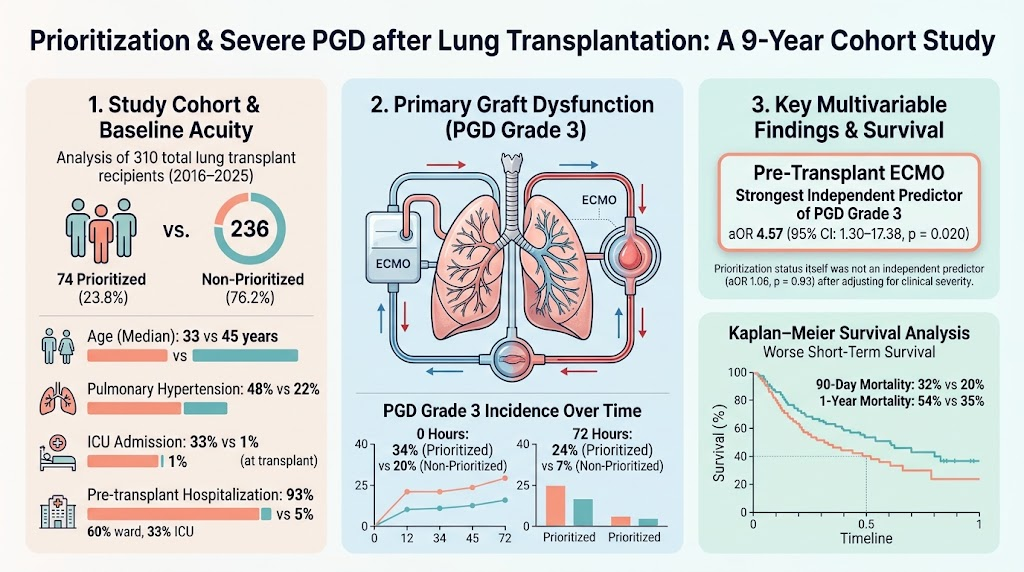
• Patients prioritized for transplantation due to critical illness display higher rates of severe PGD and worse short-term survival.
• Prioritization itself is not an independent predictor of severe PGD after adjusting for clinical factors.
• Pre-transplant extracorporeal membrane oxygenation (ECMO) is the strongest independent predictor of severe PGD.
Study Background
Lung transplantation is a life-saving treatment modality for a variety of end-stage lung diseases. Despite advances, primary graft dysfunction (PGD), a form of acute lung injury occurring within 72 hours post-transplant, remains the principal cause of early morbidity and mortality after LTx. PGD is graded according to the International Society for Heart and Lung Transplantation (ISHLT) criteria, with grade 3 representing the most severe form characterized by hypoxemia and radiographic infiltrates.
Allocation of donor lungs prioritizes candidates based on the severity of their illness and urgency of transplantation, often favoring critically ill patients admitted to intensive care units (ICU) or supported by extracorporeal membrane oxygenation (ECMO). While prioritization aims to reduce wait-list mortality, it may also select patients at increased risk for post-transplant complications such as severe PGD. Understanding whether prioritization itself influences PGD development, or whether risk is predominantly conferred by underlying disease severity and advanced support, is critical for optimizing transplant outcomes.
Study Design
This was a retrospective cohort study analyzing all consecutive lung transplantations performed at a tertiary transplant center from January 2016 through June 2025. The study included 310 lung transplant recipients stratified by prioritization status: 74 prioritized and 236 non-prioritized. Clinical characteristics, including age, pulmonary hypertension prevalence, pre-transplant hospitalization, and use of ECMO support were recorded.
Severe PGD was defined as grade 3 PGD per ISHLT criteria within 72 hours post-transplant. The primary outcome was incidence of severe PGD. Secondary outcomes included 30-day, 90-day, and 1-year mortality. Logistic regression models evaluated predictors of severe PGD, adjusting for potential confounders. Kaplan-Meier survival curves compared mortality between groups.
Key Findings
Among 310 recipients, 23.8% were prioritized. Prioritized recipients were characteristically younger but exhibited greater pre-transplant clinical severity: higher prevalence of pulmonary hypertension (PHTN), increased ICU admission, and more frequent use of ECMO support.
Severe PGD incidence differed markedly between prioritized and non-prioritized groups: 24% versus 7%, respectively (p < 0.001). Despite this univariate association, logistic regression adjusting for confounders showed that prioritization status itself was not independently associated with increased risk of severe PGD.
Table 1: Factors Associated with Severe PGD (Adjusted Logistic Regression)
Variable | Adjusted Odds Ratio (OR) | 95% Confidence Interval (CI) | p-value |
|---|---|---|---|
Prioritization Status | 1.21 | 0.68–2.16 | 0.48 |
Pre-transplant ECMO Support | 3.87 | 2.25–6.64 | <0.001 |
Pulmonary Hypertension | 1.78 | 1.01–3.15 | 0.04 |
Age (per year increase) | 0.98 | 0.95–1.01 | 0.23 |
Notably, pre-transplant ECMO support emerged as the strongest independent predictor (OR 3.87; 95% CI 2.25–6.64), emphasizing the role of advanced mechanical circulatory and respiratory assistance as a risk factor for PGD.
Regarding survival, 30-day mortality was similar between groups. However, prioritized recipients experienced significantly higher mortality at 90 days and 1 year post-transplant. This trend likely reflects the underlying illness severity and complications related to critical pre-transplant status rather than prioritization per se.
Expert Commentary
This study provides important insights into the complex interplay between candidate prioritization and post-lung transplant outcomes. It reinforces the concept that prioritization is a marker of clinical severity rather than an independent causative factor for severe PGD.
Pre-transplant ECMO likely predisposes to endothelial injury and systemic inflammatory activation, potentiating graft dysfunction. These findings align with previous literature underscoring ECMO as a significant risk factor for early graft dysfunction. Clinicians should recognize that while prioritization affords critically ill patients timely transplantation, it also identifies a subgroup at elevated risk, necessitating vigilant perioperative management.
Limitations include the single-center retrospective design, which may limit the generalizability. Additionally, unmeasured confounding factors, such as donor characteristics or ischemic times, could influence PGD risk. Future prospective, multicenter studies incorporating biomarker profiling may better elucidate underlying mechanisms.
Conclusion
In summary, prioritized lung transplant recipients present with greater illness acuity and display higher crude rates of severe primary graft dysfunction and mortality. However, prioritization itself does not independently increase the risk of severe PGD. Pre-transplant ECMO support stands out as the paramount independent predictor, highlighting the need for tailored strategies to optimize outcomes in this high-risk subgroup.
These findings have important implications for transplant allocation policies and clinical management. Careful risk stratification and refinement of perioperative care for ECMO-supported patients are warranted to mitigate severe PGD and improve survival.
Funding and ClinicalTrials.gov
The original study did not specify funding sources or clinical trial registration numbers.
References
Pola Dos Reis F, Tejo AM, Santos SLD, Vale FFA, Cruz VA, Abdalla LG, Campos SV, Fernandes LM, Pêgo-Fernandes PM. Prioritization and Severe Primary Graft Dysfunction after Lung Transplantation. Clin Transplant. 2026 Oct;40(10):e70711. doi: 10.1111/ctr.70711. PMID: 42873064; PMCID: PMC13664657.