We use cookies

Our website uses essential cookies and, with your consent, additional cookies to measure performance and improve our services. Cookie Policy.

You can change your choice at any time.

MMedXYNews
HomeVideos
MedXY AI/MedXY News/Section: Critical Care

How Respiratory Mechanics Shapes Ventilator Settings and Outcomes in Acute Brain Injury Patients
MedXY Editorial Team•Aug 25, 2026•Critical Care
mechanical ventilationrespiratory system elastancerespiratory ratetidal volumeacute brain injury

Highlight

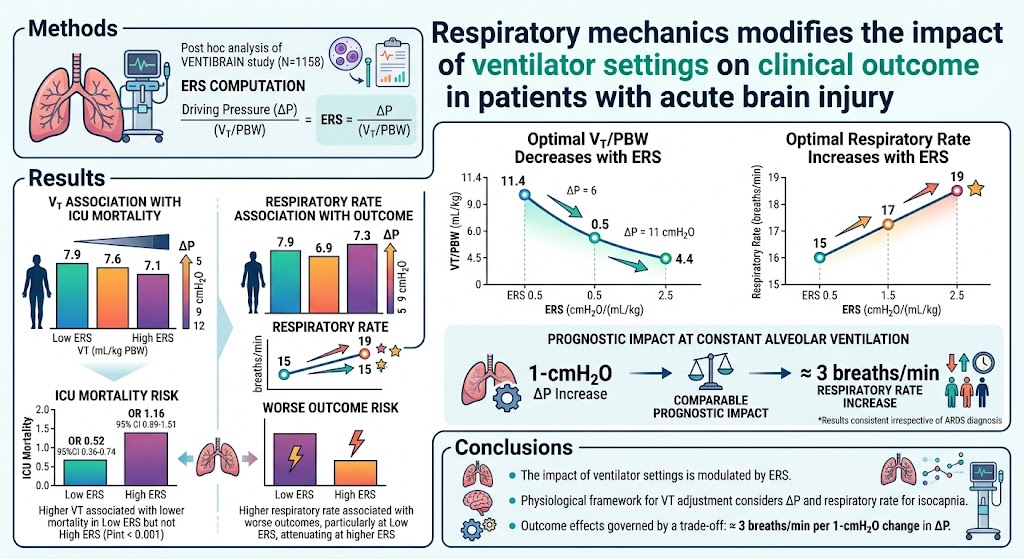
  • Respiratory system elastance (ERS) significantly modifies how tidal volume (VT) and respiratory rate influence clinical outcomes in acute brain injury patients on mechanical ventilation.
  • Higher VT is linked to lower ICU mortality in patients with low ERS, but this benefit dissipates in those with high ERS.
  • An increased respiratory rate correlates with worse outcomes, particularly at low ERS; this association weakens as elastance increases.
  • Optimal ventilator settings should balance driving pressure (ΔP) and respiratory rate to maintain adequate alveolar ventilation while minimizing harm.

Study Background

MedXY registered readers

Sign in free to continue reading

Create or use your MedXY account to unlock the complete article.

This article was created using several editorial tools, including AI, as part of the process. Human editors reviewed this content before publication.

Related articles

Open language-specific specialty feeds and department pages.

Mechanical Ventilation-Induced Neutrophil Extracellular Vesicles: A Novel Mediator in Postoperative Pulmonary ComplicationsMechanical ventilation during surgery induces neutrophil extracellular vesicles that propagate lung inflammation and contribute to postoperative pulmonary complications, highlighting potential new biomarkers and therapeutic targets.Sep 17, 2026Extracorporeal Membrane Oxygenation without Mechanical Ventilation in ARDS: Insights from an International Cohort StudyThis study evaluates ECMO as a standalone respiratory support in ARDS patients avoiding invasive mechanical ventilation, highlighting outcomes, strategy failures, and mortality implications.Sep 17, 2026Evaluating the Impact of Early Mobilization in Mechanically Ventilated ICU Patients with Sepsis or Acute Respiratory Failure: Insights from the EVER Multicenter RCTThe EVER trial examined if a structured early mobilization protocol improves functional outcomes in ventilated patients with sepsis or respiratory failure. Despite earlier and increased mobilization, no significant functional benefit was obSep 6, 2026
Loading comments...
MedXY briefing

Get the free newsletter

Evidence-led clinical news, trends, and analysis—delivered to your inbox.

Ask MedXY AI

Most popular

Intimate Health
Five Benefits for Women Continuing Sexual Activity After Menopause
Intimate Health
Why Some Women Have a Strong Sex Drive—And Why Men Shouldn't Worry About It
Nursing & care
How often should a couple have sex?
Intimate Health
Classic Intimacy Recommendations: How to Help Women Reach Orgasm and Enjoy Mutual Pleasure
Intimate Health
What Makes a Woman "Physiologically Addicted" Is Never Money, But These Two Relationship Qualities
© 2026 MedXY
Contact usAbout usPrivacy PolicyMedXY story
Understanding Acute Hypoxemic Respiratory Failure in ICU Patients: Epidemiology, Ventilatory Management, and Outcomes from a Multi-ICU Cohort Study
This study reveals that acute hypoxemic respiratory failure (AHRF) affects half of ICU patients needing respiratory support, with severity linked to worse outcomes. Lung-protective ventilation is common, underscoring the need for standardiz
Sep 1, 2026
Physical Restraint Use in Mechanically Ventilated ICU Patients: Impact on Delirium and Coma-Free Days Over 14 DaysRCT evidence shows that restrictive low-use versus liberal high-use physical restraint strategies in mechanically ventilated ICU patients do not differ in days alive without delirium or coma at 14 days.Jul 14, 2026
Revolutionizing Mechanical Ventilation: AI-Driven Real-Time Monitoring of Inspiratory Effort and Patient-Ventilator SynchronyA novel artificial intelligence algorithm enables continuous, noninvasive monitoring of inspiratory muscle effort and patient-ventilator dyssynchrony during mechanical ventilation, demonstrating accuracy comparable to invasive gold standardJul 9, 2026