Health-Related Quality of Life Following Risk-Reducing Hysterectomy: Insights from a UK Randomised Vignette Study
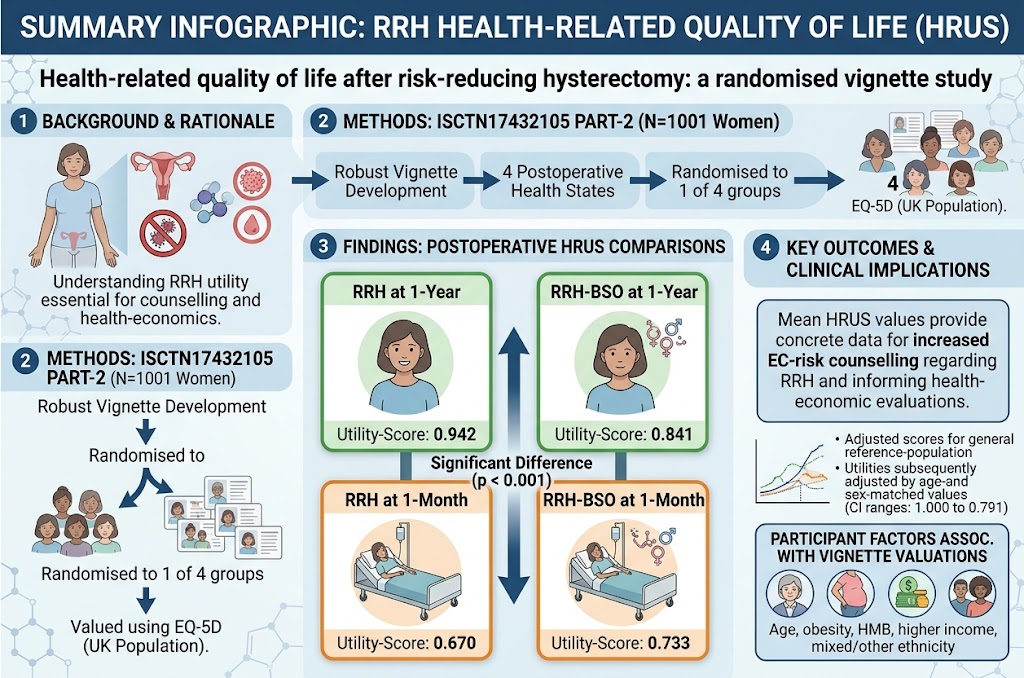
Highlight
This study provides the first randomised, population-based health-related utility scores (HRUS) for premenopausal risk-reducing hysterectomy (RRH) with and without bilateral salpingo-oophorectomy (BSO). It highlights significant differences in quality of life across postoperative intervals and surgical approaches, informing shared decision-making and health economic models in endometrial cancer prevention.
Adjusted HRUS at one year after surgery indicate near-normal quality of life for RRH but a modest decline when BSO is included. Early postoperative periods show notably lower utility scores, reflecting recovery and surgical impact.
Study Background
Endometrial cancer risk reduction is critical among women at high genetic or clinical risk. Risk-reducing hysterectomy (RRH) remains the most effective preventive surgical intervention to eliminate the risk of endometrial cancer. In many cases, concomitant removal of ovaries and fallopian tubes (bilateral salpingo-oophorectomy, BSO) is recommended to reduce ovarian cancer risk. Despite its effectiveness, the impact of RRH—with or without BSO—on health-related quality of life (HRQoL) remains incompletely characterised, especially for premenopausal women.
HRQoL data quantified as health utility scores (HRUS) are vital for counseling patients considering RRH and BSO, providing realistic expectations on postoperative wellbeing. Additionally, HRUS are fundamental for cost-effectiveness analyses guiding health policy and personalized clinical decisions.
Study Design
The Preventing Endometrial Cancers: Comparing Risk-Reducing Strategies (PRESCORES) study (ISRCTN17432105) employed a randomized vignette methodology to evaluate HRUS associated with four distinct postoperative health states in a hypothetical 40-year-old healthy premenopausal woman candidate for RRH.
Participants were drawn from the UK general female population (n=1001, mean age 53.6±11.4 years), randomized to rate one of four vignette scenarios: “RRH at 1-month”, “RRH at 1-year”, “RRH-BSO at 1-month”, and “RRH-BSO at 1-year” postoperative states using the EQ-5D instrument. Health utilities were then adjusted against age- and sex-matched general population reference values to contextualize estimates.
Associations with participant demographics and clinical variables were assessed using ordinary least squares regression with bootstrapping to ensure robustness.
Key Findings
The study reported significant differences in mean HRUS across all groups (p<0.001). Raw mean EQ-5D utilities were highest for RRH at 1 year (0.942±0.072), followed by RRH-BSO at 1 year (0.841±0.137), then RRH at 1 month (0.670±0.149), and RRH-BSO at 1 month (0.733±0.190).
Adjusted for population norms, HRUS were approximately 1.000 for “RRH at 1-year”, indicating near full recovery and quality of life comparable to general population; 0.994 for “RRH-BSO at 1-year”, reflecting a slight but measurable decrement possibly related to surgically induced menopause and related sequelae; 0.866 and 0.791 for the respective 1-month postoperative states, signifying substantial short-term morbidity and recovery burden.
Regression analyses identified several participant factors influencing valuations including older age, presence of obesity, heavy menstrual bleeding, higher income, and mixed/other ethnicity. These factors may affect perception of health states and underscore the necessity of individualized counseling.
Expert Commentary
This rigorous study design using randomized vignettes and a nationally representative sample enhances the external validity of the utility estimates. EQ-5D, a widely accepted preference-based HRQoL measure, affords comparability with other health economic evaluations.
The observed decrements with BSO likely reflect consequences of abrupt hormonal changes post-oophorectomy in premenopausal women, consistent with other literature describing impacts on vasomotor symptoms, sexual function, and general well-being.
However, the vignette approach may not perfectly capture real-world subjective experiences, especially psychological impacts and longer-term adaptation, which deserve further prospective longitudinal study. The influence of participant characteristics on utility ratings also highlights that individual perspectives and sociocultural factors are critical when interpreting HRQoL data in clinical discussions.
Conclusion
This UK randomized vignette study provides robust, population-based health utility scores for premenopausal women undergoing risk-reducing hysterectomy, with and without bilateral salpingo-oophorectomy, at early and late postoperative intervals. Utilities approach general population norms by one year post-RRH alone, with a modest reduction when BSO is included.
These findings support clinicians in delivering evidence-informed counseling regarding expected quality-of-life trajectories following RRH-BSO. Additionally, the data underpin accurate health economic models for preventive surgical interventions in gynecologic oncology.
Future research should aim to capture patient-reported outcomes longitudinally post-surgery to validate and expand upon these vignette-derived estimates, considering psychological, sexual, and hormonal domains comprehensively.
Funding and Clinical Trials Registration
The study was funded and conducted under the PRESCORES collaboration (ISRCTN17432105), a UK-based research initiative focused on endometrial cancer prevention.
References
Oxley S, Dibden A, Whenham T, Wei X, Mansour L, Kalra A, et al. Health-related quality of life after risk-reducing hysterectomy: a randomised vignette study. Gynecol Oncol. 2026 Aug 8;212:89-97. PMID: 42570385.
Greene MH, Valerie K. Prevention of endometrial cancer in high-risk populations: the role of hysterectomy and bilateral salpingo-oophorectomy. Cancer Epidemiol Biomarkers Prev. 2020;29(4):631–637.
Siegel RL, Miller KD, Jemal A. Cancer statistics, 2023. CA Cancer J Clin. 2023;73(1):17-48.
EQ-5D Development and Applications. EuroQol Group. https://euroqol.org/
This article was created using several editorial tools, including AI, as part of the process. Human editors reviewed this content before publication.