Harnessing the Vagus Nerve: A Novel Frontier in Myocardial Infarction Management
Introduction
Myocardial infarction (MI) remains a leading cause of morbidity and mortality worldwide, largely driven by ischemic injury and harmful autonomic imbalances. While sympathetic activation predominates during MI, aggravating myocardial damage and arrhythmias, the parasympathetic nervous system—and particularly the vagus nerve—exerts a counter-regulatory influence that may limit ischemic injury and improve outcomes. This article critically reviews the organization and function of vagal pathways in the context of MI, emphasizing mechanistic insights and translational implications from preclinical and clinical research.
The Burden and Autonomic Imbalance in Myocardial Infarction
MI arises primarily from coronary artery occlusion, precipitating myocardial ischemia, infarction, and mechanical and electrical dysfunction. Sympathetic overactivation during MI contributes to arrhythmogenesis, infarct expansion, and adverse remodeling. Conversely, vagal tone is generally reduced in ischemic heart disease and post-MI states, associated with worse prognosis. Restoring or enhancing vagal activity represents an intriguing therapeutic target to attenuate ischemic injury and modulate inflammation, which remains an unmet need beyond conventional reperfusion therapies.
Organization of Vagal Pathways Relevant to Myocardial Infarction
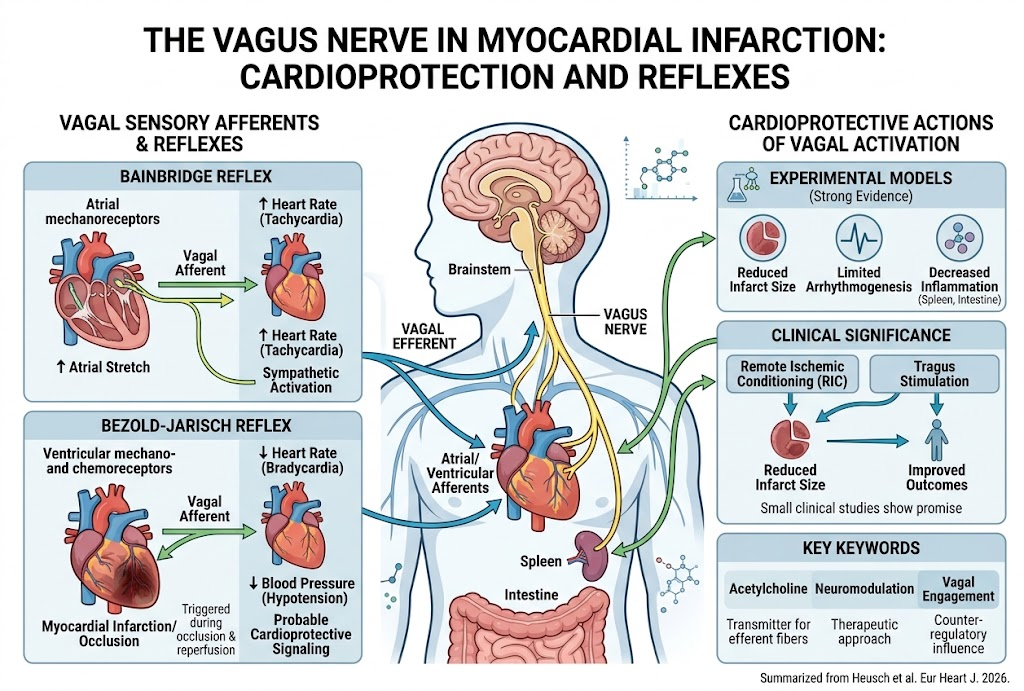
The vagus nerve comprises afferent sensory fibers and efferent motor fibers with diverse cardiac and systemic targets. The sensory afferents respond to mechanical and chemical stimuli in the atria, ventricles, and vasculature. Key reflex arcs include:
– Bainbridge reflex: Mediated by atrial mechanosensitive afferents, induces tachycardia in response to increased atrial pressure.
– Bezold-Jarisch reflex: Triggered by ventricular mechano- and chemosensitive afferents during ischemia and reperfusion, leading to bradycardia and hypotension. This reflex appears to have cardioprotective significance by reducing myocardial oxygen demand and modulating autonomic balance.
The efferent vagal fibers innervate myocardial tissue directly and influence coronary and systemic vessels, modulating heart rate, contractility, and vascular tone. Additionally, vagal projections to the intestine and spleen interface with immunomodulatory pathways, suggesting a broader systemic role in controlling post-MI inflammation.
Neurotransmitters and Receptors in Vagal Cardioprotection
Acetylcholine is the principal vagal neurotransmitter acting via muscarinic receptors in the heart, mediating negative chronotropic and inotropic effects, and anti-arrhythmic properties. Vagal afferent neurons also modulate neurotransmitter release (e.g., substance P, calcitonin gene-related peptide) influencing local myocardial and systemic responses. The balance and interaction of these neurotransmitter systems underpin the vagus nerve’s ability to limit ischemic injury and inflammatory responses.
Vagal Mechanisms in Ischemic Conditioning
Remote ischemic conditioning (RIC) refers to brief intermittent ischemic episodes at a site remote from the heart (e.g., limb) which confer protection against myocardial ischemia-reperfusion injury. This protection is thought to involve peripheral sensory stimulation triggering vagal activation with subsequent release of circulating cardioprotective factors. Evidence implicates vagal pathways as critical mediators linking peripheral conditioning stimuli to myocardial protection mechanisms.
Experimental Evidence for Vagal Stimulation in Myocardial Infarction
Preclinical models of MI provide robust evidence that vagal nerve stimulation (VNS) reduces infarct size, suppresses arrhythmogenesis, and attenuates post-ischemic inflammation. Animal studies demonstrate that electrical VNS or pharmacologic enhancement of vagal tone improves cardiac electrical stability and favors myocardial salvage, underscoring translational potential.
Clinical Studies and Translational Challenges
Smaller clinical trials have tested RIC using limb ischemia and non-invasive electrical auricular VNS in patients with MI or ischemic heart disease. These studies reported reductions in infarct size, improvements in clinical outcomes, and enhanced vagal tone. However, larger definitive studies are lacking, and heterogeneity in patient populations, timing, and protocols limit generalizability. The question remains whether RIC effectively recruits cardioprotective vagal activity robustly enough to impact hard clinical endpoints in diverse ischemic heart disease cohorts.
Expert Commentary
The vagus nerve represents a promising target for novel cardioprotective strategies in MI due to its multi-level control of heart function, autonomic balance, and systemic inflammation. Nevertheless, the complexity of vagal pathways, variability in individual anatomy and physiology, and interactions with sympathetic circuits pose challenges to clinical translation. Moreover, standardized protocols for vagal modulation and identifying responsive patient subgroups need development. Current evidence supports an integrative approach combining vagal activation with established treatments to optimize myocardial salvage and reduce adverse remodeling.
Conclusions and Future Directions
Targeting the vagus nerve offers a compelling paradigm to modulate ischemic injury, arrhythmia risk, and inflammation in MI. Experimental data strongly support vagal cardioprotection, and early clinical results are encouraging. Nevertheless, well-designed large randomized trials are required to establish efficacy, optimal stimulation modalities, timing, and patient selection criteria. Further research into underlying molecular mechanisms and integration with systemic immunity may unlock new therapeutic avenues, potentially enhancing survival and functional recovery after MI.
Funding and ClinicalTrials.gov
Information on funding sources and registration of any clinical trials referenced herein was not specified in the original article.
Reference
Heusch G, Kleinbongard P, Gourine AV. The vagus nerve in myocardial infarction. Eur Heart J. 2026 Aug 26:ehag674. doi: 10.1093/eurheartj/ehag674. Epub ahead of print. PMID: 42643152.
This article was created using several editorial tools, including AI, as part of the process. Human editors reviewed this content before publication.