We use cookies

Our website uses essential cookies and, with your consent, additional cookies to measure performance and improve our services. Cookie Policy.

You can change your choice at any time.

MMedXYNews
HomeVideos
MedXY AI/MedXY News/Section: AI

Harnessing Deep Learning for Early Detection of Incisional Surgical Site Infections Through Wound Image Analysis
MedXY Editorial Team•Aug 28, 2026•AI
surgical-site infectiontelemedicinewound imagingdeep learning

Highlight

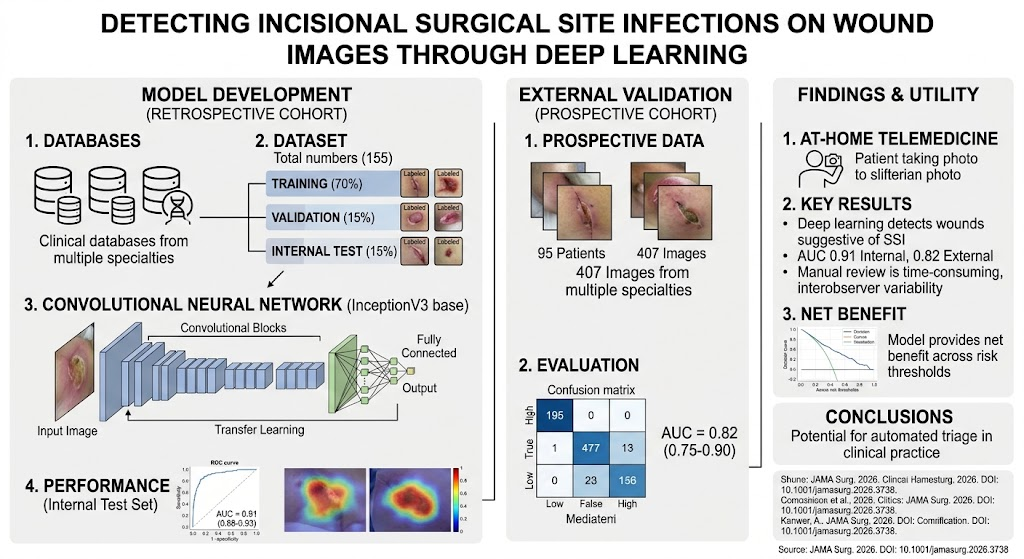
  • Development of a convolutional neural network (CNN) to detect surgical site infections (SSIs) from wound photographs with high accuracy.
  • Model training on a large multicenter, multispecialty retrospective wound image dataset (4978 images), with rigorous external validation (407 images from 95 patients) from a large academic center.
  • Demonstrated model performance with an area under the curve (AUC) of 0.91 internally and 0.82 externally, showing strong discrimination and clinical utility.
  • Potential for integration into telemedicine workflows to support automated triage and early diagnosis, reducing delays and variability in postoperative SSI detection.

Study Background

MedXY registered readers

Sign in free to continue reading

Create or use your MedXY account to unlock the complete article.

This article was created using several editorial tools, including AI, as part of the process. Human editors reviewed this content before publication.

Related articles

Open language-specific specialty feeds and department pages.

Revolutionizing Aortic Stenosis Screening: AI-Enabled Focused Cardiac Ultrasound with Novice OperatorsA novel deep learning algorithm accurately detects moderate or greater aortic stenosis using AI-guided focused cardiac ultrasound acquired by novice operators, presenting a scalable solution to expand screening accessibility.Aug 29, 2026Deep Learning Applications in Evaluating and Predicting Technical Surgical Skills in Robotic-Assisted Vaginal Cuff Closure: A Multicenter Prospective StudyThis review synthesizes evidence on deep learning models for assessing technical skills and error detection in robotic-assisted vaginal cuff closure, emphasizing objective surgical skill evaluation, model accuracy, and implications for surgAug 24, 2026Ultra-Long-Distance Robotic-Assisted Subretinal Injection for Submacular Hemorrhage: A Case ReportThis report describes the successful ultra-long-distance robotic-assisted subretinal injection of recombinant tissue plasminogen activator for submacular hemorrhage, demonstrating procedural feasibility and safety across 4000 km.Aug 23, 2026
Loading comments...
MedXY briefing

Get the free newsletter

Evidence-led clinical news, trends, and analysis—delivered to your inbox.

Ask MedXY AI

Most popular

Intimate Health
Five Benefits for Women Continuing Sexual Activity After Menopause
Intimate Health
Why Some Women Have a Strong Sex Drive—And Why Men Shouldn't Worry About It
Nursing & care
How often should a couple have sex?
Intimate Health
Classic Intimacy Recommendations: How to Help Women Reach Orgasm and Enjoy Mutual Pleasure
Intimate Health
What Makes a Woman "Physiologically Addicted" Is Never Money, But These Two Relationship Qualities
© 2026 MedXY
Contact usAbout usPrivacy PolicyMedXY story
Bridging the Gap: How Transportation Barriers Impact Primary Care Attendance and the Role of Telemedicine
This study highlights how unmet transportation needs significantly increase missed in-person primary care appointments, while telemedicine offers a viable solution to overcome these barriers, improving healthcare access.
Aug 20, 2026
Early Prediction of Dupilumab Efficacy in Facial Atopic Dermatitis via Reflectance Confocal Microscopy and Deep LearningReflectance confocal microscopy features at week 4 post-dupilumab treatment, combined with deep learning analysis, enable non-invasive prediction of therapeutic response in facial atopic dermatitis patients.Aug 12, 2026
Deep Learning-Driven Synthetic MR Perfusion Maps: A Breakthrough in Acute Ischemic Stroke ImagingThis study presents a deep learning model that generates synthetic T-max perfusion maps from noncontrast DWI and FLAIR sequences, potentially streamlining stroke imaging and eliminating the need for contrast agents.Aug 12, 2026