Glucose in Motion: Insights into Temporal Patterns of Glycemic Control in Real-World Diabetes Management
Highlights
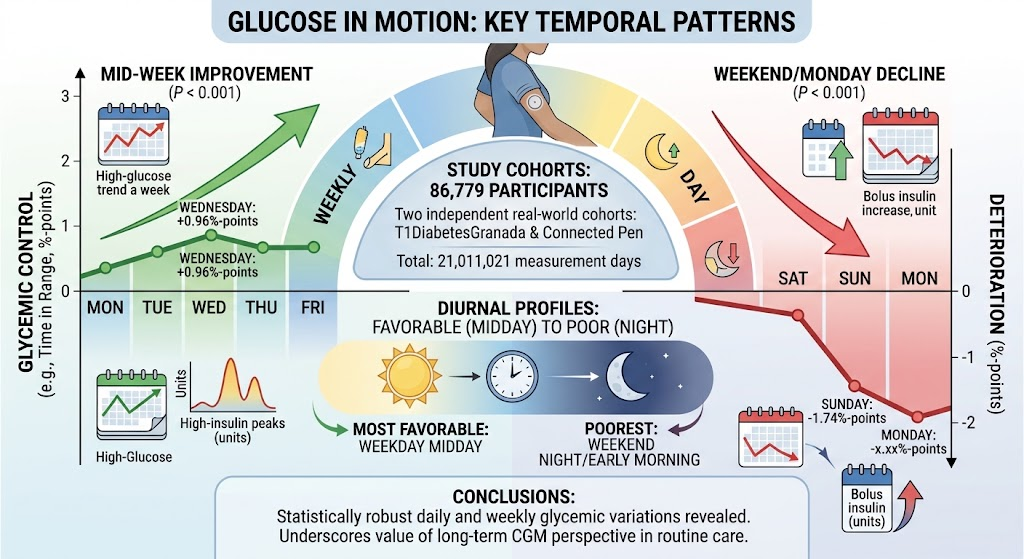
- Robust evidence from two large cohorts reveals consistent weekly glycemic variations, with better control mid-week and deterioration on weekends.
- Daily diurnal glycemic patterns show optimal glucose control during morning and midday hours on weekdays versus poorer control in evenings and nights, especially weekends.
- Bolus insulin dosing rises during weekend days, reflecting compensatory adjustments corresponding to altered glycemic patterns.
- Integrating long-term CGM data with temporal analyses enhances personalized diabetes management and clinical interpretation.
Background
Diabetes mellitus remains a global health challenge with chronic hyperglycemia contributing to microvascular and macrovascular complications. Glycemic control assessment has traditionally relied on HbA1c; however, continuous glucose monitoring (CGM) provides rich, longitudinal data enabling evaluation of temporal glucose dynamics. Understanding daily and weekly fluctuations is crucial for tailoring therapies and optimizing outcomes. This article reviews recent advances, focusing on a large observational study characterizing temporal glycemic patterns, situating findings within the broader context of diabetes research and clinical practice.
Key Content
Chronological Development of Evidence on Temporal Glycemic Patterns
The advent of CGM technology over the past two decades has revolutionized diabetes monitoring, shifting from static snapshot measures to dynamic glucose profiles. Early studies (pre-2010) primarily focused on hypoglycemia detection and overall glycemic variability. Subsequent work expanded to recognize circadian rhythms and behavioral impacts on glycemic control. Increasingly, large-scale real-world data cohorts have emerged, offering population-level insights with broad applicability.
Real-World Large Cohort Evidence: The Giese et al. 2026 Study
The featured study analyzed data from 86,779 participants across two independent cohorts—T1DiabetesGranada and Connected Pen—comprising 21 million measurement days. Employing linear mixed-effects models, the investigators delineated weekly and daily glycemic patterns.
Key results included:
- A mid-week increase in Time in Range (TIR), with Wednesday showing nearly a 1 percentage point improvement over other days (P < 0.001).
- Weekend and Monday glycemic deterioration, with Sunday’s TIR reduced by approximately 1.74 percentage points (P < 0.001).
- Bolus insulin doses increased during weekends, peaking on Sunday (+0.69 units, P < 0.001), possibly reflecting behavioral lifestyle changes like diet or activity.
- Diurnal profiles revealed more favorable glycemic control during morning and midday hours on weekdays versus poorer evening and nighttime control, disproportionately evident on weekends.
These patterns persisted across cohorts and were statistically robust despite modest effect sizes, underscoring their relevance at the population level.
Supporting and Complementary Evidence
Prior smaller observational studies have reported similar weekend glycemic deterioration linked to lifestyle modifications, increased caloric intake, alcohol consumption, and physical inactivity. Randomized crossover trials manipulating meal timing and activity confirm diurnal glucose excursions vary with behavior and circadian biology. Meta-analyses indicate that time-of-day effects contribute significantly to glycemic variability and risk of hypoglycemia or hyperglycemia.
Mechanistic and Translational Insights
Mechanistically, endogenous circadian rhythms influence insulin sensitivity and beta-cell function, with insulin resistance often peaking in late afternoon/evening. Weekend lifestyle changes, including sleep pattern shifts and dietary indulgence, exacerbate glycemic instability. Understanding these patterns facilitates anticipatory therapeutic adjustments, such as timing insulin administration or dietary counseling.
Methodological Advances
This study leveraged large-scale, real-world CGM datasets, exploiting statistical modeling (linear mixed-effects) to parse temporal effects amid heterogeneous populations. This approach advances beyond cross-sectional or single-day analyses, embracing longitudinal dynamics critical for clinical decision-making.
Expert Commentary
The Giese et al. study represents a milestone in real-world glycemic pattern characterization, confirming that even subtle daily and weekly rhythms bear clinical significance. While individual-level variations may attenuate these effects, population-level trends provide valuable context for clinicians and patients. Current guidelines (e.g., ADA, EASD) endorse personalized diabetes management but rarely incorporate temporal glycemic pattern insights systematically. This study advocates integrating CGM data into routine care to identify suboptimal periods for intervention.
A limitation is that the magnitude of differences, though statistically significant, is modest, raising questions about clinical impact. Yet, small changes in glycemic control aggregated over time may influence complication risk. Moreover, the observational design cannot infer causality, and behavioral or socio-environmental factors mediating these patterns warrant further exploration. Incorporating adjunctive data like activity, diet, sleep, and psychosocial parameters could refine understanding.
Future clinical trials targeting weekend and nocturnal glycemic control are needed, including testing tailored insulin regimen adjustments or behavioral interventions. Additionally, expanding analyses to diverse diabetes populations, including type 2 diabetes patients and pediatric cohorts, can assess generalizability.
Conclusion
Temporal patterns in glycemic control, particularly weekly and daily rhythms, are evident in large real-world CGM datasets. Recognizing better mid-week control and weekend deterioration alongside diurnal variations affords opportunities for more nuanced, personalized diabetes management. Integration of longitudinal CGM data analytics into clinical workflows can facilitate dynamic treatment adaptation, ultimately improving outcomes. Continued research bridging mechanistic insights with prospective interventions remains essential.
References
- Giese IE, Hangaard S, Hartvig NV, Hirsch IB, Jensen MH, Cichosz SL. Glucose in Motion: Characterizing Temporal Patterns in Real-World Glycemic Control in a Large Observational Cohort. Diabetes Care. 2026 Aug 17; PMID: 42606498.
- American Diabetes Association. 7. Diabetes Technology: Standards of Medical Care in Diabetes—2023. Diabetes Care. 2023 Jan;46(Suppl 1):S111-S121.
- Colella M, Campagna G, Romano F, et al. Effect of weekend versus weekday differences in physical activity and sedentary time on glycemic control in type 1 diabetes: A systematic review. Diabetes Res Clin Pract. 2022 Dec;190:110041.
- Leone TF, Bodnar TL, Moorman JP, et al. Circadian influences on glycemic control in diabetes. Endocrinol Metab Clin North Am. 2021 Jun;50(2):333-346.
- Rodriguez LM, Kim M, Feinglos MN. Randomized controlled trials for optimizing insulin delivery timing based on circadian glucose patterns. J Diabetes Sci Technol. 2020 Sep;14(5):931-936.
This article was created using several editorial tools, including AI, as part of the process. Human editors reviewed this content before publication.