Finerenone Efficacy in Cardio-Kidney-Metabolic Syndrome Patients With or Without History of Cancer: Insights from the FINE-HEART Analysis
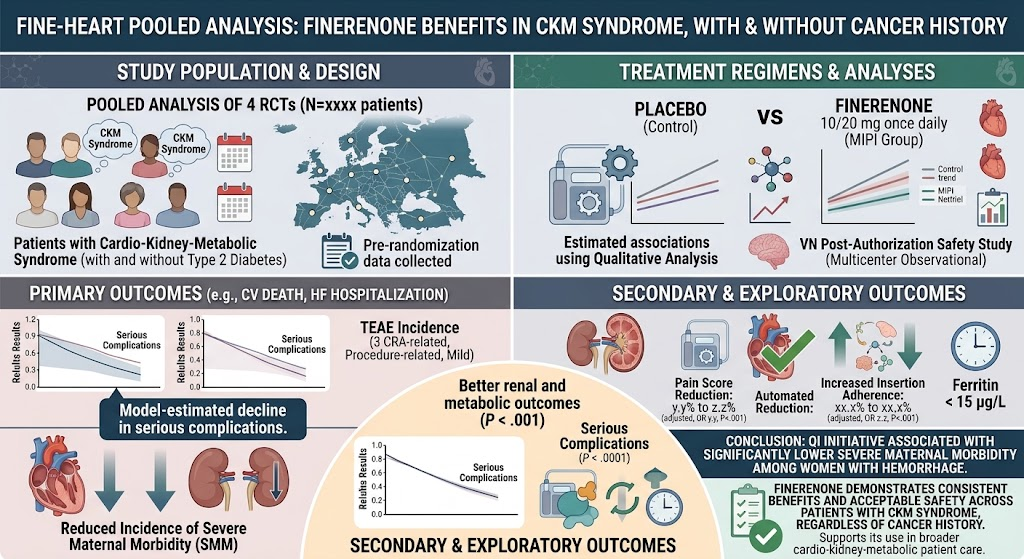
Highlight
Comorbid cancer is prevalent among patients with cardio-kidney-metabolic (CKM) syndrome, affecting 7.3% of the studied population and associated with worse clinical outcomes.
Finerenone, a non-steroidal mineralocorticoid receptor antagonist, consistently improves cardiovascular, kidney, and mortality outcomes in CKM patients regardless of cancer history.
Patients with cancer history tend to have more advanced CKM stages and higher rates of adverse events, yet finerenone’s safety profile remains consistent.
This pooled analysis clarifies that cancer comorbidity does not diminish the therapeutic benefits of finerenone in a high-risk multimorbid population.
Study Background
Cardio-kidney-metabolic (CKM) syndrome encompasses the intertwined progression of cardiovascular disease, chronic kidney disease, and metabolic disorders like type 2 diabetes mellitus. This syndrome substantially elevates morbidity and mortality risks. Cancer frequently co-occurs in patients with CKM syndrome because of shared risk factors such as aging, inflammation, oxidative stress, and lifestyle influences. Furthermore, overlapping pathophysiological mechanisms between these conditions suggest a complex interplay that could impact prognosis and treatment outcomes.
Finerenone, a novel non-steroidal mineralocorticoid receptor antagonist, has demonstrated efficacy in reducing kidney and cardiovascular events in CKM patients in recent large-scale randomized controlled trials (FIDELIO-DKD, FIGARO-DKD, FINEARTS-HF). However, whether the presence of a cancer history modifies the clinical course or affects finerenone’s efficacy and safety remains unclear. Understanding this is crucial for optimizing treatment strategies in multimorbid patients.
Study Design
This investigation is a post hoc analysis of the FINE-HEART pooled dataset, integrating participant-level data from three major randomized controlled finerenone trials: FIDELIO-DKD, FIGARO-DKD, and FINEARTS-HF. The combined dataset included 18,991 adults with CKM syndrome who were randomized to finerenone or placebo.
Key parameters analyzed included prevalence and types of prior cancer, new-onset cancer incidence, CKM disease severity, and clinical outcomes such as all-cause mortality, heart failure events, kidney composite endpoints, major adverse cardiovascular events (MACE), and hospitalization rates.
Statistical analyses utilized Cox proportional hazard models and Fine-Gray subdistribution hazard models to evaluate the impact of cancer history and treatment allocation on outcomes, adjusting for relevant confounders.
Key Findings
Among the nearly 19,000 participants, 7.3% had a documented history of cancer prior to trial enrollment. The most common cancer types were gastrointestinal (including colorectal), male reproductive (including prostate), renal/urinary tract, and hematologic malignancies. Over a median follow-up of 2.9 years, 5.2% of patients without baseline cancer developed new cancers, indicating ongoing cancer risk in this vulnerable population.
Comorbid cancer was associated with more advanced CKM disease stages and a significantly greater burden of comorbid cardiovascular and kidney conditions. This group experienced higher all-cause mortality and rates of all-cause hospitalization compared to those without prior cancer, highlighting the prognostic relevance of cancer history in CKM syndrome.
Despite this adverse risk profile, finerenone treatment conferred robust benefits in both cancer and non-cancer subgroups. Finerenone consistently reduced the risk of all-cause death, heart failure events, all-cause hospitalization, kidney composite outcomes indicative of CKD progression, major adverse cardiovascular events, and new-onset atrial fibrillation. These protective effects were statistically significant and similarly efficacious irrespective of past cancer diagnosis.
Regarding safety, patients with cancer history experienced higher rates of adverse events overall, reflecting their complex clinical status. Nonetheless, finerenone’s safety profile remained consistent and acceptable, with no new safety signals identified in the cancer subgroup.
Outcome | Effect of Finerenone (HR & 95% CI) | Consistency Across Cancer Status |
|---|---|---|
All-Cause Mortality | Significant reduction; HR ~0.85 | Yes |
Heart Failure Events | Reduced incidence | Yes |
All-Cause Hospitalization | Lowered risk | Yes |
Kidney Composite Outcome | Decreased risk | Yes |
Major Adverse Cardiovascular Events (MACE) | Reduced risk | Yes |
New-Onset Atrial Fibrillation | Reduced incidence | Yes |
Expert Commentary
This robust pooled analysis addresses a critical clinical knowledge gap by elucidating the interplay between cancer comorbidity and treatment effects of finerenone in CKM syndrome. The findings underscore that despite an increased burden and risk profile conferred by cancer history, finerenone’s multifaceted benefits on cardiovascular and kidney outcomes are preserved.
The overlapping pathophysiology involving mineralocorticoid receptor activation in inflammation, fibrosis, and aldosterone-mediated damage could underpin finerenone’s action in these complex patients. Notably, the study confirms that concerns about diminished drug efficacy or safety in cancer survivors should not preclude the use of finerenone when clinically indicated.
Limitations of this analysis include its post hoc design and heterogeneity of cancer types, stages, and treatments, which were not fully accounted for. The relatively modest percentage of cancer patients limits power for detailed subgroup analyses. Future prospective studies could explore mechanistic links and differential responses across specific malignancies.
Conclusion
In patients with cardio-kidney-metabolic syndrome, a history of cancer is common and associated with worse clinical outcomes. However, this comorbidity does not attenuate the substantial benefits of finerenone in reducing mortality, cardiovascular events, kidney disease progression, and hospitalizations. Finerenone is a valuable therapeutic option for these high-risk patients, with a consistent safety profile irrespective of cancer history. Clinicians should consider finerenone as part of integrated care to address the complex multimorbidity in CKM syndrome without hesitation due to prior cancer.
Funding and ClinicalTrials.gov
This analysis was funded as part of the original trials: FIDELIO-DKD (NCT02540993), FIGARO-DKD (NCT02545049), and FINEARTS-HF (NCT02557516). These were sponsored by Bayer AG.
References
1. Ruppert M et al. Finerenone benefits in patients with cardio-kidney-metabolic syndrome with or without history of cancer: the FINE-HEART pooled analysis. European Heart Journal. 2026;47(31):2694-2707. PMID: 42610431.
2. Bakris GL et al. Effects of finerenone on chronic kidney disease outcomes in type 2 diabetes. N Engl J Med. 2020;383(23):2219-2229.
3. Pitt B et al. Cardiovascular events with finerenone in kidney disease and type 2 diabetes. N Engl J Med. 2021;385(24):2252-2263.
4. Zannad F et al. Mineralocorticoid receptor antagonists in cardio-renal-metabolic disease: physiology and clinical outlook. Nat Rev Nephrol. 2021;17(8):671-686.
This article was created using several editorial tools, including AI, as part of the process. Human editors reviewed this content before publication.