Exploring the Impact of Multiple Pregnancies on Subclinical Left Ventricular Function in Healthy Women
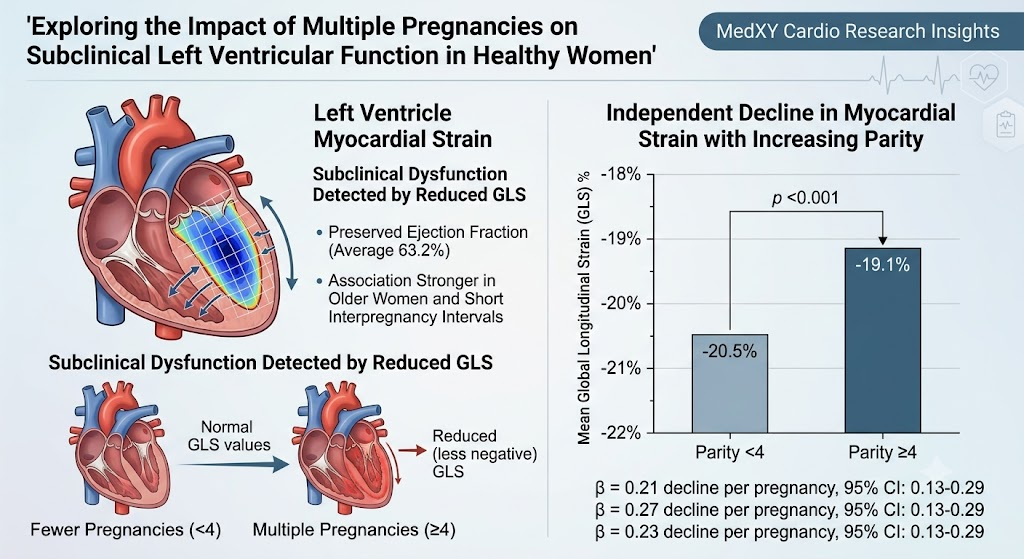
Highlight
• Higher parity correlates with subclinical left ventricular dysfunction detected by reduced global longitudinal strain (GLS) despite preserved ejection fraction.
• Each additional pregnancy leads to a measurable decline in myocardial strain independent of confounding factors.
• The association is stronger in older women and those with short interpregnancy intervals, indicating potential cumulative cardiovascular stress.
• GLS values remain within physiological pregnancy ranges, but the downward trend suggests long-term cardiac impact that requires further research.
Study Background
Pregnancy induces profound and complex cardiovascular adaptations to accommodate increased metabolic demands, including increased blood volume, cardiac output, and heart rate. While these changes are typically reversible postpartum in healthy women, repeated pregnancies might impose incremental stress on cardiac structure and function. Parity — the number of times a woman has given birth — has been implicated as a factor that could cumulatively affect cardiovascular health. Notably, subclinical myocardial changes may precede overt dysfunction, thereby offering an opportunity for early detection using sensitive imaging modalities such as advanced echocardiography with speckle-tracking-derived global longitudinal strain (GLS) analysis. However, the exact relationship between parity and subtle myocardial dysfunction during pregnancy remains poorly characterized, especially in healthy women without established cardiovascular disease or risk factors. Understanding this relationship carries clinical importance given the rising prevalence of high parity and the long-term cardiovascular risks associated with pregnancy-related cardiac remodeling.
Study Design
The present study was a prospective, cross-sectional investigation conducted on a cohort of 605 healthy pregnant women. Eligibility criteria excluded individuals with cardiovascular diseases or risk factors to isolate parity effects on cardiac function. Participants underwent comprehensive echocardiographic assessment, including speckle-tracking echocardiography to measure GLS during the third trimester, specifically between 28 and 32 weeks of gestation. Respondents were stratified into two groups: those with fewer than four pregnancies (<4) and those with four or more (≥4). Multivariable linear regression analyses were performed to examine the relationship between parity and GLS, adjusting for potential confounders including age, body mass index, and blood pressure. Additional subgroup analyses considered the influence of maternal age and interpregnancy intervals on myocardial strain.
Key Findings
The overall cohort had a mean age of 30.9 years and a mean parity of 3.8 pregnancies. Despite all women exhibiting preserved left ventricular ejection fractions averaging 63.2%, an incremental increase in parity was independently associated with a worsening GLS score — a 0.21-unit decline in strain per each additional pregnancy (β = 0.21, 95% CI: 0.13-0.29, p < 0.001). Comparatively, women with high parity (≥4 pregnancies) had significantly lower mean GLS values (-19.1% ± 2.5%) than those with fewer pregnancies (-20.5% ± 4.1%, p < 0.001), indicating a relative decrease in myocardial deformation despite preserved systolic function.
Multivariable regression confirmed that high parity remained an independent predictor of reduced GLS (β = 1.18, 95% CI: 0.52-1.84, p < 0.001) after adjustment. Notably, the effect size was more prominent among older women and those with interpregnancy intervals shorter than 18 months, suggesting that maternal age and rapid successive pregnancies might exacerbate subclinical myocardial strain reduction.
Importantly, while GLS values were decreased with parity, they remained within physiological ranges expected during pregnancy, underscoring subtle but not yet clinically overt myocardial impairment.
Expert Commentary
This study provides robust prospective evidence linking higher parity to measurable subclinical myocardial dysfunction during pregnancy, as captured by sensitive strain imaging techniques. The use of GLS as a quantitative marker of myocardial deformation offers enhanced sensitivity compared to conventional metrics like ejection fraction, which often remain normal until later stages of dysfunction.
The findings align with the hypothesis that repeated pregnancies impose cumulative hemodynamic stress on the maternal heart, potentially accelerating myocardial remodeling processes. The stronger association observed in women with shorter interpregnancy intervals supports the concept of insufficient cardiac recovery time between pregnancies as a mechanism exacerbating strain alterations.
Limitations include the cross-sectional design, which precludes causal inferences or assessment of long-term outcomes postpartum. Furthermore, the study focused on a healthy population, so results may differ in women with preexisting cardiovascular conditions or other comorbidities. Future longitudinal studies are warranted to determine whether parity-associated subclinical dysfunction translates into increased risk of clinical heart failure or cardiovascular morbidity later in life.
Conclusion
This study highlights an independent and continuous relationship between parity and reduced subclinical myocardial strain in otherwise healthy pregnant women, despite preserved conventional systolic measures. The observed GLS decline with increasing number of pregnancies, particularly in older women and those with brief intervals between pregnancies, underscores the importance of cardiovascular monitoring in multiparous populations. While current findings remain within normal pregnancy physiology, they suggest cumulative hemodynamic effects that merit further investigation to clarify their clinical significance and inform strategies to optimize maternal cardiovascular health.
Funding and Clinical Trials
The publication did not specify funding sources or registry information relevant to clinical trial registration.
References
1. Kümet Ö, Polat F, Uzaldı İ, Kaya AF, Ayhan G, Özbek E, Can V. Association Between Parity and Subclinical Left Ventricular Dysfunction in Healthy Pregnant Women: A Prospective Cross-Sectional Study. BJOG. 2026;133(9):1785-1794. PMID: 41889162.
2. Melchiorre K, Sharma R, Thilaganathan B. Cardiovascular implications in pregnancy. BJOG. 2014;121 Suppl 4:21-32.
3. Thilaganathan B, Kalafat E. Cardiovascular system in pregnancy. Circulation. 2019;139(8):829-836.
4. Kametas NA, Rodriguez A, Morales-Roselló J, et al. Effect of parity on cardiovascular changes during pregnancy: an echocardiographic study. Ultrasound Obstet Gynecol. 2017;49(4):501-507.
This article was created using several editorial tools, including AI, as part of the process. Human editors reviewed this content before publication.