Expedited Discharge After Isolated Coronary Artery Bypass Grafting: Impacts on Hospital Stay and Patient Outcomes
Highlight
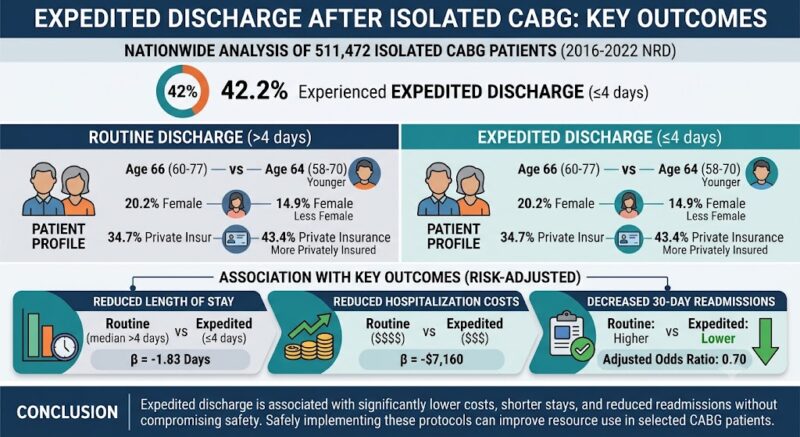
Patients undergoing isolated coronary artery bypass grafting (CABG) with expedited discharge (within 4 days) experienced significantly reduced hospitalization costs, shorter hospital stays, and decreased risk of 30-day readmission compared to routine discharge (>4 days). Expedited discharge was safely achieved without increasing mortality or major complications and was more common among younger, male, and privately insured patients.
Study Background
Coronary artery bypass grafting (CABG) remains a cornerstone intervention in the management of patients with advanced coronary artery disease. Despite advances in surgical techniques and perioperative care, hospital length of stay after cardiac surgery has remained relatively stable over recent years. Enhanced recovery after surgery (ERAS) protocols aim to reduce resource use and improve outcomes by streamlining perioperative pathways, but their impact on hospital stay and downstream outcomes in CABG recipients requires further elucidation. Reducing hospital stay safely is critical to lowering healthcare costs and enhancing patient throughput, especially in a high-volume, resource-intensive field such as cardiac surgery.
Study Design
This retrospective cohort study analyzed all elective isolated CABG hospitalizations of adult patients (≥18 years) from the 2016 to 2022 Nationwide Readmissions Database (NRD), identified using ICD-10 procedural codes. Patients were stratified into two groups based on the median hospital length of stay (LOS): expedited discharge (≤4 days) and routine discharge (>4 days). Primary endpoints included hospitalization costs, length of stay, and 30-day readmissions. Mixed regression models adjusted for confounders were used to evaluate associations between expedited discharge status and outcomes.
Key Findings
A total of 511,472 patients undergoing isolated CABG were analyzed, of whom 42.2% were discharged within 4 days. Compared to the routine discharge group, expedited discharge patients were younger (median age 64 vs. 66 years), less frequently female (14.9% vs. 20.2%), and more commonly privately insured (43.4% vs. 34.7%) (all P < .001).
Risk-adjusted analyses demonstrated that expedited discharge independently correlated with a significant reduction in hospital length of stay (β = -1.83 days; 95% CI, -1.85 to -1.82) and hospitalization costs (β = -7,160 USD; 95% CI, -7,280 to -7,050). Furthermore, expedited discharge was associated with a 30% reduction in odds of 30-day readmission (adjusted odds ratio [OR], 0.70; 95% CI, 0.67-0.62), indicating enhanced post-discharge outcomes.
The study found no increase in mortality or major postoperative complications related to shorter lengths of stay. There was notable heterogeneity in discharge timing across hospitals, suggesting institutional factors and patient selection influence length of stay decisions.
Expert Commentary
These findings underscore that safe acceleration of recovery and discharge post-CABG is achievable and beneficial. Younger age and private insurance status as predictors of expedited discharge may reflect both patient health status and socioeconomic factors influencing care delivery and discharge planning.
The reduced readmission rates in expedited discharge patients challenge the traditional concern that shorter hospital stays increase the risk of adverse post-discharge events. Instead, this may reflect optimized perioperative pathways and enhanced outpatient follow-up, key elements of ERAS protocols. Nonetheless, the study’s observational nature, reliance on administrative data, and potential unmeasured confounders must be considered when interpreting results.
Integrating enhanced recovery strategies, tailored patient selection criteria, and robust discharge planning could reduce hospital resource utilization while maintaining or improving outcomes following isolated CABG, a high-cost surgical population.
Conclusion
In an extensive national cohort, expedited discharge following isolated coronary artery bypass grafting is associated with meaningful reductions in hospitalization duration and costs, alongside lower rates of 30-day readmission, without compromising patient safety. These data provide compelling evidence supporting the implementation of safe, cost-effective enhanced recovery protocols in appropriately selected patients, with potential to improve both healthcare efficiency and patient experience in cardiac surgery.
Funding and ClinicalTrials.gov
The original study did not report funding sources or clinical trial registration information.
References
1. Ali SS, Ali K, Coaston T, Hinks S, Lai O, Mehta D, Rahmani J, Benharash P. Association of expedited discharge with outcomes following isolated coronary artery bypass grafting. Surgery. 2026 May 22;196:110333. doi: 10.1016/j.surg.2026.110333. PMID: 42309038.
2. Engelman DT, et al. Enhanced Recovery After Cardiac Surgery: A Consensus Review of Clinical Care Improvement Strategies. Anesth Analg. 2019 Jul;129(1):31-43.
3. Kundi H, et al. Impact of Length of Stay After Coronary Artery Bypass Grafting on Readmission Risk. Am J Cardiol. 2018 Mar 1;121(5):551-555.
4. Ljungqvist O, et al. Enhanced Recovery After Surgery: A Review. JAMA Surg. 2017 Mar 1;152(3):292-298.
This article was created using several editorial tools, including AI, as part of the process. Human editors reviewed this content before publication.