Expanding Horizons: Eligibility and Implications of Thrombolysis in Pediatric Acute Ischemic Stroke
Highlight
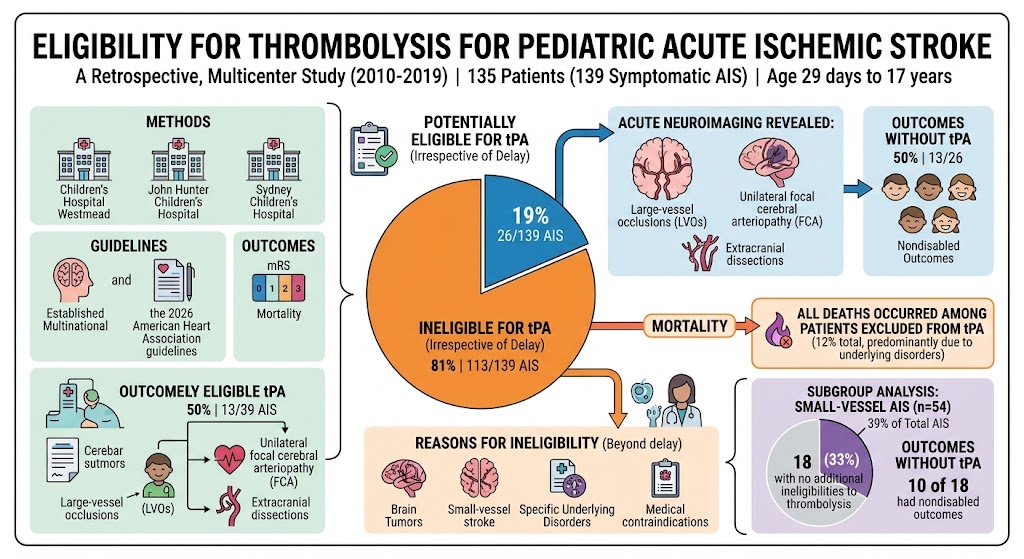
Thrombolysis using tissue-type plasminogen activator (tPA) is currently underutilized in pediatric acute ischemic stroke (AIS), with only 19% of cases potentially eligible under existing guidelines. Children with large-vessel occlusions, unilateral focal cerebral arteriopathy, or extracranial dissections represent the main eligible groups. Notably, a subset of small-vessel AIS patients might benefit from expanded thrombolytic indications, warranting future investigation.
Study Background
Acute ischemic stroke (AIS) in children is a significant but relatively rare clinical entity compared to adults, presenting unique diagnostic and therapeutic challenges. The established standard of care in adults—intravenous thrombolysis with tissue-type plasminogen activator (tPA)—has limited usage in children, partly due to scarcity of robust pediatric evidence and concerns about safety and efficacy. Moreover, diagnostic delays in pediatric AIS are common due to nonspecific symptomatology and lower clinical suspicion. Current pediatric guidelines on thrombolysis are evolving, including the 2026 American Heart Association (AHA) recommendations, yet eligibility criteria remain stringent.
This retrospective multicenter study across leading Australian children’s hospitals aimed to clarify the proportion of children with AIS who meet thrombolysis eligibility, explore reasons for exclusion beyond diagnostic delay, and assess long-term functional outcomes. Additionally, the study investigated the potential role of thrombolysis in subgroups traditionally excluded, like small-vessel AIS and AIS associated with brain tumors.
Study Design
The study implemented a retrospective, observational cohort design collecting data from three major pediatric centers—Children’s Hospital Westmead, John Hunter Children’s Hospital, and Sydney Children’s Hospital—over a 10-year period (2010–2019). Inclusion criteria were symptomatic AIS in children aged 29 days to 17 years, identified through medical records and diagnostic imaging.
Eligibility for thrombolysis with tPA was determined according to multinational criteria and the 2026 AHA guidelines, with careful documentation of reasons for ineligibility excluding diagnosis delay. Clinical endpoints included eligibility assessment, vascular imaging findings, reasons for exclusion, and long-term functional outcomes measured by the pediatric modified Rankin Scale (pmRS) over a mean follow-up of 43 months. Sub-analyses considered small-vessel AIS patients and those with underlying brain tumors, groups typically excluded from thrombolytic therapy.
Key Findings
A total of 135 children presenting with 139 symptomatic AIS episodes were analyzed; median age was 6 years, with a slight male predominance (64%). Emergency department presentation accounted for 73%, and mortality was 12% during follow-up.
Only 26 of 139 (19%) AIS cases met criteria for potential thrombolysis eligibility regardless of timing of diagnosis. These eligible cases predominantly had acute neuroimaging features of large-vessel occlusions, unilateral focal cerebral arteriopathy, or extracranial arterial dissections—vascular pathologies commonly amenable to reperfusion therapy. Importantly, half of these eligible patients (13/26) achieved nondisabled outcomes (pmRS ≤1) without thrombolytic treatment, suggesting variability in natural recovery.
The vast majority, 113 of 139 (81%), were ineligible for thrombolysis. Key exclusion factors included small-vessel disease, underlying structural brain lesions including tumors, hemorrhagic risk, and comorbid conditions. Notably, all deaths occurred in the ineligible group, primarily due to underlying conditions, underscoring the complexity of pediatric AIS populations.
Small-vessel AIS represented a substantial subgroup (54/139, 39%), with 33% of these lacking other exclusion criteria aside from vessel size. Among them, 10 children had favorable outcomes without thrombolysis, raising questions about potential benefits versus risks of extending tPA use in this subgroup.
Expert Commentary
These findings reinforce the limited but defined role of thrombolysis in pediatric AIS under current guidelines. The selective eligibility is consistent with adult stroke paradigms focusing on large-vessel occlusion amenable to timely reperfusion.
Clinical experts acknowledge the challenges in pediatric AIS diagnosis, including delayed recognition and variable presentations, which often contraindicate acute reperfusion therapy. This study’s long follow-up and robust characterization provide valuable insights for stroke teams striving to optimize pediatric stroke protocols.
Importantly, the potential reconsideration of thrombolysis in small-vessel AIS marks an area for future clinical trials. The biological plausibility arises from the recognition that some small-vessel strokes may share thrombotic mechanisms amenable to targeted intervention without excessive bleeding risk. However, caution remains warranted given the absence of randomized trials and concerns over hemorrhage.
Limitations include the retrospective design, potential selection biases, and imprecision in timing of symptom onset, which affects thrombolytic eligibility. Additionally, the study did not examine endovascular thrombectomy, an evolving therapy with growing evidence in pediatric large-vessel AIS.
Conclusions
In pediatric acute ischemic stroke, approximately one in five children is potentially eligible for thrombolysis based on current international and American Heart Association guidelines, regardless of diagnosis delay. Most eligible cases involve large-vessel occlusion or comparable arterial pathology. A sizable proportion of children with small-vessel disease currently excluded may represent a future indication for thrombolysis pending further investigation.
These results highlight the critical need for improved early recognition and vascular imaging acquisition to identify appropriate candidates rapidly. Moreover, pediatric stroke management strategies should consider broadening eligibility criteria guided by emerging evidence to optimize outcomes in this vulnerable population.
Funding and Trial Registration
The study was supported by institutional funding sources from participating hospitals. No specific clinical trial registration is reported.
References
- Briest RC, et al. Eligibility for Thrombolysis for Pediatric Acute Ischemic Stroke. Stroke. 2026 Aug 27. PMID: 42657473.
- Roach ES, et al. Management of stroke in infants and children: a scientific statement from the American Heart Association/American Stroke Association. Stroke. 2008;39(9):2644-2691.
- Mallick AA, et al. Presentation, Diagnosis, and Management of Ischemic Strokes in Children. Am J Med Genet C Semin Med Genet. 2017;175(2):286-295.
- Felling RJ, Jordan LC. Pediatric stroke: a review of risk factors, biological mechanisms, and treatment outcomes. Transl Stroke Res. 2019;10(3):293-312.
This article was created using several editorial tools, including AI, as part of the process. Human editors reviewed this content before publication.