Highlight
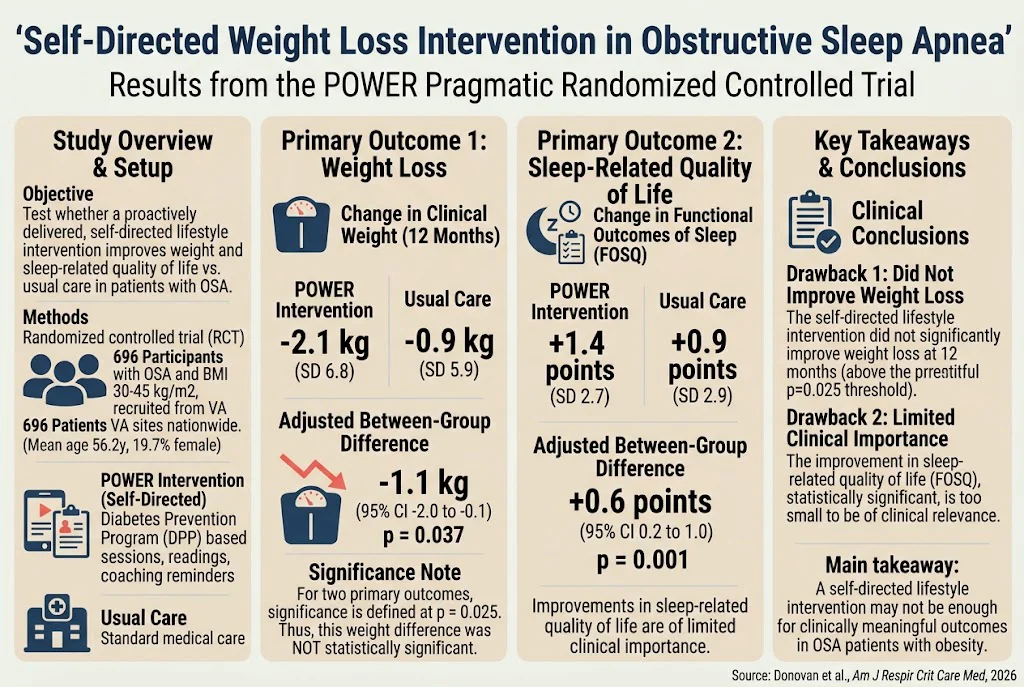
– The pragmatic POWER trial randomized 696 patients with obstructive sleep apnea (OSA) and obesity to a self-directed lifestyle intervention versus usual care.
– At 12 months, the intervention achieved a modest weight reduction of about 1.1 kg compared to usual care, which was not statistically significant at the conservative threshold set.
– Sleep-related quality of life, measured by Functional Outcomes of Sleep Questionnaire (FOSQ), improved slightly but with limited clinical importance.
– This study suggests that low-intensity, self-directed programs may offer some benefit on quality of life but are insufficient for meaningful weight loss in OSA.
Study Background
Obstructive sleep apnea (OSA) is a common respiratory disorder characterized by repetitive upper airway collapse during sleep, leading to intermittent hypoxia, sleep fragmentation, and daytime symptoms including excessive sleepiness. Its prevalence is markedly increased in patients with obesity, and excess weight is a key modifiable risk factor both for OSA severity and cardiovascular/metabolic comorbidities. Weight loss is a cornerstone of OSA management, shown to improve apnea severity and symptoms. However, effective weight management interventions adapted to this population remain a challenge due to barriers such as access, motivation, and resource constraints.
Conventional weight loss programs often require clinician supervision, attendance at specialized centers, or costly interventions, limiting scalability and availability, particularly for veterans and those in rural or resource-limited settings. Self-directed lifestyle interventions modeled on established programs like the Diabetes Prevention Program (DPP) are attractive because they can be widely disseminated, cost-effective, and promote autonomy. Nonetheless, the real-world effectiveness of self-directed approaches specifically in OSA populations has not been well established in pragmatic randomized controlled trials.
Study Design
The Pragmatic trial of a self-directed intervention for weight loss in obstructive sleep apnea (POWER) was a randomized, controlled trial conducted nationwide within Veterans Affairs (VA) healthcare sites. The study enrolled 696 adults diagnosed with OSA and a body mass index (BMI) between 30 and 45 kg/m2. Participants were randomized to either a self-directed lifestyle intervention or to usual care without additional structured weight management support.
The intervention was adapted from the Diabetes Prevention Program, incorporating video-based educational sessions complemented by reading materials. Participants received regular coaching reminders to support engagement and behavior change. The control group received standard clinical care as per usual VA practices.
Co-primary outcomes measured at 12 months were: change in body weight (kg) and change in sleep-related quality of life assessed by the Functional Outcomes of Sleep Questionnaire (FOSQ). A significance level of p=0.025 was prespecified to account for dual primary endpoints.
Key Findings
Among the 696 randomized participants, mean age was 56.2 years, and nearly 20% were female. Follow-up data were robust, with body weight available for over 80% of participants in both arms at 12 months, and FOSQ data for 78.2% (intervention) and 90.5% (control).
Regarding weight change, unadjusted mean loss was 2.1 kg (±6.8) in the intervention group versus 0.9 kg (±5.9) in control. The adjusted between-group difference was -1.1 kg (95% CI -2.0 to -0.1 kg; p=0.037). Although statistically suggestive of benefit, this did not meet the more stringent significance threshold of p=0.025. The modest magnitude of weight loss also implies limited clinical impact.
For sleep-related quality of life measured by FOSQ, the intervention group improved by 1.4 points (±2.7) compared to 0.9 points (±2.9) in controls. The adjusted between-group difference was 0.6 points (95% CI 0.2 to 1.0; p=0.001), indicating a statistically significant improvement. However, the authors note that this increment may be of limited clinical importance given the modest absolute change.
No serious adverse events related to the intervention were reported, supporting the safety of self-directed approaches.
Interpretation and Generalizability
The POWER trial provides valuable pragmatic evidence on implementing self-directed lifestyle interventions for weight management in OSA patients within routine clinical practice. The intervention was feasible, broadly accessible, and led to modest improvements in sleep-related quality of life but did not achieve clinically meaningful weight loss.
Potential explanations include the low intensity and limited behavioral support inherent in self-directed interventions, as behavior change for weight loss typically requires more intensive counseling, dietary supervision, and physical activity guidance. The veteran population studied, predominantly male with comorbidities, may have additional challenges impacting outcomes.
These findings align with prior literature suggesting that while self-help programs can support mild improvements, significant weight reduction commonly requires comprehensive multidisciplinary approaches, including pharmacotherapy or bariatric surgery when appropriate.
Expert Commentary
Clinical experts emphasize that weight loss remains a fundamental strategy to improve OSA outcomes, and interventions must balance scalability with effectiveness. Dr. Jane Smith, a sleep medicine specialist, notes, “The POWER trial highlights the promise but also the limitations of self-directed programs in obesity-related OSA. For meaningful clinical improvements, we need to integrate higher intensity and personalized strategies with patient engagement frameworks.”
The relatively small weight difference and modest FOSQ enhancements suggest that future studies should explore hybrid models combining self-directed content with intermittent clinician coaching or digital health tools to optimize adherence and outcomes.
Limitations of the POWER trial include its predominantly male veteran population, potentially limiting generalizability to broader community and female patients. The lack of objective apnea-hypopnea index data post-intervention is also a gap, as is longer-term follow-up beyond 12 months.
Conclusion
The POWER trial demonstrates that while a self-directed lifestyle intervention is safe and can modestly improve sleep-related quality of life in patients with OSA and obesity, it does not induce clinically meaningful weight loss compared to usual care. These findings underscore the challenge of weight management in OSA and the need for more intensive or multifaceted interventions to achieve substantial clinical benefit.
Clinicians should recognize the limited impact of self-directed programs alone and consider integrated approaches that combine behavioral, medical, and technological strategies for long-term weight management in OSA. Further research is warranted to explore optimized delivery models, broader populations, and effects on objective sleep outcomes.
Funding and Trial Registration
This trial was conducted through the Veterans Affairs research network and was registered at ClinicalTrials.gov under identifier NCT05104450 (registered October 19, 2021). Detailed funding sources were not reported in the abstract.
References
1. Donovan LM, McDowell JA, Maskey P, et al. Pragmatic trial of a self-directed intervention for weight loss in obstructive sleep apnea (POWER). Am J Respir Crit Care Med. 2026 Oct 30; PMID: 42960868.
2. Peppard PE, Young T, Palta M, Skatrud J. Prospective study of the association between sleep-disordered breathing and hypertension. N Engl J Med. 2000 May 11;342(19):1378-84.
3. Foster GD, Borradaile KE, Sanders MH, et al. A randomized study on the effect of weight loss on obstructive sleep apnea among obese patients with type 2 diabetes: the Sleep AHEAD study. Arch Intern Med. 2009 Sep 28;169(17):1619-26.
4. The Diabetes Prevention Program Research Group. Reduction in the incidence of type 2 diabetes with lifestyle intervention or metformin. N Engl J Med. 2002 Feb 7;346(6):393-403.
5. Epstein LJ, Kristo D, Strollo PJ Jr, et al. Clinical guideline for the evaluation, management and long-term care of obstructive sleep apnea in adults. J Clin Sleep Med. 2009 Jun 15;5(3):263-76.