Evaluating Pemetrexed Monotherapy and Combination Therapy with Carboplatin in Advanced Thyroid Cancer: A Retrospective Cohort Analysis
Highlight
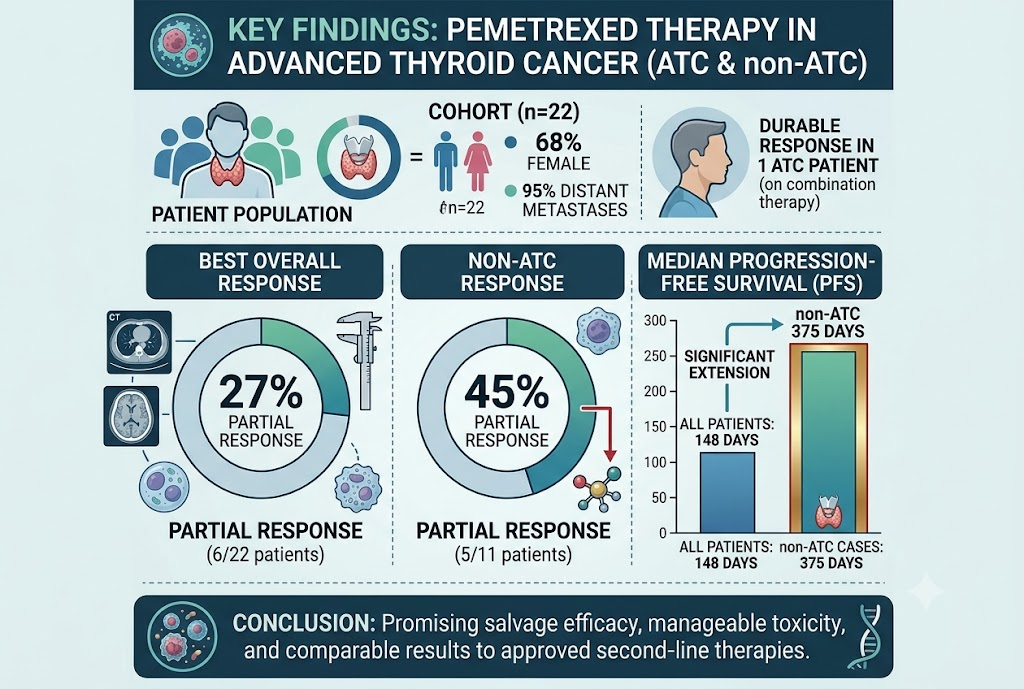
This retrospective cohort study from Memorial Sloan Kettering Cancer Center investigates the use of pemetrexed, alone or with carboplatin, as salvage treatment in advanced radioiodine-refractory differentiated and anaplastic thyroid cancer (ATC). Results show partial response in 27% of patients overall and longer progression-free survival in non-anaplastic thyroid cancer, supporting comparable efficacy to approved second-line therapies.
Study Background
Advanced thyroid cancer, particularly radioiodine-refractory differentiated thyroid cancer (DTC) and anaplastic thyroid cancer (ATC), is associated with significant morbidity and mortality due to limited effective treatment options. Radioiodine refractoriness and aggressive histology limit the efficacy of standard therapies, necessitating new salvage treatment strategies. While multiple second-line systemic therapies have been incorporated into clinical guidelines, their utility is often hindered by toxicity and development of resistance, underscoring a need for additional treatment options with manageable safety profiles.
Study Design
This retrospective cohort study examined 22 patients with advanced thyroid cancer treated at Memorial Sloan Kettering Cancer Center between December 2023 and December 2025, including 11 patients with ATC. Eligible patients had radioiodine-refractory disease and had progressed on at least three prior therapy lines, receiving pemetrexed as monotherapy or combined with carboplatin as a fourth-line or later salvage treatment. The primary endpoint was best overall response assessed by standard radiographic criteria. Secondary endpoints included progression-free survival (PFS) and disease-specific survival (DSS). Baseline demographic and clinical features, prior treatments, and treatment duration were assessed.
Key Findings
The cohort was predominantly female (68%) with 95% having distant metastatic disease. The median interval from initial therapy to pemetrexed initiation was approximately 73 months. Patients underwent therapy for a median duration of around 5 months. Partial responses (PR) were observed in 6 of 22 patients (27%) overall, with a notably higher response rate of 45% (5 of 11) in non-ATC patients. The median progression-free survival was 148 days across all patients and significantly extended to 375 days in non-ATC cases. One ATC patient demonstrated durable partial response on combination therapy.
Tolerability of pemetrexed, alone or with carboplatin, was consistent with known safety profiles, with no unexpected adverse events reported. The treatment provided a clinical benefit in a heavily pretreated population with limited options, highlighting its potential as an effective salvage therapy.
Expert Commentary
This study provides a noteworthy look into pemetrexed-based therapy as a salvage option in advanced thyroid cancers refractory to conventional treatments. The partial response rates and progression-free intervals observed correspond favorably with outcomes reported for FDA-approved second-line agents such as tyrosine kinase inhibitors and immune checkpoint inhibitors. The retrospective design and small sample size limit wide generalizability, but these findings justify prospective phase II/III trials to robustly evaluate efficacy, optimize treatment regimens, and define patient subsets most likely to benefit.
Mechanistically, pemetrexed targets folate-dependent enzymes crucial for DNA synthesis, offering a distinct therapeutic approach compared to currently used molecular targeted agents. The combination with carboplatin, a platinum-based chemotherapy with DNA cross-linking activity, may synergistically enhance antitumor effects in aggressive thyroid cancer histologies.
Conclusion
Pemetrexed, as monotherapy or combined with carboplatin, demonstrates promising efficacy and manageable toxicity in advanced, heavily pretreated thyroid cancer, including both differentiated and anaplastic subtypes. Its comparable activity to existing second-line therapies and tolerable safety profile support further prospective clinical evaluation. These findings underline the importance of expanding salvage treatment options to improve outcomes for patients facing advanced thyroid cancer refractory to current therapies.
Funding and Clinical Trial Registration
The study was conducted at Memorial Sloan Kettering Cancer Center without specific funding disclosed. Prospective studies are warranted to confirm these results.
References
1. Boucai L, Fano R, Sherman EJ, Wong W, Ho AL. The Treatment of Advanced Thyroid Cancer Using Pemetrexed Monotherapy or with Platinum-Based Chemotherapy. Thyroid. 2026 Jul 29; [Epub ahead of print]. PMID: 42524888.
2. Cabanillas ME, Ryder M, Jimenez C. Targeted Therapy for Advanced Thyroid Cancer: Kinase Inhibitors and Beyond. Endocrine-Related Cancer. 2019;26(5):R209-R233.
3. Subbiah V, Kreitman RJ, Wainberg ZA, et al. Dabrafenib plus Trametinib in Patients with BRAF(V600E)-Mutated Anaplastic Thyroid Cancer. Journal of Clinical Oncology. 2018;36(1):7-13.
4. Brose MS, Nutting CM, Jarzab B, et al. Sorafenib in Radioactive Iodine-Refractory, Locally Advanced or Metastatic Differentiated Thyroid Cancer: A Randomised, Double-Blind, Phase 3 Trial. Lancet. 2014;384(9940):319-328.
This article was created using several editorial tools, including AI, as part of the process. Human editors reviewed this content before publication.