Enhancing Sexual and Pelvic Health in Women: Efficacy of Scheduled Vibrator Use in a Randomized Controlled Trial
Highlight
– Scheduled use of a U.S. FDA-approved vibrator plus educational handout markedly improves sexual function over education alone in women with sexual dysfunction and pelvic floor disorders.
– Significant improvements were observed in arousal, lubrication, orgasm, satisfaction, and pain domains of the Female Sexual Function Index.
– A greater proportion of women using vibrators achieved normalized sexual function scores.
– Vibrator use may also alleviate urinary distress symptoms associated with pelvic floor disorders.
Study Background
Sexual dysfunction and pelvic floor disorders (PFDs) represent significant health burdens for women, often causing distress and impaired quality of life. These disorders can encompass urinary incontinence, pelvic organ prolapse, and pain during intercourse, with complex physiological and psychological interplays. Traditional treatments involve pelvic floor physical therapy, medications, and counseling but often have limited efficacy or accessibility barriers. Adjunctive approaches, including vibrational therapy, have been proposed to stimulate neural pathways, enhance pelvic floor muscle function, and improve sexual response; however, robust evidence from randomized controlled trials has been sparse.
Study Design
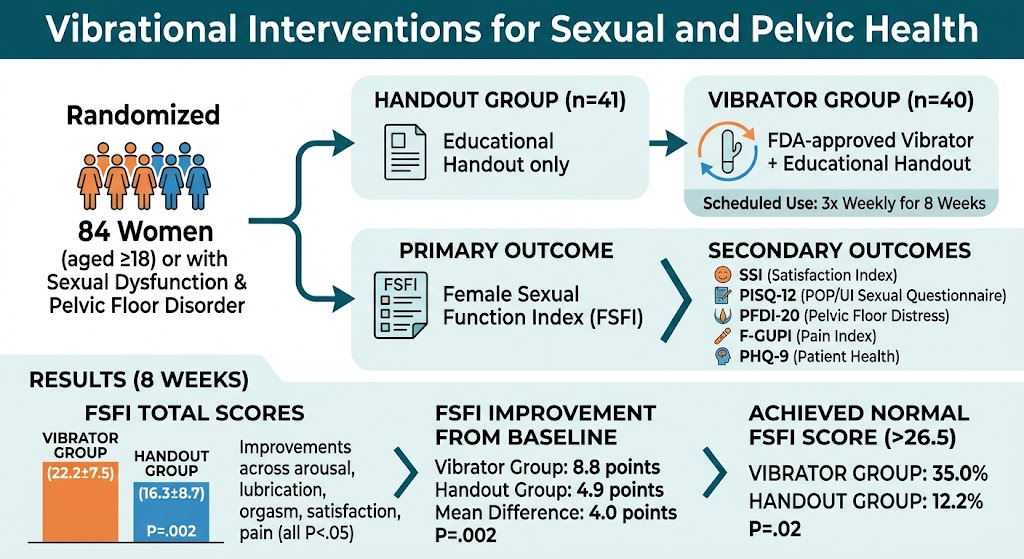
This randomized controlled trial was conducted at a single tertiary referral center in the United States, enrolling women aged 18 years or older diagnosed with sexual dysfunction and pelvic floor disorders between November 2024 and April 2025. Eighty-four participants were randomized into two groups: the vibrator group received a U.S. Food and Drug Administration–approved vibrator along with an educational handout, instructed to use the vibrator three times weekly for eight weeks; the handout group received the educational handout alone without any vibrational device.
The primary efficacy endpoint was sexual function as measured by the Female Sexual Function Index (FSFI). Secondary endpoints included sexual satisfaction (SSI), pelvic organ prolapse/urinary incontinence sexual function (PISQ-12), pelvic floor distress (PFDI-20), female genitourinary pain (F-GUPI), and depressive symptoms (PHQ-9).
Key Findings
Of the 84 participants randomized, 81 completed the study, with mean age 57.9±14.1 years. Baseline characteristics were comparable between groups. At the 8-week evaluation, the vibrator group demonstrated significantly higher FSFI total scores (22.2±7.5) compared with the handout group (16.3±8.7), with a P value of .002 indicating statistical significance.
The vibrator group showed meaningful improvements across multiple FSFI domains: arousal, lubrication, orgasm, satisfaction, and pain (all P<.05). The mean improvement in FSFI score from baseline was 8.8 points in the vibrator group versus 4.9 points in the handout group, with a mean difference of 4.0 points (P=.002), suggesting a clinically relevant benefit.
Importantly, 35.0% of women in the vibrator group achieved normalized FSFI scores exceeding 26.5 compared to only 12.2% in the handout group (P=.02), highlighting the potential for vibrator therapy to restore normal sexual function in a substantial subset of women.
Secondary measures indicated trends toward improvement in urinary distress symptoms among vibrator users, although detailed statistics on these outcomes were not highlighted in the abstract. Depression scores (PHQ-9) and genitourinary pain indices also followed similar improvement patterns pertinent to overall quality of life enhancements.
The interventions were well tolerated with no reported adverse events related to vibrator use, supporting the safety and feasibility of this approach.
Expert Commentary
This rigorously designed randomized trial provides strong evidence supporting the incorporation of scheduled vibrator therapy into comprehensive management plans for women suffering from sexual dysfunction complicated by pelvic floor disorders. The FDA approval status of the device used adds credibility and potential for broad clinical adoption.
The multidomain improvements observed suggest that vibrational stimulation may enhance neurovascular engagement and pelvic floor muscle function, thereby addressing both physiological and sensory components of sexual dysfunction. Furthermore, the noted reduction in urinary distress symptoms raises exciting possibilities for multifaceted therapeutic impact.
However, generalizability may be constrained by the single-site design, and longer-term outcomes beyond eight weeks remain unclear. Future multicenter trials would be valuable to confirm these findings and investigate durability of benefit. Moreover, mechanistic studies to elucidate biological underpinnings of vibrational effects on pelvic floor musculature and neural pathways could deepen therapeutic insights.
Conclusion
For women with coexisting sexual dysfunction and pelvic floor disorders, combining scheduled vibrator use with educational support significantly enhances sexual function compared with education alone. This intervention holds promise as an accessible, non-invasive adjunct that may also alleviate urinary distress symptoms, thereby potentially improving holistic pelvic health and quality of life. Integration of vibrational therapy into clinical practice and guidelines should be considered, with further research warranted to optimize protocols and expand understanding.
Funding and Clinical Trial Registration
The clinical trial was registered on ClinicalTrials.gov under identifier NCT06677541. Funding sources are not explicitly detailed in the abstract but can be found in the original publication.
References
Roberts BL, Rogers RG, Leong KA, Carlton CE, Grimes CL, Jacobs BE, Dahl JA, Deverdis EC. Vibrational Interventions for Sexual and Pelvic Health: A Randomized Controlled Trial. Obstetrics and Gynecology. 2026 Aug 27. PMID: 42671435. Available from: https://pubmed.ncbi.nlm.nih.gov/42671435/
This article was created using several editorial tools, including AI, as part of the process. Human editors reviewed this content before publication.