Highlight
Use of autologous anterior lens capsule as an intrascleral spacer during deep sclerectomy combined with phacoemulsification (PE-DS) significantly lowers intraocular pressure (IOP) at 6 and 12 months postoperatively.
The spacer group demonstrated higher cumulative surgical success under stringent IOP thresholds compared to controls without the spacer.
Medication usage was reduced in the spacer group, reflecting improved pressure control, although this trend did not reach robust statistical significance.
The autologous nature of the anterior lens capsule offers a biocompatible and cost-effective alternative spacer in glaucoma filtration surgery.
Study Background
Glaucoma is a leading cause of irreversible blindness worldwide, characterized primarily by elevated intraocular pressure (IOP) causing progressive optic neuropathy. Medically uncontrolled glaucoma frequently necessitates surgical intervention to prevent further vision loss. Deep sclerectomy (DS) is a non-penetrating glaucoma surgery designed to enhance aqueous humor outflow while minimizing intraoperative and postoperative complications compared with traditional trabeculectomy. Phacoemulsification (PE) is commonly combined with DS in patients with coexisting visually significant cataracts, offering simultaneous management.
Despite its advantages, DS may be limited by fibrosis or collapse of the intrascleral space, leading to suboptimal pressure control. Spacers have been introduced to maintain this space and ensure sustained aqueous filtration. However, synthetic spacers can incur risks of foreign body reaction and increased cost. The use of an autologous anterior lens capsule, harvested during the cataract extraction, as an intrascleral spacer represents a novel biofriendly and potentially safer alternative.
Study Design
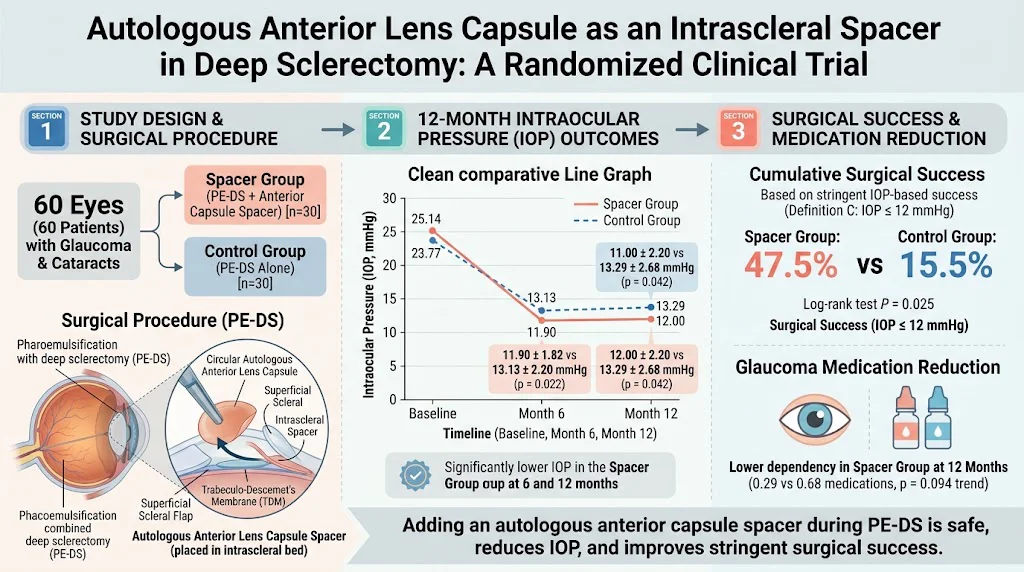
This prospective, randomized, parallel-group clinical trial enrolled 60 adult eyes from patients with medically uncontrolled glaucoma and visually significant cataracts. Participants were randomly allocated to undergo combined phacoemulsification and deep sclerectomy with either insertion of an autologous anterior lens capsule spacer (Spacer group) or no spacer (Control group).
The inclusion of only one eye per patient eliminated inter-eye correlation bias. Follow-up was conducted for at least 12 months post-surgery. The primary endpoint was the change in IOP from baseline through 12 months. Secondary endpoints involved glaucoma medication usage, surgical success based on predefined IOP criteria, and adverse event rates.
Key Findings
Baseline demographic and clinical characteristics were balanced between groups, with mean IOPs of approximately 25.1 mmHg in the spacer group and 23.8 mmHg in controls (P nonsignificant).
Both groups exhibited significant IOP reduction at all postoperative visits compared to baseline. However, the spacer group achieved significantly lower mean IOP values at 6 months (11.90 ± 1.82 mmHg vs. 13.13 ± 2.20 mmHg; P = 0.022) and 12 months (12.00 ± 2.20 mmHg vs. 13.29 ± 2.68 mmHg; P = 0.042).
Medication use tended to be lower in the spacer group at both 6 months (0.14 ± 0.45 vs. 0.48 ± 0.85; P = 0.063) and 12 months (0.29 ± 0.66 vs. 0.68 ± 1.04; P = 0.094), though these differences approached but did not reach conventional statistical significance.
Under stringent success definitions (e.g., IOP ≤ 12 mmHg without additional filtering surgery), the spacer group showed superior cumulative success rates (47.5% vs. 15.5%, log-rank test P = 0.025), reflecting enhanced durability of surgical outcomes.
Both groups had a comparable safety profile with no significant differences in adverse events, underscoring the procedure’s relative safety.
Expert Commentary
The innovative utilization of the autologous anterior lens capsule as an intrascleral spacer is notable for leveraging tissue readily available during combined cataract surgery without incurring foreign material risks. The lens capsule’s biocompatibility and mechanical properties may favor maintenance of the filtration space and prevent tissue collapse, thereby optimizing aqueous outflow and IOP control.
While the observed statistically significant IOP reductions at mid- and long-term follow-up are clinically meaningful, the near-significant reduction in medication use motivates further larger studies to robustly confirm these trends. Moreover, the enhanced surgical success under stringent IOP thresholds is particularly relevant for glaucoma patients requiring low target pressures to prevent progression.
Limitations include the single-center design and modest sample size, which may limit generalizability. Additionally, longer follow-up is needed to confirm sustained benefits and to monitor late complications. Future comparative studies against other spacer materials may delineate relative advantages more clearly.
Conclusion
This randomized clinical trial provides compelling evidence that incorporating an autologous anterior lens capsule as an intrascleral spacer during deep sclerectomy combined with phacoemulsification improves IOP control and surgical success in patients with medically uncontrolled glaucoma and cataracts. This technique represents a promising, cost-effective, and biocompatible approach to enhance filtration surgery outcomes, potentially reducing dependence on IOP-lowering medications.
These findings have broad clinical implications, encouraging ophthalmic surgeons to consider autologous tissues as innovative adjuncts in glaucoma surgery. Further multicenter trials with extended follow-up are warranted to consolidate these results and inform clinical guidelines.
Funding and Clinical Trials Registration
The study was supported by institutional grants from the participating ophthalmology departments. The clinical trial registration number is not specified in the provided data.
References
1. Einollahi N, Doozandeh A, Rezaei J, et al. Autologous Anterior Lens Capsule as an Intrascleral Spacer in Deep Sclerectomy: A Randomized Clinical Trial. Am J Ophthalmol. 2026 Oct 27;PMID: 42946033.
2. Shaarawy T, Sherwood MB, Grehn F, editors. Guidelines on Design and Reporting of Glaucoma Surgical Trials. Kugler Publications; 2009.
3. Rossetti L, Comes N, Rulli E, et al. Deep sclerectomy with collagen implant versus trabeculectomy: five-year results. Ophthalmology. 2008;115(10):1827-1833.
4. Ammar DA, Kahook MY, Feldman RM. The use of exogenous implants during nonpenetrating glaucoma surgery. Ophthalmol Clin North Am. 2005;18(3):357-66.