Efficacy and Outcomes of Short-Course Perioperative Antiviral Prophylaxis in Hepatitis C Viremic Donor Kidney Transplantation
Highlight
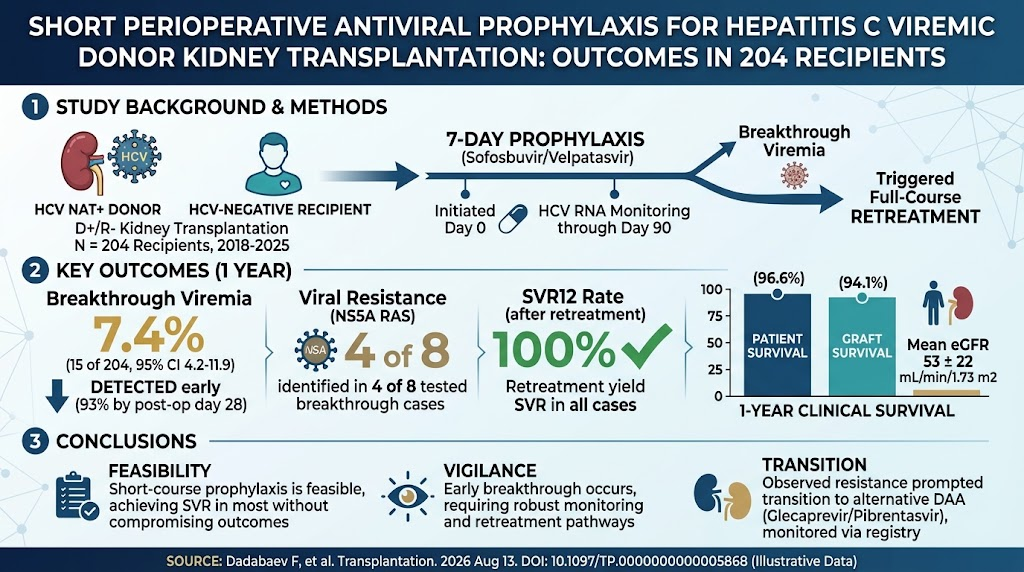
This study reports the largest cohort of hepatitis C nucleic acid test-positive donor to hepatitis C-negative recipient (D+/R-) kidney transplants managed with a 7-day perioperative direct-acting antiviral (DAA) prophylaxis, achieving virologic cure in over 92% after prophylaxis alone.
Breakthrough viremia occurred in 7.4% of recipients, most detected by postoperative day 28, with resistance-associated substitutions identified in some cases, prompting successful first-line retreatment.
One-year patient and graft survival rates were high (96.6% and 94.1%, respectively), with stable graft function demonstrating clinical safety and efficacy of this short-course antiviral strategy.
Study Background
Kidney transplantation remains the preferred treatment for end-stage renal disease (ESRD), but organ shortages limit availability. Utilizing hepatitis C virus (HCV) viremic donors for HCV-negative recipients (D+/R-) has become increasingly feasible due to the advent of highly effective direct-acting antivirals (DAAs). This strategy expands the donor pool but raises concerns about transmission and management of donor-derived HCV infection.
Though full-course posttransplant antiviral therapy has shown excellent outcomes, short-course perioperative prophylaxis represents a potentially cost-effective and logistically simpler approach. However, real-world data on outcomes with short-course (7-day) antiviral prophylaxis remains limited.
Study Design
This investigation was a single-center, prospective observational cohort study involving 204 consecutive kidney transplant recipients from HCV nucleic acid test-positive donors to HCV-negative recipients performed between December 2018 and August 2025.
All recipients received a 7-day course of sofosbuvir/velpatasvir (400 mg/100 mg daily) initiated on the day of transplantation. Serial monitoring for HCV RNA was conducted through 90 days posttransplant. Patients with breakthrough viremia—defined as detectable HCV RNA after prophylaxis initiation—were treated with full-course DAA therapy according to resistance testing when available.
Endpoints included the rate of breakthrough viremia, sustained virologic response at 12 weeks (SVR12) following prophylaxis or retreatment, and one-year patient and graft survival with assessment of renal function.
Key Findings
Out of 204 recipients, 15 (7.4%; 95% confidence interval 4.2%-11.9%) developed donor-derived breakthrough viremia. The majority (93.3%) of cases were identified by postoperative day 28, suggesting early viral replication despite short prophylaxis.
Resistance-associated substitutions specifically in the nonstructural protein 5A (NS5A) region were detected in 4 of 8 tested breakthrough cases, indicating some viral resistance that may compromise prophylaxis efficacy.
Among those with breakthrough infections, first-line full-course retreatment with DAAs yielded SVR12 in 14 of 15 patients (93.3%). One patient required additional salvage antiviral therapy but ultimately achieved SVR12, resulting in an overall cure rate of 100% in treated breakthrough cases.
Notably, initiation of retreatment was delayed by insurance prior authorization in 93% of patients, with a median wait of 36 days, highlighting potential barriers to timely antiviral therapy posttransplant.
One-year patient survival was 96.6%, and graft survival was 94.1%, with stable renal function throughout (mean estimated glomerular filtration rate 53.0 ± 22.0 mL/min/1.73 m2). No significant adverse safety signals were noted related to the prophylaxis or transplantation procedure.
Expert Commentary
This study provides robust, real-world evidence supporting the feasibility and efficacy of a short 7-day perioperative antiviral prophylaxis strategy to mitigate HCV transmission in kidney transplantation from viremic donors to naïve recipients. The high rate of SVR following prophylaxis alone in most patients demonstrates that viral infection can be effectively prevented or controlled with early intervention.
However, the occurrence of breakthrough viremia and the presence of NS5A resistance-associated substitutions underscore the importance of vigilant viral monitoring and accessible retreatment pathways. The observed delays due to insurance prior authorization emphasize systemic challenges that may impact timely patient care.
Given the resistance patterns observed, the investigators have prudently transitioned to a 7-day glecaprevir/pibrentasvir regimen, which may offer improved resistance coverage. The ongoing REFORM-HEPC registry will provide further data on the comparative efficacy and safety of alternative prophylactic regimens.
While the study’s single-center design may limit broad generalizability, its prospective nature and large cohort size strengthen the validity of its findings. Future multicenter randomized studies could more definitively establish optimal prophylaxis duration and regimens.
Conclusion
Short-course, 7-day perioperative antiviral prophylaxis with sofosbuvir/velpatasvir in HCV viremic donor kidney transplantation is a viable and effective strategy, achieving viral cure in the majority of recipients without compromising patient or graft outcomes at one year.
Breakthrough infections remain manageable through timely full-course antiviral retreatment but highlight the necessity of ongoing monitoring and rapid access to therapy. Transition to alternative DAA combinations targeting potential resistance mutations may further optimize outcomes.
These real-world data contribute to evolving clinical practices that expand the kidney donor pool safely while maintaining favorable transplant outcomes.
Funding and ClinicalTrials.gov
Details on study funding and clinical trial registration were not provided in the source abstract. Further information may be available from the corresponding publication or institution.
References
1. Dadabaev F, Yakubu I, Agegnehu B, et al. Short Perioperative Antiviral Prophylaxis for Hepatitis C Viremic Donor Kidney Transplantation: Outcomes in 204 Recipients. Transplantation. 2026 Aug 13. PMID: 42587362.
2. Saxena V, et al. Kidney transplantation from hepatitis C viremic donors into negative recipients: a systematic review. Transpl Infect Dis. 2020;22(1):e13293.
3. Levitsky J, et al. Use of HCV-infected donors in solid organ transplantation: expanding the donor pool with direct-acting antivirals. Am J Transplant. 2017;17(9):2531-2539.
This article was created using several editorial tools, including AI, as part of the process. Human editors reviewed this content before publication.