Dynamic Metabolic Profiling in Chronic Heart Failure: Insights from Serial NMR Biomarkers and Risk Prediction
Highlight
- Serial measurements of 45 metabolic biomarkers via nuclear magnetic resonance (NMR) were analyzed longitudinally in two independent cohorts of patients with chronic heart failure (HF).
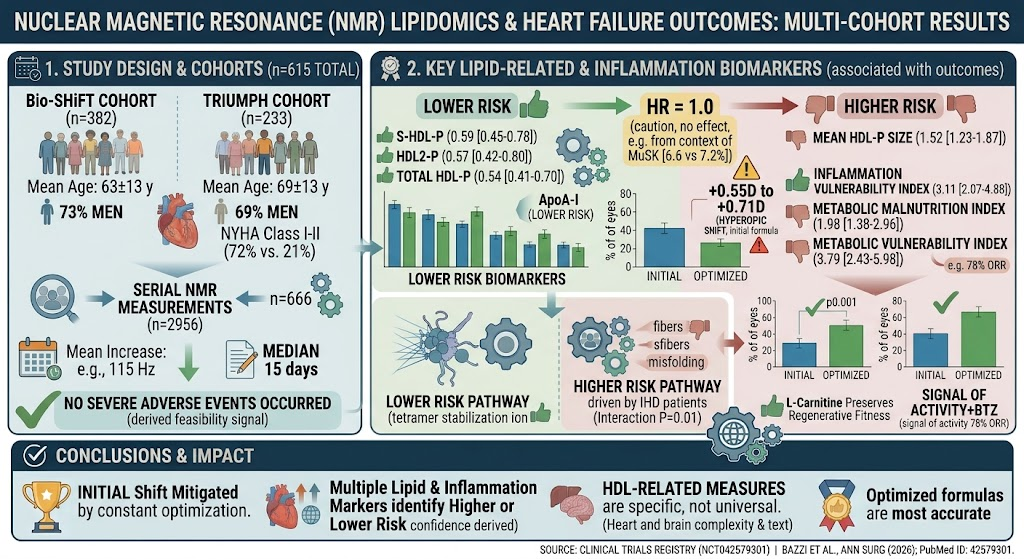
- Higher levels of specific high-density lipoprotein (HDL) particles were associated with reduced risk of HF hospitalization, advanced HF therapy, or cardiovascular death, while larger HDL particle size was linked to increased risk.
- Elevated triglyceride-rich lipoprotein particles and apolipoprotein A-I (ApoA-I) surprisingly correlated with lower adverse event rates, challenging traditional lipid risk paradigms in HF.
- Inflammation and metabolic dysregulation biomarkers, including inflammation vulnerability index and metabolic vulnerability indices, were strong predictors of poor outcomes, underscoring systemic metabolic derangements in HF progression.
Study Background
Chronic heart failure remains a leading cause of morbidity and mortality worldwide, with complex underlying pathophysiology involving not only hemodynamic impairment but also extensive metabolic and lipid disturbances. Prior research has established associations between static lipid and metabolic profiles and adverse prognosis in stable HF populations. Nonetheless, the dynamic changes in metabolic biomarkers over time and their prognostic implications have been less well characterized. Understanding how serially measured metabolic biomarkers correlate with clinical outcomes could augment precision in risk stratification and open avenues for targeted therapeutic interventions aimed at modulating metabolism and inflammation in HF.
Study Design
This robust longitudinal investigation involved two independent cohorts: Bio-SHiFT (n=382) and TRIUMPH (n=233), encompassing adult patients with chronic stable heart failure. Serial plasma samples were collected prospectively and analyzed using nuclear magnetic resonance spectroscopy to quantify a panel of 45 metabolic biomarkers, including lipoprotein particle concentrations, sizes, standard lipid components, and indices reflective of inflammation and metabolic vulnerability.
The primary composite endpoint in each cohort comprised hospitalization due to HF exacerbation, initiation of advanced HF therapies (such as ventricular assist devices or transplant), or cardiovascular death. Statistical evaluation employed joint models that integrate linear mixed-effects models for repeated biomarker measures with Cox proportional hazards models for time-to-event analysis, allowing assessment of the association between current biomarker levels and adverse outcomes while adjusting for established clinical covariates.
Key Findings
The Bio-SHiFT cohort provided 2956 serial NMR measurements across participants with a mean age of 63 years and mostly mild-to-moderate HF (72% NYHA class I-II). The TRIUMPH cohort, older on average (mean age 69), contributed 666 measurements with a lower proportion of mild HF.
Major lipid-related findings consistent across both cohorts included:
– Higher circulating concentrations of small HDL particles, HDL subclass 2 particles, and total HDL particle count were independently associated with significantly lower risk of the composite endpoint (hazard ratios ranging from 0.54 to 0.59 per standard deviation increase in natural log-transformed biomarkers).
– Conversely, increased mean HDL particle size portended higher risk, a finding that challenges traditional assumptions linking larger HDL size with cardiovascular benefit.
– Unexpectedly, elevated levels of medium triglyceride-rich lipoprotein particles, total triglycerides, triglyceride-rich lipoprotein cholesterol, total triglycerides within these particles, and apolipoprotein A-I were associated with reduced adverse event risk. This suggests altered lipoprotein functionality or energy substrate utilization in chronic HF may play a complex role in patient outcomes.
Beyond lipids, biomarkers indicative of systemic inflammation and metabolic distress demonstrated strong predictive capacity:
– Higher inflammation vulnerability index was related to a more than threefold increased risk.
– Metabolic malnutrition and metabolic vulnerability indices similarly conferred elevated risk (hazard ratios around 2 to 3.8), underscoring the deep interconnection between metabolic derangement and HF progression.
Expert Commentary
This study provides compelling evidence that serial metabolic profiling via NMR spectroscopy yields dynamic insights into prognosis in chronic heart failure, complementing traditional clinical risk factors. The associations of specific HDL particle subclasses with improved outcomes align with growing recognition that HDL functionality, particle heterogeneity, and metabolic context matter more than bulk lipid levels alone.
Intriguingly, the inverse association of higher triglyceride-rich lipoproteins and ApoA-I levels with risk contradicts the conventional dyslipidemia paradigm in cardiovascular disease, illustrating the unique metabolic milieu in HF, potentially reflecting compensatory mechanisms for energy utilization or altered lipoprotein metabolism.
The robust associations of inflammation and metabolic vulnerability indices highlight systemic maladaptive metabolic and inflammatory responses integral to HF pathophysiology. These indices could serve as novel biomarkers to identify high-risk patients and guide personalized therapeutic strategies targeting metabolic and inflammatory pathways.
Limitations include the observational design, confounding by unmeasured factors, and the need for external validation in broader populations. Nonetheless, the consistent findings across two distinct cohorts strengthen the credibility and generalizability of the results.
Conclusion
Serial measurement of plasma metabolic biomarkers by nuclear magnetic resonance spectroscopy provides valuable prognostic information in chronic stable heart failure. Specific profiles of HDL particles, triglyceride-rich lipoproteins, and indices of inflammation and metabolic dysregulation were independently associated with risk of HF-related hospitalization, advanced therapy, or death. These findings advocate for further research into serial metabolic biomarker integration to refine risk stratification and personalize management in HF. Ultimately, metabolic profiling may facilitate a paradigm shift toward precision cardiology that addresses the metabolic complexities underlying heart failure progression.
Funding and ClinicalTrials.gov
Details regarding funding sources and clinical trial registry identifiers were not included in the provided publication information and should be referenced directly from the original article for completeness.
References
1. Lu L, Abou Kamar S, Palm CL, et al. Serially Measured Metabolic Plasma Biomarkers and Adverse Outcomes in Chronic Heart Failure: A Longitudinal NMR Spectroscopy Study in Two Cohorts. Circulation: Heart Failure. 2026 Aug 6:e013971. doi:10.1161/CIRCHEARTFAILURE.125.013971. PMID: 42558058.
2. Tang WHW, et al. Lipid metabolism in heart failure: From bench to bedside. Heart Fail Rev. 2020;25(6):1027-1046.
3. Van Linthout S, et al. Targeting inflammation in heart failure. Cardiovasc Res. 2020;116(8):1464-1478.
4. Shah AM, et al. Metabolic modulators in heart failure: a clinical update. Eur J Heart Fail. 2019;21(12):1368-1381.
This article was created using several editorial tools, including AI, as part of the process. Human editors reviewed this content before publication.