Decoding Pancreatic Islet Single-Cell Transcriptomic Diversity Across Type 2 Diabetes Subtypes
Highlight
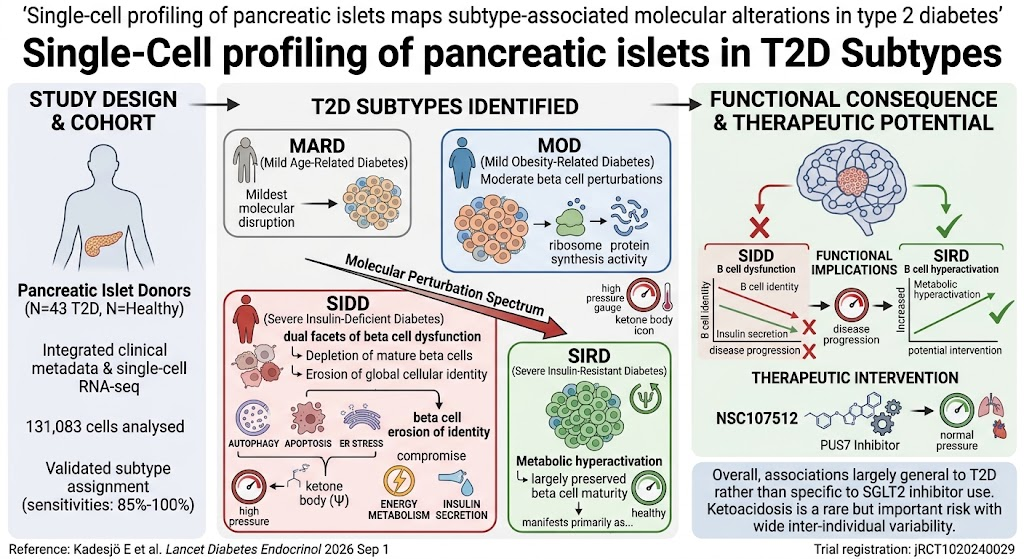
This study employs single-cell RNA sequencing to map pancreatic islet cell transcriptomes across clinically defined type 2 diabetes (T2D) subgroups, revealing distinct molecular alterations in beta cell function and metabolic pathways among mild age-related diabetes (MARD), mild obesity-related diabetes (MOD), severe insulin-deficient diabetes (SIDD), and severe insulin-resistant diabetes (SIRD). The research identifies pronounced beta cell identity loss and dysfunction in SIDD, metabolic hyperactivation in SIRD, moderate perturbations in MOD, and minimal disruption in MARD, paving the way for precision medicine approaches in T2D.
Study Background
Type 2 diabetes is a complex and clinically heterogeneous metabolic disorder characterized by varying degrees of insulin resistance, beta cell dysfunction, and resultant hyperglycemia. Recognizing distinct clinical subgroups—such as mild age-related diabetes (MARD), mild obesity-related diabetes (MOD), severe insulin-deficient diabetes (SIDD), and severe insulin-resistant diabetes (SIRD)—has improved understanding of disease heterogeneity. However, the underlying molecular alterations driving the pathophysiology of these subtypes at a cellular level remain inadequately characterized. Profiling pancreatic islets at single-cell resolution offers a powerful approach to discern subtype-specific molecular perturbations, which could inform personalized therapeutic strategies and improve clinical outcomes.
Study Design
The investigators conducted an integrative analysis combining clinical metadata from both healthy donors and individuals diagnosed with T2D with high-throughput single-cell RNA sequencing (scRNA-seq) data derived from pancreatic islets. The study cohort consisted of 43 pancreatic islet donors with type 2 diabetes subjected to clinical subtype clustering using an established classification framework validated against external centroid datasets to ensure subtype assignment accuracy. Subsequently, scRNA-seq data comprising 131,083 individual cells from 32 donors with T2D were analyzed to investigate cellular composition differences and molecular perturbations associated with each subtype.
Key Findings
The study successfully identified four T2D subgroups that paralleled the clinical classification of MARD, MOD, SIDD, and SIRD. Validation of subtype assignments demonstrated high sensitivity, ranging from 85% to 100% in the full donor cohort and 91.7% to 100% in the scRNA-seq sub-cohort, underscoring robust and reliable classification.
Beta Cell Molecular Alterations in SIDD: The severe insulin-deficient diabetes (SIDD) group exhibited the most profound disturbances in beta cells. Key features included depletion of mature beta cell subpopulations and loss of global beta cell identity markers. At the molecular level, there was marked activation of autophagy, apoptosis, and endoplasmic reticulum (ER) stress pathways, reflecting heightened cellular stress and programmed cell death. Additionally, genes involved in energy metabolism and insulin secretion pathways were significantly downregulated, consistent with impaired beta cell functional capacity. These findings mechanistically explain the insulin deficiency characteristic of SIDD.
Metabolic Hyperactivation in SIRD: In contrast, the severe insulin-resistant diabetes (SIRD) subgroup maintained largely preserved beta cell maturity, with less evident loss of beta cell identity. Instead, SIRD beta cells showed signatures of metabolic hyperactivation, likely compensating for peripheral insulin resistance with preserved secretory function. This suggests a distinct pathophysiological trajectory compared to SIDD, where beta cells are actively engaged but challenged by systemic insulin resistance.
Moderate Changes in MOD: Mild obesity-related diabetes (MOD) displayed moderate beta cell molecular perturbations, characterized by enriched expression of genes involved in ribosomal function and protein synthesis. These changes may reflect adaptive responses to increased metabolic demand associated with obesity but retain relatively preserved beta cell functional markers.
Mild Disruption in MARD: Mild age-related diabetes (MARD) showed the least molecular alterations, consistent with its clinically milder phenotype. Beta cells retained most markers of cellular identity and function, indicating a relatively preserved beta cell compartment with mild disruptions potentially related to aging processes.
Expert Commentary
This study compellingly illustrates the cellular heterogeneity of type 2 diabetes subtypes at an unprecedented single-cell resolution. The differential molecular landscapes of beta cells across subgroups highlight the necessity for subtype-specific biomarker development and precision therapeutic interventions. In particular, the elucidation of ER stress and apoptotic pathways in SIDD points to potential intervention targets to preserve beta cell function. Meanwhile, SIRD’s metabolic hyperactivation underscores the complexity of addressing insulin resistance and beta cell compensation simultaneously.
However, despite its strengths, some limitations merit consideration. The study’s cross-sectional nature limits causal inferences regarding the temporal sequence of molecular changes. Additionally, the cohort size, though substantial for scRNA-seq studies, may still benefit from expansion to capture broader population diversity. Future longitudinal investigations integrating genetic, environmental, and pharmacological data will be critical to refine the subtype-specific molecular pathogenesis further.
Conclusion
This comprehensive single-cell transcriptomic profiling of pancreatic islets across clinically relevant type 2 diabetes subtypes provides a valuable resource for understanding the heterogeneous molecular underpinnings of T2D. The distinct beta cell perturbations mapped here may inform future development of subtype-specific diagnostics and therapeutic strategies, ushering in more effective personalized management of type 2 diabetes.
Funding and ClinicalTrials.gov
The original study did not specify funding sources or clinical trial registration details. Further inquiries into the publication or associated resources are recommended for information on funding and trial registration.
References
1. Xie X, Wu C, Luo X, et al. Single-cell profiling of pancreatic islets maps subtype-associated molecular alterations in type 2 diabetes. Diabetologia. 2026 Sep 1. PMID: 42678439.
2. Ahlqvist E, Storm P, Käräjämäki A, et al. Novel subgroups of adult-onset diabetes and their association with outcomes: a data-driven cluster analysis of six variables. Lancet Diabetes Endocrinol. 2018;6(5):361-369.
3. Butler AE, Janson J, Bonner-Weir S, Ritzel R, Rizza RA, Butler PC. Beta-cell deficit and increased beta-cell apoptosis in humans with type 2 diabetes. Diabetes. 2003 Jan;52(1):102-10.
4. Prentki M, Nolan CJ. Islet beta cell failure in type 2 diabetes. J Clin Invest. 2006 Jul;116(7):1802-1812.
5. Segerstolpe Å, Palasantza A, Eliasson P, et al. Single-cell transcriptome profiling of human pancreatic islets in health and type 2 diabetes. Cell Metab. 2016 Apr 12;24(4):593-607.
This article was created using several editorial tools, including AI, as part of the process. Human editors reviewed this content before publication.