We use cookies

Our website uses essential cookies and, with your consent, additional cookies to measure performance and improve our services. Cookie Policy.

You can change your choice at any time.

MMedXYNews
HomeVideos
MedXY AI/MedXY News/Section: Cardiology

Declining Use But Persistent Readmissions: A National Analysis of Open Lower Extremity Revascularization Outcomes
MedXY Editorial Team•Aug 19, 2026•Cardiology
Chronic Limb-Threatening IschemiaPeripheral Artery Diseaseopen lower extremity revascularizationReadmission

Highlight

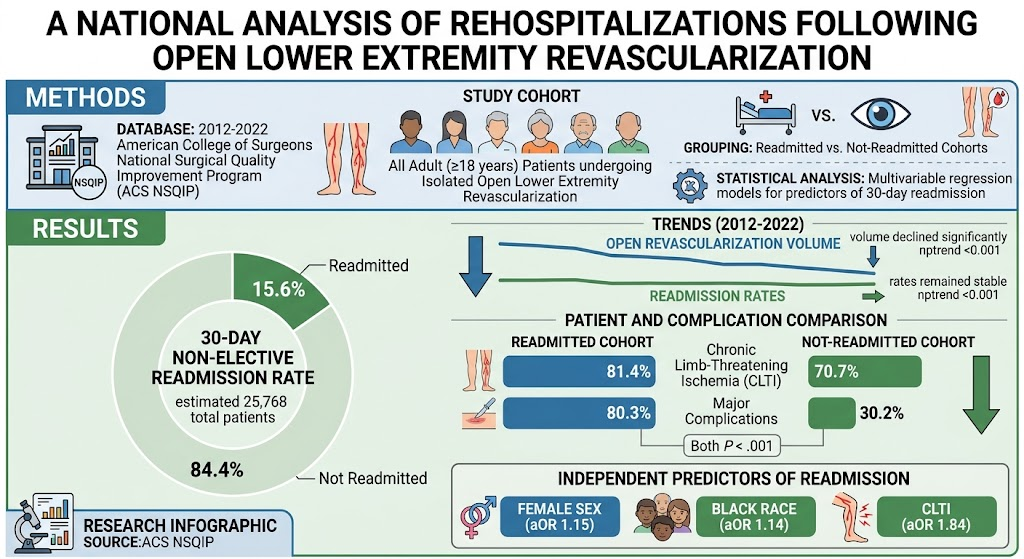
  • Open lower extremity revascularization volume declined significantly nationally from 2012 to 2022, yet 30-day nonelective readmission rates remained stable at 15.6%.

  • Patients undergoing readmission more frequently presented with chronic limb-threatening ischemia and experienced substantially higher rates of major postoperative complications.

  • Independent predictors of increased readmission risk included female sex, Black race, and diagnosis of chronic limb-threatening ischemia.

  • The findings emphasize the critical need for standardized discharge protocols to reduce rehospitalization after this complex vascular surgery.

Study Background

MedXY registered readers

Sign in free to continue reading

Create or use your MedXY account to unlock the complete article.

This article was created using several editorial tools, including AI, as part of the process. Human editors reviewed this content before publication.

Related articles

Open language-specific specialty feeds and department pages.

Comparing Endovascular and Surgical Revascularization Outcomes in Claudication Due to Femoropopliteal Disease: Insights from Medicare-Linked DataThis study compares long-term outcomes of endovascular versus open bypass interventions for femoropopliteal disease in patients with claudication, finding similar rates of major adverse limb events and progression to critical limb ischemiaSep 17, 2026Harnessing Genetic Insights: Polygenic Risk Score Enhances Prediction of Peripheral Artery Disease and Limb EventsA validated polygenic risk score (PRS) independently predicts peripheral artery disease (PAD) and major adverse limb events (MALE) in patients with cardiometabolic disease, adding modest but significant predictive value beyond traditional cSep 6, 2026Transforming Readmission Risk After Colorectal Surgery in Older Adults: From Nonmodifiable to Actionable Geriatric and Comorbidity FactorsThis study highlights that geriatric vulnerabilities and comorbidities, once considered nonmodifiable, play a dominant role in 30-day readmissions after colorectal surgery in older adults, emphasizing the need for integrated perioperative iAug 25, 2026
Loading comments...
MedXY briefing

Get the free newsletter

Evidence-led clinical news, trends, and analysis—delivered to your inbox.

Ask MedXY AI

Most popular

Intimate Health
Five Benefits for Women Continuing Sexual Activity After Menopause
Intimate Health
Why Some Women Have a Strong Sex Drive—And Why Men Shouldn't Worry About It
Nursing & care
How often should a couple have sex?
Intimate Health
Classic Intimacy Recommendations: How to Help Women Reach Orgasm and Enjoy Mutual Pleasure
Intimate Health
What Makes a Woman "Physiologically Addicted" Is Never Money, But These Two Relationship Qualities
© 2026 MedXY
Contact usAbout usPrivacy PolicyMedXY story
Bempedoic Acid Significantly Reduces Limb and Cardiovascular Events in Statin-Intolerant Patients with Peripheral Artery Disease: Insights from the CLEAR Outcomes TrialBempedoic acid reduces the risk of major adverse limb and cardiovascular events in statin-intolerant patients with peripheral artery disease, illustrating its potential to enhance vascular risk management.Aug 22, 2026
Peripheral Artery Disease: Emerging Advances in Medical Therapy to Reduce Cardiovascular and Limb RisksThis article reviews recent advances in the medical management of peripheral artery disease, emphasizing comprehensive risk factor control, novel pharmacotherapies, and individualized approaches to improve cardiovascular and limb outcomes iJul 18, 2026
Long-Term SAFE-PAD Data Reassure on Mortality After Paclitaxel-Coated Femoropopliteal InterventionsIn Medicare patients undergoing femoropopliteal revascularization, drug-coated devices were not associated with higher long-term mortality, supporting the safety of paclitaxel-coated technology after years of regulatory concern.May 6, 2026