We use cookies

Our website uses essential cookies and, with your consent, additional cookies to measure performance and improve our services. Cookie Policy.

You can change your choice at any time.

MMedXYNews
HomeVideos
MedXY AI/MedXY News/Section: Diabetes & Endocrinology

Crowded Optic Discs and Risk Stratification of NAION in GLP-1 Receptor Agonist Users: Insights from a Large Multicenter Study
MedXY Editorial Team•Aug 10, 2026•Diabetes & Endocrinology
cup-to-disc ratioNAIONGLP-1 receptor agonistsoptic neuropathy

Highlight

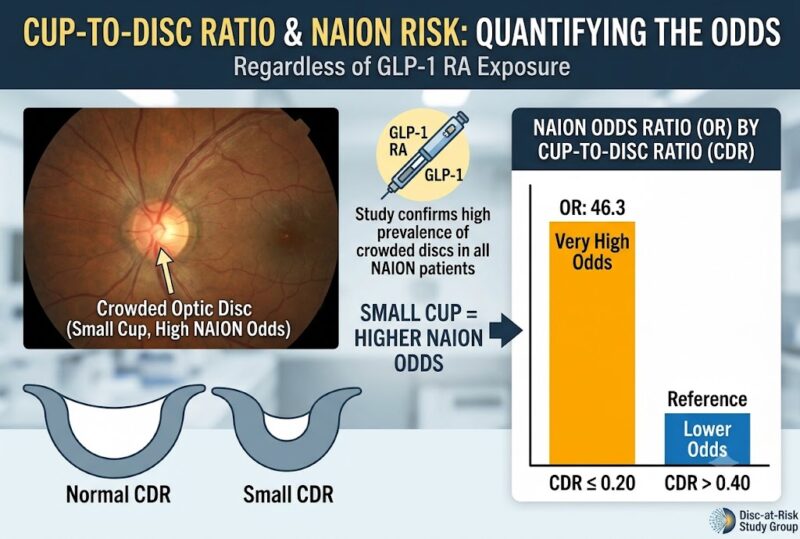
  • Nonarteritic anterior ischemic optic neuropathy (NAION) patients exposed to GLP-1 receptor agonists (GLP-1 RA) have similar optic disc crowding as non-exposed NAION patients.
  • A smaller cup-to-disc ratio (CDR) in the unaffected fellow eye is strongly associated with increased odds of developing NAION.
  • Patients with a CDR ≤ 0.20 exhibit 46-fold higher odds of NAION compared to those with CDR > 0.40.
  • GLP-1 RA exposure does not independently alter the risk of NAION related to optic disc morphology.

Study Background

MedXY registered readers

Sign in free to continue reading

Create or use your MedXY account to unlock the complete article.

This article was created using several editorial tools, including AI, as part of the process. Human editors reviewed this content before publication.

Related articles

Open language-specific specialty feeds and department pages.

Evaluating Complication Rates in Post-Weight-Loss Body Contouring: Comparing Surgery, GLP-1 Pharmacotherapy, Combination, and Lifestyle ApproachesThis study investigates postoperative complication rates following body-contouring surgery among patients with differing weight-loss methods, revealing that weight-loss modality does not affect complications, while BMI and diabetes at surgeSep 3, 2026Impact of Weight-Loss Methods on Post-Bariatric Body Contouring Surgery Outcomes: A Comparative AnalysisThis study examines complication rates following body-contouring surgeries in patients after weight loss via bariatric surgery, GLP-1 receptor agonists, combination therapy, or lifestyle changes, finding modality-independent risk but highliSep 2, 2026Glucagon-Like Peptide 1 Receptor Agonists, Mortality, and Cardiovascular Outcomes in Serious Mental Illness: A Comprehensive ReviewGLP-1 receptor agonists reduce mortality and cardiovascular events more effectively than SGLT2 inhibitors in serious mental illness (SMI), with early benefits and consistent effects across bipolar disorder, major depression, and schizophrenSep 2, 2026
Loading comments...
MedXY briefing

Get the free newsletter

Evidence-led clinical news, trends, and analysis—delivered to your inbox.

Ask MedXY AI

Most popular

Intimate Health
Five Benefits for Women Continuing Sexual Activity After Menopause
Intimate Health
Why Some Women Have a Strong Sex Drive—And Why Men Shouldn't Worry About It
Nursing & care
How often should a couple have sex?
Intimate Health
Classic Intimacy Recommendations: How to Help Women Reach Orgasm and Enjoy Mutual Pleasure
Intimate Health
What Makes a Woman "Physiologically Addicted" Is Never Money, But These Two Relationship Qualities
© 2026 MedXY
Contact usAbout usPrivacy PolicyMedXY story
Impact of Weight-Loss Methods on Post-Bariatric Body Contouring Surgery Outcomes: A Comparative Analysis
This study evaluates complication rates following body contouring after weight loss via bariatric surgery, GLP-1 receptor agonists, combination therapy, and lifestyle changes, finding weight-loss modality does not affect postoperative compl
Sep 1, 2026
GLP1R R131Q Variant: A Genetic Key to Preserving β-Cell Function and Enhancing GLP-1RA Efficacy in Type 2 DiabetesThe gain-of-function GLP1R R131Q variant slows β-cell decline and improves glycemic response to GLP-1 receptor agonists, highlighting its potential role in precision diabetes therapeutics.Aug 26, 2026
Exploring the Link Between GLP-1 Receptor Agonists and Sensory Disturbances in Diabetes CareThis study reveals a significant association between GLP-1 receptor agonist therapy and increased risk of smell and taste disturbances in type 2 diabetes patients, highlighting the need for awareness and monitoring.Aug 17, 2026