Cost-Effectiveness Analysis of Menopausal Hormone Therapy: Integrating Risk-Benefit Profiles and Economic Models
Highlights
- Recent Markov modeling indicates menopausal hormone therapy (MHT) using transdermal estradiol, alone or with micronized progesterone, is cost-effective for symptomatic 50-year-old women over 5 years.
- The cardiovascular protective effect of MHT, particularly reduction in atherosclerotic cardiovascular disease (ASCVD), is the main driver of economic benefit alongside reductions in hip fracture and colon cancer risks.
- Increased breast cancer incidence associated with MHT is outweighed by gains in quality-adjusted life years (QALYs) and overall mortality reduction.
- Cost-effectiveness findings align with prior economic evaluations and clinical trial data, supporting judicious MHT use in appropriate populations.
Background
Menopausal hormone therapy, encompassing estrogen with or without progestogens depending on uterine status, remains a cornerstone for managing vasomotor symptoms in peri- and postmenopausal women. Beyond symptomatic relief, MHT impacts a range of health outcomes including cardiovascular disease (CVD), osteoporosis-related fractures, colorectal and breast cancers. The balance of benefits and risks varies by formulation, route, timing, and patient characteristics.
Clinical guidelines favor short-term use individualized to symptom severity and risk profiles. Historically, concerns following landmark trials such as the Women’s Health Initiative (WHI) led to decreased MHT utilization due to perceived cardiovascular and breast cancer risks. However, nuanced interpretation and subsequent trials have refined understanding, emphasizing safer options like transdermal estradiol and micronized progesterone with potentially more favorable safety profiles.
Cost-effectiveness analysis integrating these risk-benefit data is critical to inform health policy and clinical decision making, especially considering the demographic burden and economic implications of menopausal symptoms and associated comorbidities.
Key Content
Markov Model Analysis of MHT Cost-Effectiveness (Gill et al. 2026)
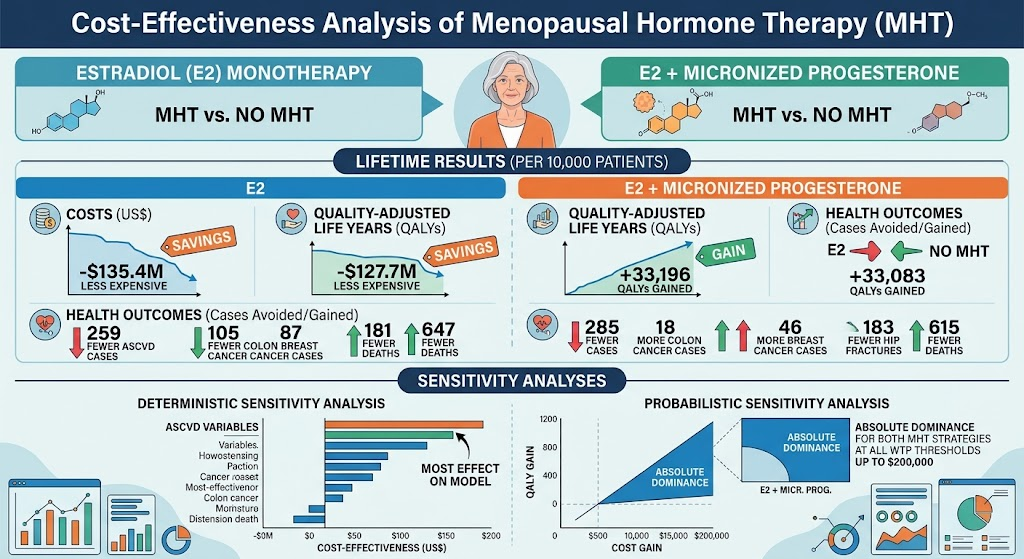
The recent study by Gill and colleagues utilized a Markov model simulating clinical events and costs in hypothetical 50-year-old women initiating MHT for 5 years. Two strategies were compared: transdermal estradiol alone (for hysterectomized women) and transdermal estradiol combined with micronized progesterone (for women with a uterus) versus no MHT, applying a health system payer perspective.
Key parameters incorporated epidemiologic risk estimates for atherosclerotic cardiovascular disease (ASCVD), breast and colon cancers, hip fractures, and mortality, with utilities and costs derived from the literature. The primary outcome was incremental cost-effectiveness ratio (ICER) expressed as cost per quality-adjusted life year (QALY) gained; a threshold willingness-to-pay was set at $100,000 per QALY.
Results demonstrated absolute dominance of MHT strategies over no therapy. For every 10,000 patients treated, MHT use yielded over 33,000 additional QALYs and saved approximately $127-135 million over a lifetime, mainly by reducing ASCVD events (259–285 fewer cases) and hip fractures (181–183 fewer cases). While breast cancer cases increased modestly (46–87 more cases depending on regimen), the net mortality decreased substantially (615–647 fewer deaths).
Sensitivity analyses identified ASCVD-related variables as the most influential model drivers, highlighting cardiovascular benefit’s pivotal role in cost-effectiveness. Probabilistic sensitivity analysis confirmed robustness of findings across willingness-to-pay thresholds up to $200,000 per QALY.
Supporting Evidence from Prior Economic and Clinical Studies
Earlier investigations utilizing WHI data and health economic models corroborate cost-effectiveness of hormone therapy, particularly in women with hysterectomy or those at elevated fracture risk. For example, a 2008 cost-effectiveness model across Sweden, the UK, and the US showed that HT reduced fracture-related morbidity and was cost-effective mainly among women with prior fractures or hysterectomy (PMID:18053789).
Linked Medicare data from WHI trials also demonstrated balanced effects on healthcare spending, with MHT altering expenditures variably across hormone-sensitive diseases but overall modest net cost impact in women aged ≥65 (PMID:29653631).
Additionally, randomized controlled trial data indicate that transdermal estradiol combined with micronized progesterone has a safer cardiovascular and breast cancer profile compared to oral conjugated equine estrogens plus medroxyprogesterone acetate, supporting use of contemporary formulations in cost-effectiveness considerations.
Alternative and Complementary Therapies and Economic Perspectives
Meta-analyses and HTA reports on alternative treatments for menopausal symptoms (e.g., phytoestrogens, acupuncture) show limited or inconclusive cost-effectiveness due to variable efficacy and methodological limitations (PMID:22690252). This underscores the relative value of MHT when appropriately selected.
Expert Commentary
The 2026 Markov modeling analysis by Gill et al. strategically integrates updated epidemiologic and economic data to reinforce the favorable cost-effectiveness of MHT initiated at age 50 and used for 5 years. The robust inclusion of transdermal routes and bioidentical progesterone aligns with clinical insights toward safer hormone formulations mitigating thromboembolic and breast cancer risks.
Critically, the dominant driver is the cardiovascular risk reduction, a finding consistent with the timing hypothesis that early initiation of MHT near menopause onset confers vascular protection. This contrasts with earlier risks identified in older populations or with different regimens.
The modest increase in breast cancer cases remains a concern; however, absolute mortality benefit and quality-of-life gains tilt the risk-benefit balance positively. Clinicians should individualize therapy considering baseline cancer risks, fracture history, and patient preferences.
Economic analyses highlight that despite initial drug and monitoring costs, MHT may reduce long-term healthcare expenses by preventing debilitating cardiovascular and musculoskeletal events. These data can inform policy on coverage and access to contemporary MHT regimens.
Limitations include assumptions inherent in modeling approaches, uncertainties in long-term cancer risk projections, and exclusion of rare adverse events or quality-of-life nuances beyond utilities. Real-world adherence and diverse patient populations require further study.
Conclusion
Current evidence supports menopausal hormone therapy using transdermal estradiol, with or without micronized progesterone, as a cost-effective intervention for symptomatic menopausal women starting near age 50 and used for a limited duration (around 5 years). The principal driver of cost-effectiveness is cardiovascular risk reduction, supplemented by fracture prevention and mortality benefit.
These findings should guide clinicians and policymakers in balancing treatment benefits against risks and costs, optimizing patient-centered menopausal care. Future research priorities include long-term comparative effectiveness of varying formulations, inclusion of broader patient populations, and real-world economic analyses integrating quality-of-life outcomes.
References
- Gill E, Zeng W, Shvartsman K, Brown J. Cost-Effectiveness Analysis of Menopausal Hormone Therapy. Obstetrics and gynecology. 2026 Aug 13. PMID: 42594384.
- Schousboe JT, Weber DR, Lo JC, et al. Cost effectiveness of hormone therapy in women at high risks of fracture in Sweden, the US, and the UK – results based on the Women’s Health Initiative randomized controlled trial. Bone. 2008 Feb;42(2):294-306. PMID: 18053789.
- Manson JE, Cook NR, Lee IM, et al. Impact of hormone therapy on Medicare spending in the Women’s Health Initiative randomized clinical trials. Am Heart J. 2018 Apr;198:108-114. PMID: 29653631.
- Orth S, Waldenberger M, Hartmann B, et al. Alternative methods for the treatment of post-menopausal troubles: a systematic review and health technology assessment. GMS Health Technol Assess. 2012;8:Doc03. PMID: 22690252.
This article was created using several editorial tools, including AI, as part of the process. Human editors reviewed this content before publication.