We use cookies

Our website uses essential cookies and, with your consent, additional cookies to measure performance and improve our services. Cookie Policy.

You can change your choice at any time.

MMedXYNews
HomeVideos
MedXY AI/MedXY News/Section: Clinical Updates

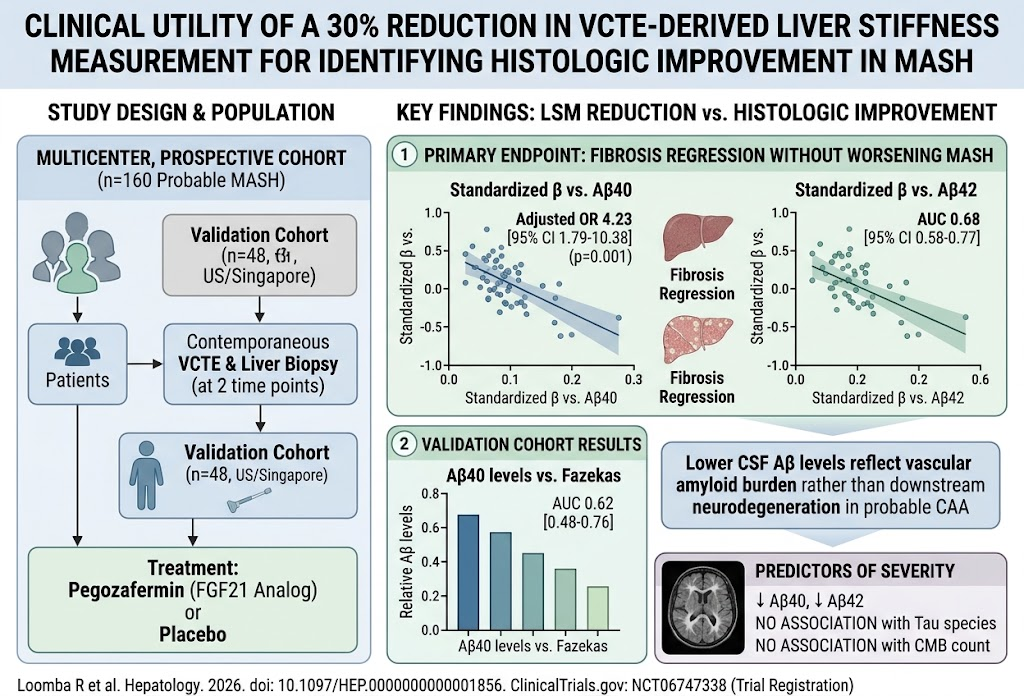
Clinical Utility of a 30% Reduction in VCTE-Derived Liver Stiffness Measurement for Identifying Histologic Improvement in Metabolic Dysfunction-Associated Steatohepatitis
MedXY Editorial Team•Sep 6, 2026•Clinical Updates
liver stiffness measurementVCTEfibrosis regressionmetabolic dysfunction-associated steatohepatitis

Highlights

  • A ≥30% relative decline in VCTE-derived liver stiffness measurement (LSM) is modestly predictive of histologic fibrosis regression in MASH patients.
  • This non-invasive marker aligns with regulatory recommendations but shows only moderate diagnostic accuracy (AUC ~0.65), underscoring the need for complementary biomarkers.
  • Multivariable-adjusted analyses confirm the independent association between ≥30% LSM reduction and fibrosis improvement without worsening steatohepatitis.
  • Validation across diverse cohorts reveals consistent but limited performance, indicating population heterogeneity and measurement variability.

Background

MedXY registered readers

Sign in free to continue reading

Create or use your MedXY account to unlock the complete article.

This article was created using several editorial tools, including AI, as part of the process. Human editors reviewed this content before publication.

Related articles

Open language-specific specialty feeds and department pages.

Longitudinal Weight Changes in MASLD: Impact on Liver Outcomes and Disease ProgressionThis study reveals that weight gain exceeding 5% in MASLD patients increases liver-related event risks and liver stiffness, whereas weight loss improves liver stiffness and may reduce adverse outcomes, especially with obesity reversal.Aug 19, 2026Validating Liver Stiffness Measurement as a Prognostic Tool in Primary Sclerosing Cholangitis: Insights from the Prospective FICUS CohortThis prospective study confirms that liver stiffness measurement (LSM) by Fibroscan® effectively predicts transplant-free survival in primary sclerosing cholangitis (PSC), highlighting both static and dynamic assessments as powerful risk stAug 13, 2026Liver Stiffness Measurements as Prognostic Tools in Primary Sclerosing Cholangitis: Insights from the Prospective FICUS CohortThis prospective study confirms that liver stiffness measurements by Fibroscan® strongly predict transplant-free survival in primary sclerosing cholangitis patients, validating both static values and dynamic changes as vital prognostic markAug 7, 2026
Loading comments...
MedXY briefing

Get the free newsletter

Evidence-led clinical news, trends, and analysis—delivered to your inbox.

Ask MedXY AI

Most popular

Intimate Health
Five Benefits for Women Continuing Sexual Activity After Menopause
Intimate Health
Why Some Women Have a Strong Sex Drive—And Why Men Shouldn't Worry About It
Nursing & care
How often should a couple have sex?
Intimate Health
Classic Intimacy Recommendations: How to Help Women Reach Orgasm and Enjoy Mutual Pleasure
Intimate Health
What Makes a Woman "Physiologically Addicted" Is Never Money, But These Two Relationship Qualities
© 2026 MedXY
Contact usAbout usPrivacy PolicyMedXY story
Long-Term Real-World Effectiveness, Safety, and Liver Stiffness Changes with Obeticholic Acid in Primary Biliary Cholangitis
This study confirms the sustained effectiveness and safety of obeticholic acid (OCA) in primary biliary cholangitis (PBC) over a 2-year median follow-up, highlighting its impact on liver stiffness and fibrosis progression, especially in bio
Oct 28, 2025
Liver Stiffness Measurement vs. Biochemical Response in Primary Biliary Cholangitis: Predicting Liver Decompensation with PrecisionIn primary biliary cholangitis, liver stiffness measurement (LSM) outperforms biochemical response in predicting first hepatic decompensation, emphasizing LSM’s pivotal role in clinical risk stratification despite frequent discordanceOct 28, 2025
Rapirosiran: A Promising RNAi Therapy Targeting HSD17B13 in Metabolic Dysfunction-Associated SteatohepatitisThis phase I study evaluates rapirosiran, an RNA interference therapeutic targeting HSD17B13, demonstrating safety, tolerability, and significant liver mRNA reduction in patients with metabolic dysfunction-associated steatohepatitis (MASH).Oct 8, 2025