Bridging the Gap: Understanding and Reducing Diagnostic Delays in Childhood Onset Uveitis
Highlight
Delays in diagnosing symptomatic childhood onset uveitis remain common, with median time from symptom onset to diagnosis at 9 days but extending up to 568 days.
Bilateral disease and initial presentation to primary care are independently associated with longer diagnostic delays.
Younger age and socioeconomic deprivation significantly increase the likelihood of structural ocular complications at diagnosis.
Enhanced education for primary care providers and equitable access to ophthalmic services are critical to reducing delays and preventing lifelong visual disability.
Study Background and Disease Burden
Childhood onset uveitis is a potentially blinding inflammatory eye disease that frequently requires timely diagnosis and treatment to prevent irreversible visual impairment. Non-infectious uveitis in children is rare yet constitutes a significant burden due to diagnostic challenges, variable clinical presentations, and risk of severe structural ocular complications at diagnosis. Early symptoms such as redness, pain, and photophobia are often unspecific, leading to potential delays in diagnosis. These delays can result in sight-threatening complications such as cataracts, glaucoma, and posterior synechiae, impacting quality of life and lifelong visual function. Despite advances in ophthalmic care, pediatric uveitis remains under-recognized in primary care, and mechanisms underpinning diagnostic delays have not been systematically evaluated on a national scale. The United Kingdom Uveitis in Childhood National Inception Cohort (UNICORN) Study addresses this knowledge gap by prospectively examining factors contributing to delayed diagnosis and complications in childhood onset non-infectious uveitis across the UK.
Study Design
The UNICORN study is a prospective, nationwide cohort study enrolling children aged less than 18 years with newly diagnosed non-infectious uveitis from March 1, 2020, to February 28, 2023. The study included 221 children with a median age of 10.9 years; 52% were girls. Patients were followed from onset of symptoms through diagnosis, with detailed recording of clinical features, time intervals from symptom onset to diagnosis, initial clinical presentation, and presence of structural ocular complications at diagnosis. The main endpoints were the time from symptomatic onset to diagnosis and the presence of ocular structural complications at diagnosis, analyzed using multivariable linear and logistic regression to identify independent predictors. The study adjusted for confounding factors including the impact of the COVID-19 pandemic lockdown period.
Key Findings
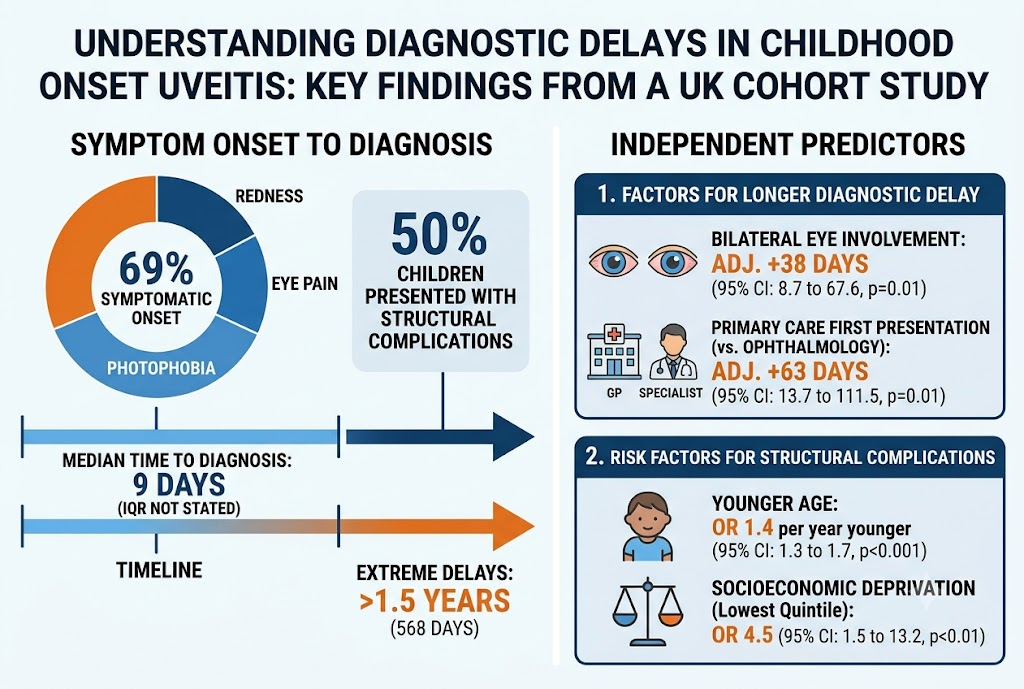
Among the pediatric patients studied, 69% were diagnosed following symptomatic disease onset, commonly presenting with redness, eye pain, and photophobia. The median time from symptom onset to formal diagnosis was 9 days (interquartile range not stated), though extreme delays extended up to over 1.5 years (568 days). Notably, half of the children presented with at least one structural complication at diagnosis, highlighting the significant burden of delayed recognition.
Independent predictors for prolonged diagnostic delay included:
Bilateral eye involvement: associated with an adjusted increase in time to diagnosis of approximately 38 days (95% confidence interval [CI]: 8.7 to 67.6 days; p=0.01).
Initial clinical presentation to primary care providers rather than directly to ophthalmology or eye specialist services showed an adjusted delay of approximately 63 days (95% CI: 13.7 to 111.5; p=0.01), underscoring the role of referral pathways in timely diagnosis.
Structural ocular complications at diagnosis were independently associated with:
Younger age—with an odds ratio (OR) of 1.4 per year younger (95% CI: 1.3 to 1.7; p<0.001)—demonstrating more severe disease impact or delayed recognition in younger children.
Socioeconomic deprivation, measured by the lowest quintile of deprivation, was associated with a markedly increased risk of complications (OR 4.5; 95% CI: 1.5 to 13.2; p<0.01), indicating health disparities in disease outcomes.
These data emphasize the uneven distribution of diagnostic delay impacts across demographic strata and healthcare access levels.
Expert Commentary
The UNICORN study provides crucial insights into diagnostic delays in pediatric uveitis at a national scale, revealing modifiable factors such as initial point of care contact and socioeconomic barriers. The extended delays associated with presentation to primary care likely reflect limited awareness and experience with pediatric uveitis among general practitioners and non-specialist ophthalmic professionals. Given that early symptoms are common and non-specific, primary care clinicians may not promptly recognize the urgency for urgent ophthalmic referral.
The association of socioeconomic deprivation with both delays and structural complications underscores the need for health system measures to ensure equitable access to subspecialty care. Younger children are particularly vulnerable to worse outcomes, possibly due to difficulty in communicating symptoms or less obvious clinical signs. This highlights an imperative for pediatricians, optometrists, and primary care providers to maintain a high index of suspicion in younger patients presenting with eye complaints.
Limitations of the study include potential selection bias inherent to a national inception cohort and the impact of pandemic-related healthcare access disruptions, although adjustments were made for lockdown periods. The broad range of diagnostic delays suggests variability in healthcare pathways that warrants intervention through standardized referral guidelines and educational initiatives.
Conclusion
Delays in diagnosis remain a significant challenge in childhood onset non-infectious uveitis, contributing to a high burden of ocular complications at presentation. Bilateral involvement and initial assessment by primary care practitioners are key factors associated with prolonged diagnosis, while younger age and socioeconomic deprivation predispose to structural damage. Strategies to enhance awareness among primary care providers, implement efficient referral pathways, and promote equitable access to specialty eye care are pivotal to preventing long-term vision loss in affected children. Future research should explore interventions targeting these delays and evaluate their impact on visual outcomes and quality of life.
Funding and ClinicalTrials.gov
The study was conducted under the auspices of the UK National Health Service and coordinated by the UNICORN study group. Specific funding sources were not detailed here. No ClinicalTrials.gov identifier was provided.
References
1. Kellett S, McLoone E, Ashworth J, et al. Factors associated with delays in the diagnosis of childhood onset uveitis: findings from a nation-wide cohort study. Am J Ophthalmol. 2026 Aug 4; PMID: 42551781.
2. Edelsten C, Lee V, Dunci P et al. Pediatric uveitis: diagnosis and management challenges. Curr Opin Ophthalmol. 2020;31(5):420-426.
3. Smith JR, Rosenbaum JT. The eye in rheumatic disease. Rheum Dis Clin North Am. 2019;45(1):153-164.
4. Reck AC, Foeldvari I, Walscheid K, et al. Clinical characteristics and outcomes of childhood uveitis: a systematic review. Br J Ophthalmol. 2021;105(8):1032-1038.
This article was created using several editorial tools, including AI, as part of the process. Human editors reviewed this content before publication.