Bridging Social Determinants of Health and Multidimensional Frailty Among Older Adults: A Domain-Specific Latent Class and Network Analysis
Introduction
Frailty among older adults is a complex condition characterized by increased vulnerability to health stressors, leading to adverse outcomes such as falls, disability, hospitalization, and mortality. Traditionally, frailty research has focused on physical aspects; however, it is increasingly understood as a multidimensional syndrome involving physical, cognitive, psychological, and social components. Social determinants of health (SDoH)—the non-medical factors influencing health outcomes—play a critical role in frailty development but remain understudied concerning their multidimensional impact.
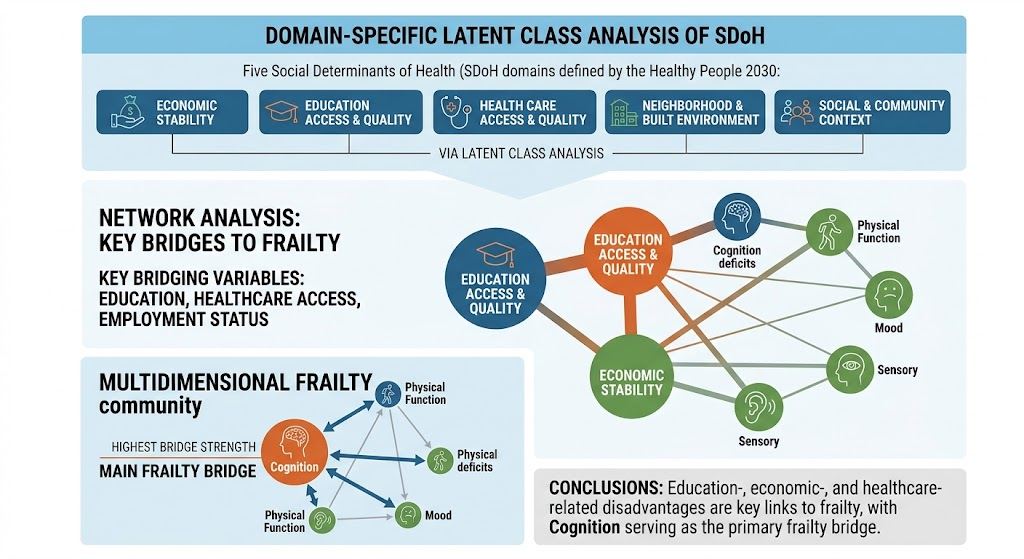
The Healthy People 2030 framework outlines five key SDoH domains: Economic Stability, Education Access and Quality, Health Care Access and Quality, Neighborhood and Built Environment, and Social and Community Context. Each domain comprises various elements with potential influence on health trajectories in late life.
This study aimed to investigate how these SDoH domains and their specific variables associate with different frailty domains among Chinese community-dwelling older adults. By applying innovative latent class and network analyses, the research sought to uncover bridging factors that connect social disadvantages with frailty, providing insights for targeted interventions.
Methods
The study analyzed data from 10,654 individuals aged 60 years and older, derived from the 2020 wave of the China Health and Retirement Longitudinal Study (CHARLS), a nationally representative cohort.
Five SDoH domains based on Healthy People 2030 were assessed:
1. Economic Stability – encompassing employment status, income, and financial security,
2. Education Access and Quality – including educational attainment and literacy,
3. Health Care Access and Quality – focusing on availability, accessibility, and utilization of medical services,
4. Neighborhood and Built Environment – relating to housing quality and community safety,
5. Social and Community Context – covering social support, participation, and cohesion.
A 30-item multidimensional frailty index was used to identify frailty across physical, cognitive, and psychological domains.
Latent class analysis clustered participants into groups with similar SDoH profiles. Mixed graphical models estimated associations (networks) at the domain and variable levels, identifying central and bridging variables through measures like centrality and bridge strength. Sensitivity analyses were performed to ensure robustness, including complete-case and post hoc edge removal methods.
Results
At the domain level, Education Access and Quality along with Economic Stability emerged as the primary bridges linking SDoH to frailty. Notably, the strongest domain-level connection was between Education Access and Quality and cognitive deficits, demonstrating an edge weight of 0.688, indicating a substantial associative strength.
Variable-level analysis highlighted education level, access to healthcare, and employment status as critical bridging variables connecting social determinants to frailty dimensions. Among frailty domains, cognitive function consistently exhibited the highest bridge strength, establishing it as a central nexus within the frailty network.
These findings underscore the strong interplay between educational disadvantage and cognitive impairment, although the causality direction warrants cautious interpretation given the cross-sectional nature of the data.
Discussion
This study illuminates pivotal pathways linking social disadvantages to multidimensional frailty in older Chinese adults. Education status, economic conditions, and healthcare access constitute key structural factors influencing frailty risk, especially via their effect on cognitive function.
Educational attainment likely shapes cognitive reserve and health literacy, both protective against cognitive decline and broader frailty risks. Economic stability affects resource availability for health maintenance and medical care, which can mitigate or exacerbate frailty progression. Access to quality healthcare enables timely interventions and management of chronic conditions that contribute to frailty.
Neighborhood and social factors, while critical to overall well-being, showed weaker direct bridging roles in this analysis, suggesting their effects might be mediated by education, economy, and healthcare domains.
The identification of cognition as the principal bridge within frailty highlights the importance of cognitive assessments and interventions in frailty management programs. Cognitive health promotion, including lifelong learning and social engagement, may reduce frailty vulnerability.
Clinical and Public Health Implications
Given the aging population in China and globally, addressing social determinants offers a strategic opportunity to reduce frailty prevalence and its adverse outcomes. Interventions should prioritize enhancing education accessibility and quality even in later life, improving economic support for older adults, and ensuring equitable access to healthcare services.
Policy efforts might include community education programs, financial assistance schemes, and strengthening primary care and geriatrics services. Tailored cognitive health programs can simultaneously address a core component of frailty bridging.
Limitations and Future Directions
This study’s cross-sectional design limits causal inferences. Longitudinal studies are needed to examine directionality and changes over time. Additionally, unmeasured factors such as cultural influences and psychological resilience could further inform frailty pathways.
Future research could explore intervention trials targeting SDoH factors and their impact on frailty trajectories. Integration with biomarkers and neuroimaging might refine understanding of cognitive frailty mechanisms.
Conclusion
Education access and quality, economic stability, and healthcare access are critical social determinants underpinning multidimensional frailty among Chinese older adults. Cognition acts as a central bridging domain linking social disadvantage to frailty manifestations. These insights highlight the need for integrated public health approaches addressing social vulnerabilities to mitigate frailty and improve healthy aging outcomes.
Reference
Gao Y, Cheung DST, Chau PH. Bridging Social Determinants of Health and Multidimensional Frailty Among Older Adults: A Domain-Specific Latent Class and Network Analysis. J Gen Intern Med. 2026 Aug 20. doi: 10.1007/s11606-026-10734-7. Epub ahead of print. PMID: 42624997.
This article was created using several editorial tools, including AI, as part of the process. Human editors reviewed this content before publication.