We use cookies

Our website uses essential cookies and, with your consent, additional cookies to measure performance and improve our services. Cookie Policy.

You can change your choice at any time.

MMedXYNews
HomeVideos
MedXY AI/MedXY News/Section: Neurology

Brain Structure Changes in Chronic Cough: Insights from a Large-Scale Longitudinal Study
MedXY Editorial Team•Aug 11, 2026•Neurology
neuroplasticityBrain Atrophygrey matter volumechronic cough

Highlight

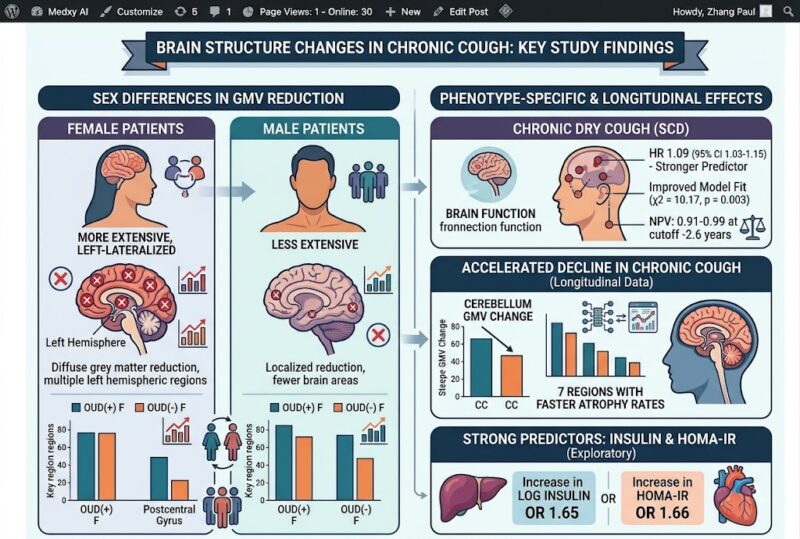
  • Chronic cough is associated with significant grey matter volume reduction in multiple brain regions, particularly the right ventral striatum.
  • Sex differences observed with females showing more extensive and left-lateralized brain structural remodeling.
  • Chronic dry cough linked specifically to decreased grey matter in bilateral postcentral gyrus.
  • Longitudinal data indicate an accelerated rate of grey matter decline in cerebellar and other brain regions in chronic cough patients, suggesting dynamic neurostructural remodeling.

Study Background

MedXY registered readers

Sign in free to continue reading

Create or use your MedXY account to unlock the complete article.

This article was created using several editorial tools, including AI, as part of the process. Human editors reviewed this content before publication.

Related articles

Open language-specific specialty feeds and department pages.

Gabapentin for Cough in Idiopathic Pulmonary Fibrosis: Efficacy and Safety Insights from a Randomized Controlled TrialA randomized, double-blind, placebo-controlled trial demonstrates gabapentin’s significant efficacy and acceptable safety for treating cough in IPF, supporting its clinical use amid limited alternatives.Sep 1, 2026Paramagnetic Rim Lesions as Predictors of Progression in Multiple Sclerosis: Insights from a 5-Year Longitudinal StudyParamagnetic rim lesions detected via MRI are associated with increased risk of disability progression independent of relapse activity and accelerated brain atrophy in multiple sclerosis, highlighting their role as prognostic biomarkers forAug 22, 2026Real-Time fMRI Neurofeedback Shows Promise for Reading Rehabilitation in Post-Stroke AphasiaThis feasibility RCT demonstrates that contingent fMRI neurofeedback targeting the left supramarginal gyrus can improve reading comprehension in stroke survivors with aphasia, outperforming both healthy controls and non-contingent neurofeedApr 14, 2026Beyond Immersion: Why Combining Action Observation with Virtual Reality is a Game-Changer for Post-Stroke Hand Recovery
Loading comments...
MedXY briefing

Get the free newsletter

Evidence-led clinical news, trends, and analysis—delivered to your inbox.

Ask MedXY AI

Most popular

Intimate Health
Five Benefits for Women Continuing Sexual Activity After Menopause
Intimate Health
Why Some Women Have a Strong Sex Drive—And Why Men Shouldn't Worry About It
Nursing & care
How often should a couple have sex?
Intimate Health
Classic Intimacy Recommendations: How to Help Women Reach Orgasm and Enjoy Mutual Pleasure
Intimate Health
What Makes a Woman "Physiologically Addicted" Is Never Money, But These Two Relationship Qualities
© 2026 MedXY
Contact usAbout usPrivacy PolicyMedXY story
A multicenter randomized controlled trial reveals that integrating action observation with virtual reality significantly improves paretic hand dexterity in stroke patients, with benefits persisting six months post-intervention, offering a s
Mar 28, 2026
Exoskeleton-Assisted Therapy for Upper Limb Motor Recovery in Early Subacute Stroke: Evidence from a Multicenter Randomized Controlled TrialA comprehensive review of a multicenter RCT (Morone et al., 2026) demonstrating that exoskeleton-based robot-assisted therapy significantly improves upper limb motor impairment and clinical outcomes in the early subacute phase of stroke recMar 13, 2026
Challenging the ‘More is Better’ Paradigm: Intensive Training Shows No Added Benefit in Recent Spinal Cord InjuryA Phase 3 pragmatic trial found that 12 hours of weekly intensive task-specific training added to usual care does not improve motor recovery in recent spinal cord injury patients, suggesting a potential plateau in the benefits of early rehaMar 9, 2026