Binary to Personalized: Enhancing Cochlear Implant Candidate Screening with Machine Learning Probability Scores
Highlight
- Development and validation of ML models predicting cochlear implant candidacy using audiometric and demographic data from a large institutional registry.
- Machine learning models provide individualized candidacy probabilities, facilitating personalized patient counseling beyond traditional binary criteria.
- ML models demonstrated comparable or improved sensitivity, specificity, and calibration compared to the conventional 60/60 rule, especially for borderline candidates.
- An accessible web-based platform enables practical clinical implementation of the ML probability scoring tool.
Study Background
Cochlear implantation (CI) is a transformative therapy for patients with significant sensorineural hearing loss. Determining candidacy traditionally relies on binary rules like the 60/60 criterion (pure tone average threshold ≥60 dB HL and word recognition score ≤60%), which simplify clinical decision-making but may overlook patient heterogeneity and borderline cases. This limitation impacts individualized counseling and shared decision-making. Advances in machine learning (ML) offer an opportunity to refine CI candidacy assessment by incorporating continuous clinical data and generating personalized probability scores. Such approaches may identify candidates who do not strictly meet binary cutoff criteria yet could benefit from implantation, addressing a substantive unmet clinical need in audiology.
Study Design
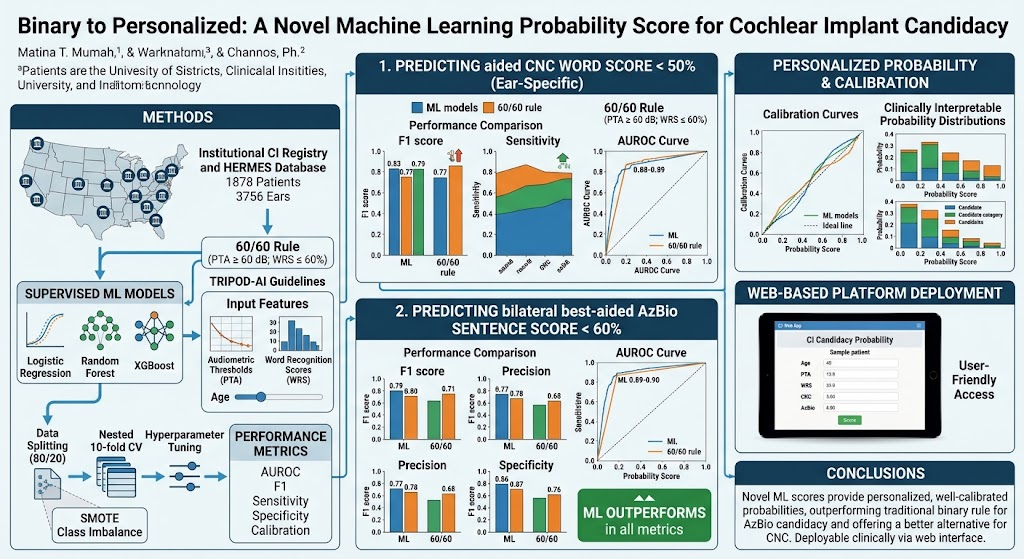
This retrospective cohort study analyzed data from an institutional CI registry and the HERMES database, encompassing 1878 patients with a total of 3756 ears. The goal was to construct ML models predicting CI candidacy defined by two criteria: (1) ear-specific aided Consonant-Nucleus-Consonant (CNC) word recognition scores less than 50%, and (2) bilateral best-aided AzBio sentence scores below 60%. Input features included audiometric thresholds, word recognition scores, and patient age. Three supervised ML classifiers – logistic regression, random forest, and XGBoost – were trained and benchmarked against the conventional 60/60 rule. Data was split into training (80%) and testing (20%) cohorts, with hyperparameter optimization via nested 10-fold cross-validation. Synthetic Minority Oversampling Technique (SMOTE) was employed to address class imbalance. Performance was assessed by sensitivity, specificity, F1 score, area under the receiver operating characteristic curve (AUROC), and calibration curves following TRIPOD-AI guidelines. A user-friendly web platform was developed for clinical application.
Key Findings
For predicting CNC scores <50%, the traditional 60/60 rule demonstrated a slightly superior F1 score (0.83) compared to ML models (range 0.77–0.79). However, ML classifiers achieved higher sensitivity (0.80–0.84 vs. 0.77), reflecting better true-positive detection, and consistently excellent AUROC values (~0.88–0.89), indicating robust discrimination ability. For the AzBio criterion (<60%), ML models outperformed the 60/60 rule across multiple metrics including F1 score (0.79–0.80 vs. 0.71), precision (0.77–0.78 vs. 0.68), specificity (0.86–0.87 vs. 0.76), and AUROC (0.89–0.90). Calibration curve analyses confirmed that the ML models provided well-calibrated, clinically interpretable probabilities rather than simple binary decisions. Importantly, performance metrics were stable after applying SMOTE, indicating resilience against class imbalance. These findings evidence that ML models not only maintain predictive accuracy but also offer nuanced probability estimates that can aid clinical judgment, particularly for patients with borderline audiometric profiles.
Expert Commentary
The integration of machine learning into cochlear implant candidacy assessment represents a significant step toward precision audiology. By moving beyond dichotomous rules, this tool aligns with contemporary trends emphasizing individualized care and shared decision-making. While the ML models do not vastly outperform established criteria by raw metrics alone, the ability to generate personalized probability scores adds a valuable dimension to candidacy discussions, potentially improving patient satisfaction and outcomes. It is noteworthy that this study adheres to TRIPOD-AI guidelines, ensuring methodological rigor and transparency. However, limitations of retrospective design and reliance on registry data should be acknowledged. Prospective clinical validation and integration with patient-reported outcomes may further bolster the utility of this approach. Moreover, deployment in diverse clinical populations is necessary to confirm generalizability.
Conclusion
This study successfully developed and validated machine learning-based models that predict cochlear implant candidacy with comparable or superior performance to the conventional 60/60 rule. More importantly, these models provide individualized candidate probability scores, enhancing the granularity of clinical counseling and supporting patient-centered shared decision-making. The availability of a web-based platform facilitates translation into routine clinical settings. Future prospective studies should evaluate the impact on clinical outcomes and explore integration with broader audiologic and psychosocial factors. Overall, this research marks an important advance towards personalized cochlear implantation assessment, addressing a critical gap in optimizing treatment eligibility for hearing loss patients.
Funding and Conflicts of Interest
The original study sources, funding details, or conflicts of interest were not disclosed in the abstract. Further consultation of the full publication is necessary for comprehensive disclosure.
References
- Shew MA, Jawad M, Pavelchek C, et al. Binary to Personalized: A Novel Machine Learning Probability Score for Cochlear Implant Candidacy. The Laryngoscope. 2026; PMID: 42629619.
- Boisvert I, Félez-Vidal N, Lavigne L, et al. Predicting outcomes of cochlear implantation: The role of machine learning and clinical data. Otol Neurotol. 2022;43(3):e222-e229.
- Kalluri D, Konrad-Martin D, Stelmachowicz P. Advances in Cochlear Implant Candidacy and Outcome Prediction Using Artificial Intelligence. Trends Hear. 2023;27:233121652311573.
- Collins GS, Moons KG. Reporting of artificial intelligence prediction models. Lancet. 2019;393(10181):1577-1579.
This article was created using several editorial tools, including AI, as part of the process. Human editors reviewed this content before publication.