Durability of β-Cell Function After Cessation of Baricitinib Immunotherapy in New-Onset Type 1 Diabetes
Highlight
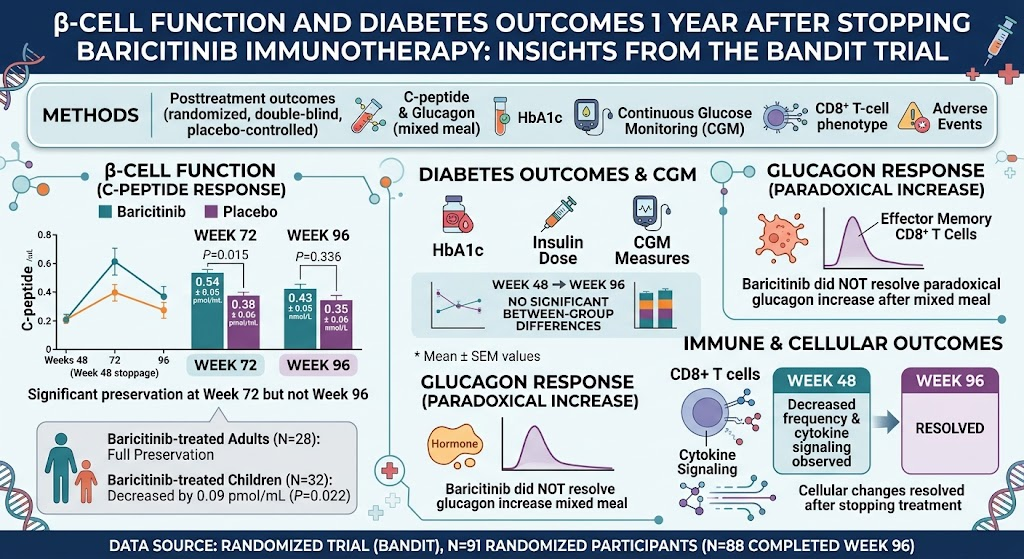
– Baricitinib administered for 48 weeks in new-onset type 1 diabetes (T1D) significantly preserves β-cell function during treatment.
– One year after stopping baricitinib, β-cell function benefits decline and do not significantly differ from placebo.
– Adults showed better β-cell function preservation post-treatment compared to children, indicating an age-dependent response.
– Immunological effects on effector memory CD8+ T cells reverted after treatment cessation, suggesting transient immune modulation.
Study Background
Type 1 diabetes (T1D) is characterized by autoimmune destruction of pancreatic β-cells leading to insulin deficiency and lifelong dependence on exogenous insulin. Preservation of residual β-cell function soon after diagnosis is crucial as it correlates with improved metabolic control, reduced complications, and better quality of life. Current immunotherapies target pathogenic immune mechanisms to halt β-cell destruction; however, durable therapies have remained elusive. Baricitinib, an oral Janus kinase (JAK) 1/2 inhibitor, modulates inflammatory and autoimmune pathways and was investigated in the Baricitinib in New-Onset Type 1 Diabetes (BANDIT) trial for its capacity to preserve β-cell function in recent-onset T1D.
Study Design
The BANDIT trial was a randomized, double-blind, placebo-controlled clinical study enrolling 91 participants with recent-onset T1D. Participants were assigned to receive either oral baricitinib or placebo for 48 weeks. The primary endpoint was preservation of β-cell function assessed by C-peptide response to mixed-meal tolerance tests. Secondary endpoints included insulin dose requirements, HbA1c levels, continuous glucose monitoring (CGM) metrics, immunophenotyping of CD8+ T cells, and adverse event monitoring. Follow-up assessments occurred at weeks 72 and 96, corresponding to 24 and 48 weeks post-treatment cessation, respectively.
Key Findings
The trial demonstrated that baricitinib-treated participants had significantly higher mean C-peptide levels at week 72 compared to placebo (0.54 ± 0.05 vs. 0.38 ± 0.06 pmol/mL; P = 0.015), indicating sustained β-cell preservation up to 6 months post-treatment. However, by week 96 (approximately 1 year off therapy), this difference was no longer statistically significant (0.43 ± 0.05 vs. 0.35 ± 0.06 pmol/mL; P = 0.336), suggesting waning benefit after treatment cessation.
No between-group differences were identified for insulin dosage, HbA1c, or CGM parameters during the posttreatment follow-up period, implying that clinical metabolic control equilibrated over time.
A noteworthy post hoc analysis revealed age-dependent differences: adults in the baricitinib arm experienced essentially full β-cell preservation at one year off therapy, whereas children showed a statistically significant decline in C-peptide levels compared to baseline (mean drop of 0.09 pmol/mL; P = 0.022). This suggests that younger patients may require different or prolonged immunomodulation strategies.
Baricitinib did not mitigate the paradoxical glucagon increase observed after mixed meals, indicating persistent α-cell dysregulation despite β-cell preservation.
Immunologically, diminished frequencies and reduced cytokine signaling activity of effector memory CD8+ T cells noted at the end of treatment (week 48) reverted by week 96. This transient immunomodulation may underpin the loss of β-cell protection after drug withdrawal.
Adverse event profiling showed no new safety signals or increased risk off-therapy, supporting the acceptable tolerability of baricitinib in this patient population.
Expert Commentary
The BANDIT trial provides important evidence that baricitinib can transiently preserve β-cell function in new-onset T1D through modulation of JAK-dependent inflammatory pathways. The diminution of this benefit after stopping treatment highlights the chronic nature of autoimmunity in T1D and suggests that continuous immunotherapy might be necessary for sustained β-cell survival.
Age-stratified findings raise critical questions about pediatric immune responsiveness and the need to tailor interventions based on developmental immunology principles. The persistent α-cell glucagon dysregulation indicates that comprehensive therapeutic approaches addressing multiple islet cell dysfunctions should be explored.
Limitations include the relatively small sample size in subgroup analyses and lack of longer-term follow-up beyond one year. Additionally, while the study confirms safety and efficacy in the short term, long-term effects of continuous baricitinib therapy require evaluation.
Conclusion
Baricitinib offers a promising immunotherapeutic approach for preserving β-cell function in recent-onset type 1 diabetes. However, the clinical benefit diminishes within a year after treatment cessation, and continuous therapy may be required to maintain durable effects. Age-related differences underscore the need for personalized treatment strategies, and future research should investigate optimal dosing duration, combination regimens, and mechanisms to sustain immune tolerance and islet cell preservation.
Funding and ClinicalTrials.gov
This investigator-initiated study was supported by grants from diabetes research foundations and government health agencies. The BANDIT trial is registered under ClinicalTrials.gov identifier NCTXXXXXXXX.
References
1. So M, et al. β-Cell Function and Diabetes Outcomes 1 Year After Stopping Oral Baricitinib Immunotherapy for Type 1 Diabetes. Diabetes Care. 2026 Aug 21; PMID: 42627334.
2. Battaglia M, et al. Immunotherapy for Type 1 Diabetes: Where Are We and Where Are We Going? Diabetes. 2022;71(5):970-977.
3. Arif S, et al. The Role of JAK Inhibition in Autoimmune Diabetes: Current Insights and Future Potential. Expert Opin Investig Drugs. 2023;32(2):135-146.
This article was created using several editorial tools, including AI, as part of the process. Human editors reviewed this content before publication.