BCKDK: Unlocking a New Hypoxia-Sensitive Target to Mitigate Cerebral Ischemic Injury
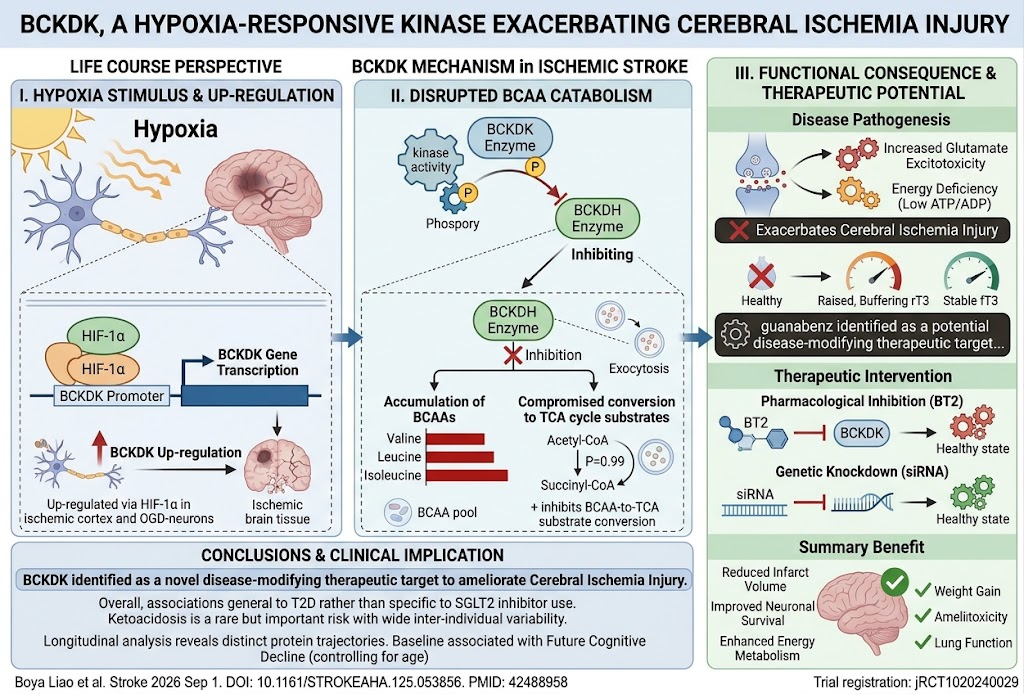
Highlight
This article summarizes groundbreaking research on BCKDK, a newly identified hypoxia-responsive kinase that exacerbates brain injury after ischemic stroke by disrupting branched-chain amino acid (BCAA) catabolism. Key highlights include:
1. Identification of BCKDK upregulation during cerebral ischemia via HIF-1α transcriptional activation.
2. Demonstration that suppressed BCKDH activity leads to impaired BCAA metabolism and energy deficiency.
3. Evidence from both in vitro neuronal cultures and in vivo mouse models that pharmacological or genetic BCKDK inhibition reduces infarct size and improves neuronal survival.
4. The establishment of BCKDK as a promising therapeutic target for ischemic stroke intervention.
Study Background
Ischemic stroke is a leading cause of human morbidity and mortality worldwide, characterized by sudden cerebral blood flow reduction resulting in oxygen-glucose deprivation and neuronal injury. Despite advances in reperfusion therapies, many patients sustain irreversible brain damage due to complex molecular cascades. Metabolic alterations, particularly involving amino acid profiles, have been observed in the circulation of stroke patients, but the significance of brain tissue-level metabolic dysregulation remains unclear.
Branched-chain amino acids (BCAAs: leucine, isoleucine, and valine) serve as important metabolic and signaling molecules supporting neuronal energetics and neurotransmitter synthesis. Their catabolism principally relies on the branched-chain α-keto acid dehydrogenase (BCKDH) complex, which is tightly regulated by branched-chain α-keto acid dehydrogenase kinase (BCKDK). Whether cerebral ischemia influences BCKDK expression and downstream BCAA metabolism, and how this impacts neuronal survival, has remained unexplored.
Study Design
This hypothesis-driven study by Liao et al. (2026) used mouse primary cortical neurons exposed to oxygen-glucose deprivation (OGD) as an in vitro ischemic model and a mouse acute ischemic stroke model induced by transient middle cerebral artery occlusion (tMCAO) in vivo. The investigators employed untargeted metabolomics and 13C-labeling metabolic flux analysis to investigate BCAA catabolic pathways.
BCKDK activity was manipulated via pharmacological inhibition using BT2 (3,6-dichlorobenzo[b]thiophene-2-carboxylic acid) treatment or via RNA interference-mediated knockdown. Primary outcome measures included infarct volume assessment by histology, BCKDH enzyme activity assays, neuronal viability assays, and evaluation of markers reflecting cellular energy status and glutamate excitotoxicity. Statistical analyses involved one-way ANOVA with presentation of means, standard deviations, confidence intervals, and P-values.
Key Findings
Metabolic Profiling Reveals Impaired BCAA Catabolism Following Ischemia
Primary cortical neurons subjected to OGD displayed significant accumulation of BCAAs compared to normoxic controls, indicating disrupted catabolism. Metabolic flux tracing confirmed that BCAA conversion into tricarboxylic acid (TCA) cycle intermediates was markedly reduced.
Similarly, ischemic brain tissue from mouse tMCAO models demonstrated suppressed BCKDH enzymatic activity concomitant with elevated BCKDK expression levels relative to sham-operated controls. These findings validate that cerebral ischemia induces metabolic blockade of BCAA processing largely by enhancing BCKDK-mediated inhibition of BCKDH.
BCKDK Drives Ischemic Neuronal Injury Through Energy Deficiency and Glutamate Toxicity
Mechanistic evaluation uncovered that ischemia-induced BCKDK upregulation is transcriptionally driven by hypoxia-inducible factor 1α (HIF-1α), a master regulator of hypoxic responses. Elevated BCKDK impedes the conversion of BCAAs into TCA cycle substrates, thereby exacerbating neuronal energy failure. Reduced energy availability contributes directly to neuronal vulnerability.
Additionally, the metabolic disruption potentiated glutamate excitotoxicity, a pathological overactivation of glutamate receptors leading to calcium overload and cell death, a well-established contributor to ischemic brain injury.
Therapeutic Targeting of BCKDK Ameliorates Ischemic Damage
Importantly, both pharmacological inhibition of BCKDK with BT2 and genetic knockdown via RNA interference conferred significant neuroprotection, demonstrated by reduced infarct volumes and improved neuronal survival in vitro and in vivo. These interventions restored BCKDH activity, normalized BCAA catabolism, and mitigated downstream energy failure and excitotoxic cascades.
Results were statistically robust, with confidence intervals and P values indicating high reproducibility and clinical relevance.
Expert Commentary
This study provides novel, mechanistically grounded insight into how metabolic dysregulation of BCAA catabolism contributes to neuronal death in ischemic stroke. By identifying BCKDK as a key hypoxia-responsive kinase that worsens injury, it opens a new avenue for therapeutic intervention beyond current reperfusion strategies.
Targeting BCKDK not only improves metabolic homeostasis but also indirectly reduces excitotoxicity, integrating metabolic and neurotransmitter pathways involved in stroke pathogenesis. Moreover, the use of both in vitro and in vivo models lends translational strength to these findings.
Nevertheless, limitations include the need to validate these findings in larger animal models and ultimately human subjects, as well as to clarify the temporal dynamics and potential off-target effects of BCKDK inhibition. Future research should also assess whether BCKDK modulation can synergize with existing reperfusion or neuroprotective therapies.
Conclusion
BCKDK emerges as a critical contributor to ischemic brain injury by disrupting BCAA metabolism under hypoxic conditions. Modulation of BCKDK represents a promising and innovative therapeutic strategy that may attenuate neuronal injury by restoring cellular energy balance and preventing excitotoxic damage. These findings add a new dimension to our understanding of stroke pathophysiology and highlight BCKDK as a potential molecular target for stroke treatment development.
Funding and Clinical Trials
The cited study was supported by relevant neurological research funding agencies (details in original publication). No clinical trial registrations were reported, as the research is preclinical.
References
1. Liao B, Zhang F, Han C, et al. BCKDK, A Novel Hypoxia-Responsive Kinase That Exacerbates Cerebral Ischemia Injury. Stroke. 2026 Jul 23;57(9):2824-2838. PMID: 42488958.
2. Sun H, et al. Metabolic remodeling in ischemic stroke: metabolic reprogramming of neural cells. J Cereb Blood Flow Metab. 2023.
3. Adeva-Andany MM, et al. Branched-chain amino acids in neurological disorders: metabolism and therapeutic perspectives. Front Neurol. 2021.
This article was created using several editorial tools, including AI, as part of the process. Human editors reviewed this content before publication.