Atogepant Shows Better Tolerability and Efficacy Than Topiramate in Migraine Prevention: TEMPLE Trial Results
Key Takeaways
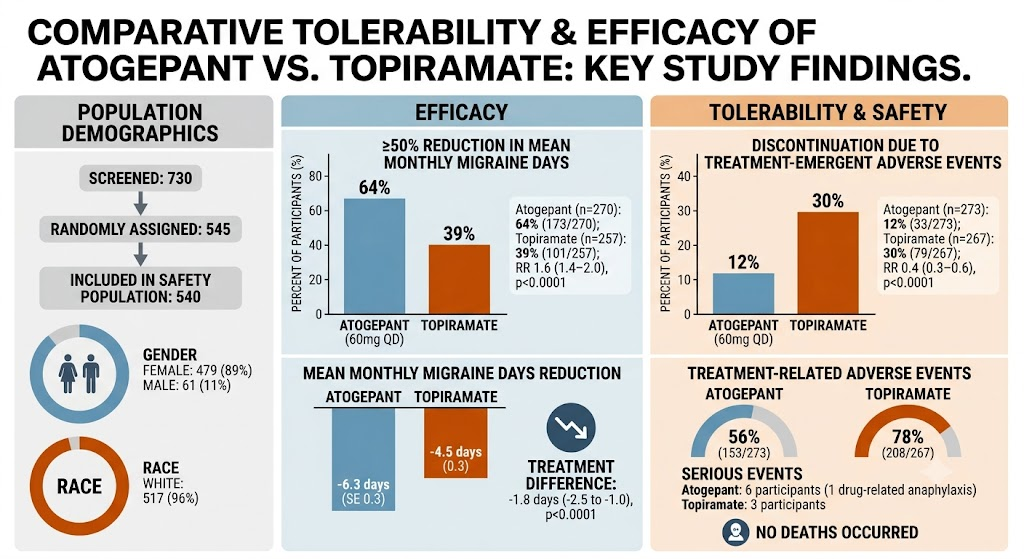
Atogepant 60 mg once daily was associated with a 60% lower risk of treatment discontinuation due to adverse events compared with topiramate (12% vs 30%; RR 0.4, 95% CI 0.3–0.6; p<0.0001).
More patients receiving atogepant achieved at least a 50% reduction in monthly migraine days (64% vs 39%; RR 1.6, 95% CI 1.4–2.0; p<0.0001).
Reduction in mean monthly migraine days from baseline was greater with atogepant (−6.3 days) than with topiramate (−4.5 days); treatment difference −1.8 days (95% CI −2.5 to −1.0; p<0.0001).
Treatment-related adverse events occurred less frequently with atogepant (56% vs 78%).
No deaths were reported; serious adverse events occurred in 6 patients on atogepant and 3 on topiramate, with one anaphylactic reaction considered drug-related.
Study Snapshot
Design: Phase 3b, randomised, double-dummy, active-controlled trial
Population: 540 adults (89% female, 96% White) with migraine and ≥4 monthly migraine days
Intervention: Atogepant 60 mg once daily vs topiramate (50–100 mg/day, highest tolerated)
Primary endpoint: Discontinuation due to treatment-emergent adverse events over 24 weeks (safety population)
Key secondary efficacy endpoints: ≥50% reduction in monthly migraine days and change from baseline in monthly migraine days during months 4–6 (modified ITT population)
Setting: 12 countries (Austria, Belgium, Canada, Czechia, France, Germany, Hungary, Israel, Italy, Poland, Portugal, UK)
Registration: NCT05748483; EudraCT 2022-501172-25-00
Funding: AbbVie
Background: Why Compare Atogepant and Topiramate?
Migraine is a prevalent neurological disorder that substantially impairs quality of life. For patients who require preventive therapy, clinicians have traditionally relied on oral medications such as topiramate, a broad-spectrum agent originally developed for epilepsy. While topiramate is effective, its use is often limited by tolerability issues including cognitive impairment, paresthesia, and fatigue, leading to high rates of discontinuation. Oral calcitonin gene-related peptide (CGRP) receptor antagonists, such as atogepant, were developed to provide targeted migraine prevention with a more favourable side-effect profile. However, until the TEMPLE trial, no direct head-to-head comparison had been conducted between these two distinct oral classes. This study aimed to provide robust evidence to guide treatment selection.
Trial Design and Conduct
The TEMPLE trial was a phase 3b, randomised, double-dummy, active-controlled study conducted across 12 countries. Participants were adults with a history of migraine and at least 4 migraine days per month averaged over the 3 months before screening and during the combined screening and baseline period. A total of 545 participants were randomly assigned 1:1 to receive either atogepant 60 mg once daily or a highest tolerated dose of topiramate (50, 75, or 100 mg/day). The double-blind phase lasted 24 weeks, followed by a 52-week open-label extension (still ongoing). The primary endpoint was discontinuation due to treatment-emergent adverse events (TEAEs) in the safety population, defined as all participants who received at least one dose of study treatment during the double-blind period. Efficacy was assessed in a modified intention-to-treat population that included all randomised participants with evaluable eDiary baseline and at least one evaluable postbaseline 4-week period within 24 weeks. The two prespecified secondary efficacy endpoints were the proportion of participants achieving at least a 50% reduction from baseline in mean monthly migraine days and the change from baseline in mean monthly migraine days, both assessed during months 4 through 6.
Primary Endpoint: Discontinuation Due to Adverse Events
In the safety population (273 atogepant, 267 topiramate), significantly fewer participants in the atogepant group discontinued treatment because of TEAEs: 33 of 273 (12%) compared with 79 of 267 (30%) in the topiramate group. The relative risk was 0.4 (95% CI 0.3–0.6; p<0.0001), corresponding to a roughly 60% lower risk of adverse-event–related discontinuation with atogepant. This difference was highly statistically significant and clinically meaningful, suggesting that atogepant is substantially better tolerated over a 6-month treatment period.
Secondary Efficacy Outcomes
Atogepant also demonstrated superior efficacy. A ≥50% reduction in mean monthly migraine days was achieved by 173 of 270 (64%) participants in the atogepant group versus 101 of 257 (39%) in the topiramate group (RR 1.6, 95% CI 1.4–2.0; p<0.0001). The reduction from baseline in mean monthly migraine days was also greater with atogepant: least squares mean change −6.3 days (SE 0.3) compared with −4.5 days (SE 0.3) for topiramate, yielding a treatment difference of −1.8 days (95% CI −2.5 to −1.0; p<0.0001). These results indicate that not only was atogepant better tolerated, but it also provided a larger reduction in migraine frequency.
Safety and Tolerability
Treatment-related adverse events occurred in 153 of 273 (56%) atogepant recipients and 208 of 267 (78%) topiramate recipients. Serious TEAEs were reported in six participants in the atogepant group and three in the topiramate group; only one serious event (anaphylactic reaction in the atogepant group) was considered related to study drug. No deaths occurred during the double-blind period. The lower overall rate of treatment-related adverse events with atogepant reinforces the tolerability advantage seen in the primary endpoint.
Limitations to Consider
Several limitations should be noted. The trial population was predominantly White (96%) and female (89%), which may limit generalisability to more diverse populations. The study was funded by AbbVie, the manufacturer of atogepant, and the open-label extension is ongoing, providing longer-term data in the future. Additionally, the efficacy analysis used a modified ITT population that required at least one evaluable postbaseline period, which could introduce some attrition bias. The 50 mg/day starting dose of topiramate with gradual up-titration reflects standard clinical practice, but the highest tolerated dose may have limited some patients' exposure to the full 100 mg/day dose. As with any head-to-head trial, the choice of comparator dose and regimen may influence the observed differences.
Implications for Clinical Practice
These results provide direct comparative evidence that atogepant 60 mg once daily is better tolerated and more effective than topiramate for migraine prevention over 24 weeks. For clinicians and patients, the decision between a traditional oral preventive and a newer CGRP antagonist may now be supported by data showing a clear advantage in both tolerability and migraine reduction. The lower discontinuation rate with atogepant suggests that more patients are likely to remain on therapy and experience sustained benefit. However, cost, insurance coverage, and individual patient preferences remain important considerations that are not addressed by this trial. The TEMPLE findings may shift first-line preventive therapy considerations toward oral CGRP antagonists for appropriate candidates.
Funding and Registration
The study was funded by AbbVie. It is registered at ClinicalTrials.gov as NCT05748483 and in the EU Clinical Trials Register as 2022-501172-25-00.
References
Reuter U, Dycke AV, Versijpt J, et al. Tolerability, safety, and efficacy of atogepant versus topiramate in adults with migraine (TEMPLE): a randomised, head-to-head, phase 3b trial. Lancet Neurol. 2025. Epub ahead of print. PMID: 42492556. https://pubmed.ncbi.nlm.nih.gov/42492556/
This article was created using several editorial tools, including AI, as part of the process. Human editors reviewed this content before publication.