Highlights
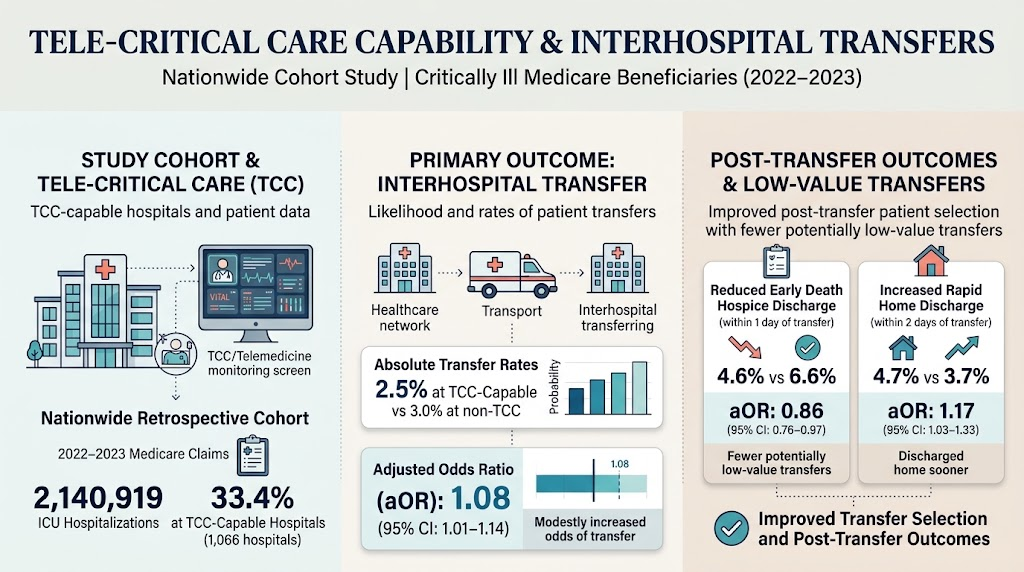
Tele-critical care (TCC) capability modestly increases interhospital transfer odds while improving transfer selection among critically ill Medicare beneficiaries.
TCC presence corresponds with fewer potentially low-value transfers, evidenced by lower early post-transfer mortality and hospice discharges.
Post-transfer outcomes from TCC hospitals show increased likelihood of early discharge home, suggesting enhanced triage and management.
Nationwide cohort data from 2021-2023 provide robust real-world evidence supporting the integration of TCC programs to optimize ICU resource utilization.
Background
Interhospital transfer of critically ill patients is a pivotal process enabling access to specialized interventions and higher levels of care not uniformly available across hospitals. However, such transfers incur patient risks including transport-related complications, delays in care, and exacerbation of illness, alongside systemic burdens reflected in increased costs and resource allocation challenges. Identifying strategies that can reduce unnecessary or “low-value” transfers without compromising care outcomes is therefore a critical priority.
Tele-critical care (TCC) programs leverage telemedicine technology to provide remote intensivist consultation and continuous monitoring to resource-limited or rural hospitals. This approach holds promise for enhancing clinical decision-making onsite, potentially reducing inappropriate transfers, and facilitating early recognition of patients truly needing advanced interventions. Despite growing adoption of TCC, its impact on transfer patterns and outcomes remains incompletely defined.
Key Content
Methodological Overview of Principal Study
The landmark study by Rai et al. (PMID:42878611), published in 2026, represents a comprehensive national retrospective cohort analysis linking Medicare fee-for-service ICU hospitalizations (2022-2023) with hospital characteristics from the American Hospital Association Annual Survey Database (AHAASD). TCC capability was dichotomized by either hospital self-reporting or a threshold number of TCC claims, allowing objective classification.
This study analyzed over 2.1 million ICU admissions across 1,066 TCC-capable hospitals and comparators. The primary endpoint was incidence of interhospital ICU transfer. Secondary analyses examined post-transfer receipt of specialty procedures, early mortality or hospice discharge, overall survival up to 30 days, and discharge disposition.
Hierarchical logistic regression models adjusted for comprehensive clinical covariates including patient demographics, comorbidities, organ failure burden, and hospital-level factors, accounting for clustering by transferring hospital.
Association Between TCC and Transfer Patterns
Crude rates of transfer were comparable between TCC-capable and non-capable hospitals (3.0% vs. 2.5%), yet adjusted models revealed a modest but statistically significant increase in transfer odds associated with TCC (aOR 1.08, 95% CI 1.01-1.14). This suggests TCC programs may enhance detection of critically ill patients requiring escalation rather than indiscriminately suppressing transfers.
Notably, transferred patients originating from TCC hospitals demonstrated higher acute illness severity indicators, reinforcing that TCC assists in identifying appropriate transfer candidates rather than just reducing overall transfer volume.
Impact on Potentially Low-Value Transfers and Outcomes
Critically, the study’s exploratory outcome analyses indicate fewer low-value transfers associated with TCC capability. Patients transferred from TCC hospitals had significantly lower early mortality or hospice discharge within one day post-transfer (4.6% vs. 6.6%; aOR 0.86), implying better transfer timing and decision-making.
Moreover, these patients exhibited a higher likelihood of discharge home within 2 days (4.7% vs. 3.7%; aOR 1.17), suggesting rapid post-transfer recovery or stabilization in appropriately selected populations.
Importantly, in-hospital and 30-day mortality did not significantly differ, underscoring that the improvement in early outcomes was not offset by downstream harms and pointing to enhanced patient-centered transfer triage.
Contextualizing Within Broader Literature
Previous smaller-scale or single-center studies have described TCC’s benefits in mortality reduction and complication mitigation in ICUs lacking onsite intensivists, but evidence specifically linking TCC to transfer utilization patterns has been sparse. This large nationwide study advances the field by providing real-world evidence that TCC not only supports quality care locally but also refines transfer practices to mitigate unnecessary or premature transfers.
Randomized controlled trials (RCTs) evaluating TCC have largely focused on mortality, length of stay, or process outcomes without explicitly addressing transfer decisions. Meta-analyses summarizing TCC interventions report mortality benefits particularly in resource-limited settings but call for more nuanced examination of resource utilization metrics, including transfers.
Expert guidelines increasingly recognize telemedicine as a tool for expanding critical care access and optimizing triage, highlighting the translational relevance of these findings for policy and hospital system planning.
Expert Commentary
This study’s findings offer compelling evidence that TCC programs facilitate complex clinical decision-making, balancing risks and benefits of interfacility transfers in critically ill Medicare patients. The modest increase in transfer odds with concomitant reduction in potentially low-value transfers suggests TCC enhances discerning patient selection rather than simply deterring transfer reflexively.
Mechanistically, access to remote intensivist expertise and continuous monitoring may enable earlier recognition of deterioration or stability, thus guiding optimal timing of transfer or empowering local management. This aligns with biological rationales emphasizing dynamic clinician oversight in critical care trajectory modulation.
Clinical applicability spans rural or under-resourced hospitals where onsite intensivist availability is limited. Integrating TCC may foster equitable access to specialist input and reduce unwarranted transfers that can delay definitive care or cause unnecessary burden.
Limitations warranting attention include potential residual confounding inherent in observational data, the proxy definition of TCC capability via claims and survey reporting, and the study timeframe limiting longer-term outcomes scrutiny. Furthermore, heterogeneity in TCC program models and intensity constrains generalizability.
Future research should focus on prospective trials incorporating transfer decision support, patient-centered outcomes, and cost-effectiveness analyses to elucidate TCC’s role in complex care networks.
Conclusion
The association between tele-critical care capability and interhospital transfer among critically ill Medicare patients highlights a nuanced balance: TCC modestly increases transfer rates but simultaneously reduces potentially low-value transfers and improves early post-transfer outcomes. This evidence underscores TCC’s potential as an integral mechanism to optimize critical care delivery, enhance resource allocation, and improve patient trajectories in heterogeneous hospital settings. Broader implementation and further rigorous evaluation of TCC programs could substantially advance ICU care quality and health system efficiency nationwide.
References
Rai K, Mehta AB, Burke JF, Brummel NE. Association of Tele-Critical Care Capability With Interhospital Transfers and Potentially Low-Value Transfers Among Critically Ill Medicare Beneficiaries. Crit Care Med. 2026 Oct 15. PMID: 42878611.
Wilcox ME, Adhikari NKJ. The effect of telemedicine in critically ill patients: systematic review and meta-analysis. Crit Care. 2012;16(4):R127. PMID: 22850569.
Kahn JM, Le TQ, Barnato AE, Hargett CW, Angus DC. The Structure of Critical Care Telemedicine Programs: A Nationwide Survey. Crit Care Med. 2016;44(3):558-564. PMID: 26667324.
Dougherty M, Turan JM, Gaillot L, et al. Telemedicine and Pediatric Critical Care Tele-ICU Implementation: A Systematic Review. J Intensive Care Med. 2019;34(8):664-675. PMID: 29636820.
National Academies of Sciences, Engineering, and Medicine. The Role of Telehealth in an Evolving Health Care Environment: Workshop Summary. Washington, DC: The National Academies Press; 2012. ISBN: 978-0-309-25737-6.