We use cookies

Our website uses essential cookies and, with your consent, additional cookies to measure performance and improve our services. Cookie Policy.

You can change your choice at any time.

MMedXYNews
HomeVideos
MedXY AI/MedXY News/Section: AI

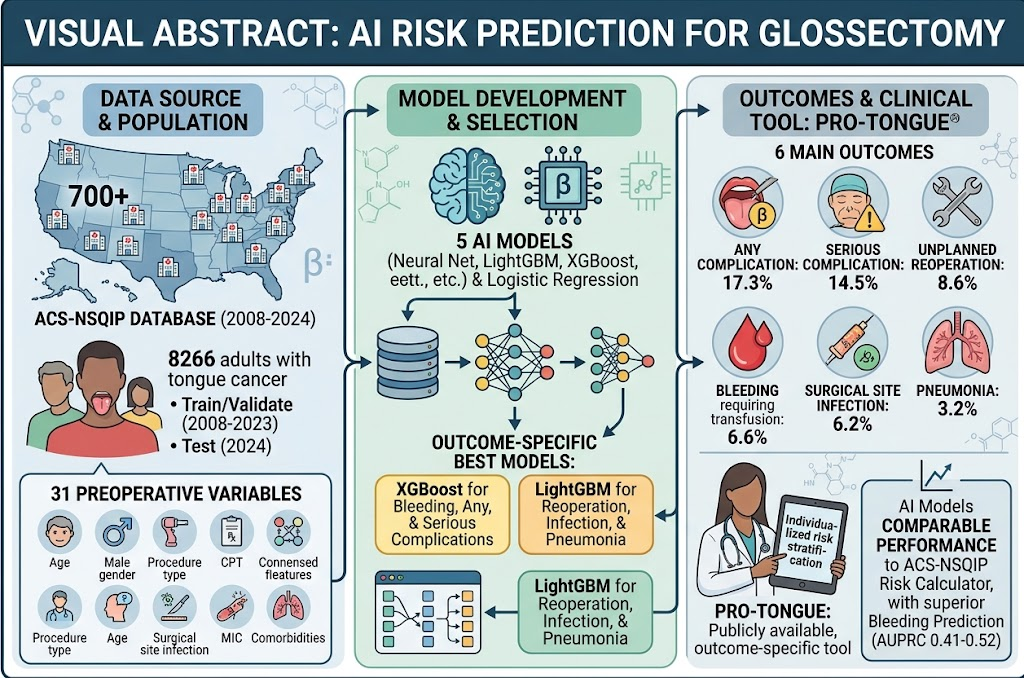
Artificial Intelligence Enhances Risk Prediction for Postoperative Complications After Tongue Cancer Surgery
MedXY Editorial Team•Aug 18, 2026•AI
术后并发症Risk PredictionTongue Cancer Surgeryartificial intelligencemachine learning

Highlight

  • Development of PRO-TONGUE, an AI-based risk prediction tool for individualized 30-day postoperative complication risk after tongue cancer surgery.
  • Use of advanced machine learning techniques, including XGBoost and LightGBM, to enhance accuracy across multiple complication outcomes.
  • Performance of ML models comparable or superior to the ACS-NSQIP risk calculator, especially for bleeding requiring transfusion prediction.
  • PRO-TONGUE offers interpretable, outcome-specific risk estimates to assist preoperative planning and shared decision-making.

Study Background

MedXY registered readers

Sign in free to continue reading

Create or use your MedXY account to unlock the complete article.

This article was created using several editorial tools, including AI, as part of the process. Human editors reviewed this content before publication.

Related articles

Open language-specific specialty feeds and department pages.

Machine Learning-enhanced Steroid Profiling for Rapid Diagnosis of Congenital Adrenal Steroidogenesis DisordersThis article reviews a validated machine learning decision-tree model using LC-MS/MS steroid profiles to accurately and rapidly diagnose congenital disorders of adrenal steroidogenesis (CDAS), enhancing clinical decision-making and patientSep 19, 2026Reevaluating Angiography in the Diagnosis and Management of Intraluminal Hemorrhage Following Pancreatoduodenectomy: Insights from 115 Cases Among 3,011 SurgeriesThis study highlights the diagnostic and therapeutic value of angiography in intraluminal postpancreatoduodenectomy hemorrhage, revealing its superiority in bleeding source localization and effective hemostasis compared to other modalities.Sep 17, 2026Impact of an AI-Powered Gamified Mobile Health Application on Blood Pressure Control in a Matched Patient CohortStudy found that use of an AI-driven gamified mobile app integrating home blood pressure monitoring significantly improved blood pressure control compared to usual care in hypertensive patients.Sep 17, 2026
Loading comments...
MedXY briefing

Get the free newsletter

Evidence-led clinical news, trends, and analysis—delivered to your inbox.

Ask MedXY AI

Most popular

Intimate Health
Five Benefits for Women Continuing Sexual Activity After Menopause
Intimate Health
Why Some Women Have a Strong Sex Drive—And Why Men Shouldn't Worry About It
Nursing & care
How often should a couple have sex?
Intimate Health
Classic Intimacy Recommendations: How to Help Women Reach Orgasm and Enjoy Mutual Pleasure
Intimate Health
What Makes a Woman "Physiologically Addicted" Is Never Money, But These Two Relationship Qualities
© 2026 MedXY
Contact usAbout usPrivacy PolicyMedXY story
Intraoperative Botulinum Toxin Injection to Reduce Postoperative Sialocele After Parotidectomy: A Retrospective Cohort Analysis
This study suggests intraoperative botulinum toxin may reduce sialocele formation after parotidectomy, though larger prospective trials are needed to confirm efficacy and guide clinical use.
Sep 15, 2026
Impact of Severe Anastomotic Leak After Esophagectomy on Long-Term Survival: Insights from a Modern Multicenter CohortA large European study shows that severe anastomotic leaks requiring surgical reintervention after esophagectomy significantly reduce long-term survival and increase postoperative mortality, underscoring the need for targeted management strSep 12, 2026
Advancing Prognostic Precision in HFpEF: The LIFE-Preserved Risk Prediction ModelThe LIFE-Preserved model accurately predicts short-term and lifetime risks of heart failure hospitalization or cardiovascular death in HFpEF patients, enabling tailored clinical risk stratification and improved management.Sep 11, 2026