Highlight
This study identifies two distinct anti-müllerian hormone (AMH) decline trajectories leading to the final menstrual period, differentiated by initial AMH levels and rate of decline. Unexpectedly, a lower baseline AMH with slower decline trajectory correlates with adverse postmenopausal cardiovascular risk profiles despite fewer vasomotor symptoms.
Study Background
The menopause transition is marked by endocrine changes, particularly alterations in ovarian reserve markers such as anti-müllerian hormone (AMH). AMH, produced by ovarian granulosa cells, is widely recognized for reflecting the quantity of the follicular pool and serves as a biomarker for reproductive aging. Understanding AMH decline trajectories provides clinical insight into the timing of the final menstrual period (FMP) and associated health outcomes. Prior research has established that menopause timing influences long-term health, including cardiovascular disease risk, yet the linkage between AMH decline patterns and postmenopausal cardiovascular profiles remains inadequately characterized.
Study Design
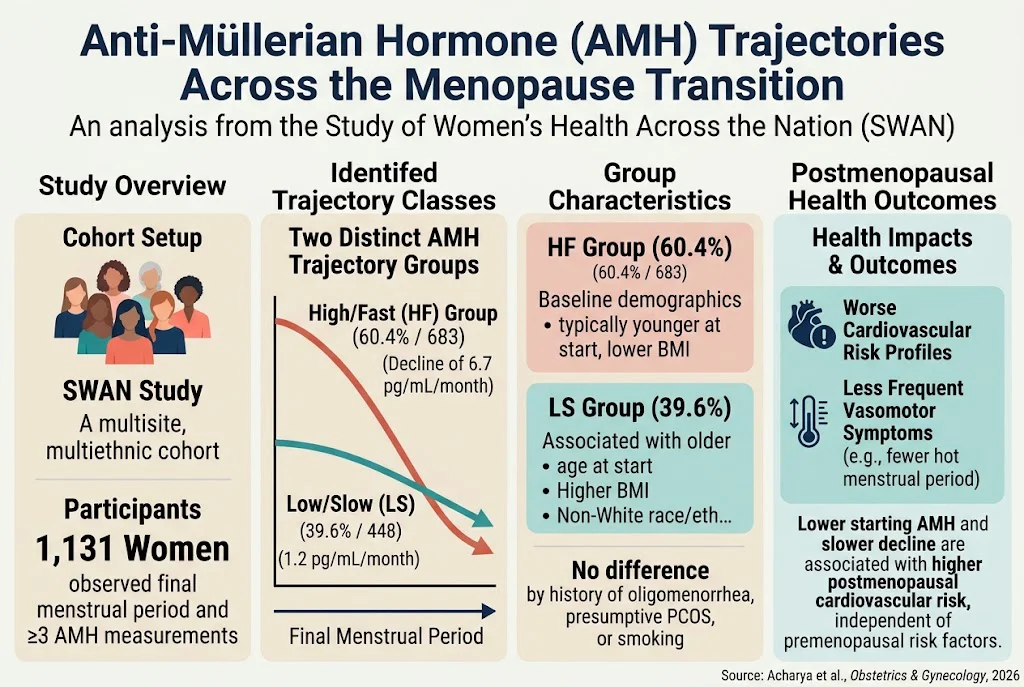
This investigation leveraged data from the Study of Women’s Health Across the Nation (SWAN), a multisite, multiethnic longitudinal cohort study designed to examine the menopausal transition among women. The analysis included 1,131 women who experienced an observed final menstrual period and had at least three AMH measurements during perimenopause.
Participants were stratified via statistical trajectory modeling into distinct AMH decline classes based on serum AMH levels and their rate of change across the perimenopausal phase. Baseline demographic and health parameters were compared across these AMH classes using analysis of variance and chi-square tests. Additionally, generalized estimating equation models assessed associations between AMH trajectory class and longitudinal outcomes, accounting for repeated measures within participants.
Key Findings
Two principal AMH trajectory classes emerged:
Low/Slow (LS) group: 448 women (39.6%) characterized by lower initial AMH levels and a median decline rate of 1.2 pg/mL per month.
High/Fast (HF) group: 683 women (60.4%) with higher initial AMH levels and a steeper median decline rate of 6.7 pg/mL per month.
Key distinctions between these groups included:
Demographics: The LS group was older at baseline, had higher body mass index (BMI), and was more frequently non-White in racial/ethnic composition compared to the HF group.
Medical History: No significant differences were identified by history of oligomenorrhea, presumptive polycystic ovarian syndrome, or smoking status between groups.
Postmenopausal Health Outcomes: Women in the LS group demonstrated worse cardiovascular risk profiles after menopause, independent of premenopausal risk factors. Paradoxically, they also reported fewer frequent vasomotor symptoms following the final menstrual period compared with the HF group.
The findings suggest that a slower AMH decline, though associated with lower baseline ovarian reserve, portends a higher cardiovascular risk burden in later life. This counters the general assumption that a rapid ovarian aging trajectory necessarily confers increased cardiovascular risk.
Expert Commentary
This study offers a novel perspective on the heterogeneity of AMH trajectories through menopause and their clinical relevance beyond reproductive aging. The delineation of two distinct AMH decline patterns highlights possible underlying biological differences in ovarian senescence and systemic aging processes. The association of the low/slow AMH trajectory with adverse cardiovascular profiles suggests that ovarian reserve metrics may serve as surrogate markers for broader vascular aging mechanisms.
However, limitations include reliance on observed final menstrual period, which may introduce misclassification if menstrual patterns were irregular. The cohort’s demographic diversity strengthens generalizability but also necessitates careful consideration of confounding socioeconomic and lifestyle factors.
Future research should explore pathophysiological mechanisms linking AMH trajectories to cardiovascular risk, potentially examining inflammatory pathways, endothelial function, and metabolic parameters. Integration of AMH monitoring into cardiovascular risk assessment during menopause transition might refine preventive strategies tailored to individualized aging trajectories.
Conclusion
This study identifies two distinct trajectories of AMH decline during the menopausal transition, with the low baseline and slower decline trajectory linked to higher postmenopausal cardiovascular risk independent of traditional early-life risk factors. These findings underscore the complexity of menopause biology and suggest AMH may be a useful biomarker not only for reproductive aging but also for identifying women at elevated cardiovascular risk postmenopause. Incorporating AMH trajectory assessment into clinical practice could enhance risk stratification and guide personalized interventions for cardiovascular health in aging women.
Funding and ClinicalTrials.gov
The SWAN study is federally funded, with no specific funding sources reported for this secondary analysis. The SWAN cohort is registered under ClinicalTrials.gov identifier NCT00000435.
References
Acharya KS, Bozzuto L, Kaizer LK, et al. Anti-Müllerian Hormone Trajectories Across the Menopause Transition. Obstet Gynecol. 2026 Oct 27. PMID: 42945500.
Broer SL, Broekmans FJ, Laven JS, Fauser BC. Anti-Müllerian hormone: ovarian reserve testing and its potential clinical implications. Hum Reprod Update. 2014 May-Jun;20(5):688-701.
Burke EW, Wattick RA, Hayat MJ, Ziv-Gal A. Menopausal transition and cardiovascular disease risk in women. Womens Health (Lond). 2020;16:1745506520919474.
Harlow SD, Gass M, Hall JE, et al. Executive summary of the Stages of Reproductive Aging Workshop + 10: addressing the unfinished agenda of staging reproductive aging. Menopause. 2012 Apr;19(4):387-95.
Santoro N, Lasley BL, McConnell D, et al. Hormone dynamics during the menopausal transition: the Study of Women’s Health Across the Nation (SWAN). J Clin Endocrinol Metab. 2003 Oct;88(10):4316-22.