AMBUSH-AI: Advancing Burn Depth Diagnosis with Artificial Intelligence and Ultrasound Imaging
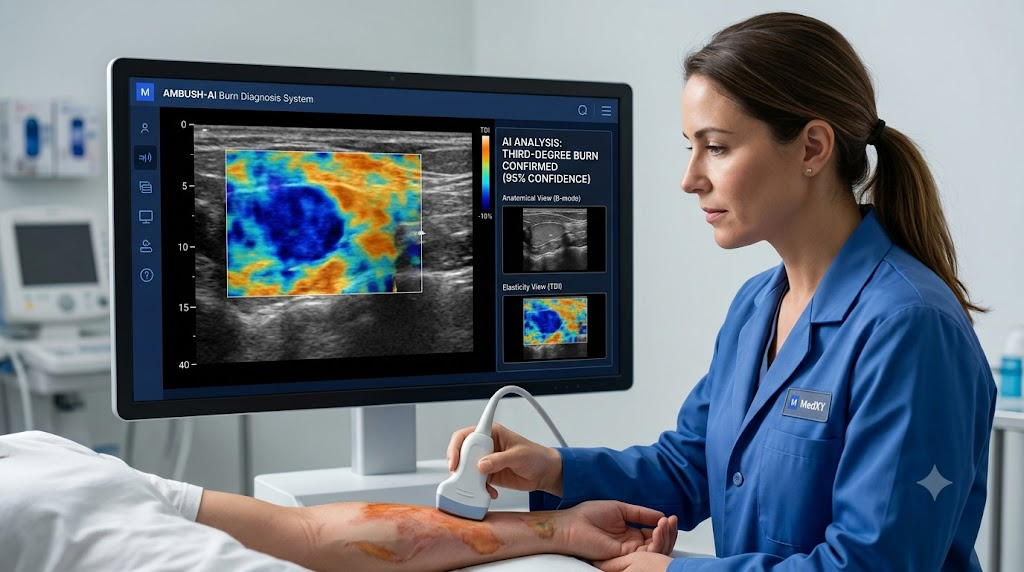
Highlight
1. AMBUSH-AI integrates FDA-approved ultrasound techniques with AI to noninvasively determine burn wound depth with high accuracy.
2. The system achieved 95% accuracy in detecting third-degree burns in human subjects, substantially exceeding traditional clinical diagnostic accuracy.
3. Combining Tissue Doppler Elastography Imaging (TDI) and Harmonic B-mode ultrasound provides functional and anatomical data critical for precise depth assessment.
4. This AI-based approach could reduce diagnostic uncertainty and improve surgical decision-making in burn care.
Study Background
Burn wound depth assessment critically informs clinical management, guiding the decision on whether surgical intervention is necessary. Traditionally, burn surgeons rely on physical examination as the diagnostic gold standard to distinguish between superficial, partial-thickness, and full-thickness (third-degree) burns. However, the subjective nature of visual evaluation results in only about 76% diagnostic accuracy even among experts, dropping to 50% for less experienced providers. This diagnostic uncertainty can delay appropriate treatment, prolong recovery, and increase morbidity.
Recent advances in ultrasound imaging modalities offer noninvasive ways to assess burn tissue characteristics. Tissue Doppler Elastography Imaging (TDI) quantifies tissue stiffness, which is a key indicator of tissue viability, while Harmonic B-mode ultrasound delineates anatomical landmarks. Despite these technological enhancements, interpretation remains complex and operator-dependent.
Artificial intelligence (AI) promises to standardize and enhance image interpretation through data-driven pattern recognition. The Automated Noninvasive Burn Diagnostic System for Health Care using Artificial Intelligence (AMBUSH-AI) was developed to combine these imaging modalities with AI to improve the diagnostic accuracy of burn depth assessment.
Study Design
The study was conducted in two phases: an initial development phase using a pig burn model (n=12) and a prospective human validation cohort (n=30) with thermal burns. In the animal model, various depths of burns were created to generate a representative dataset for AI training.
For human subjects, images were obtained using two ultrasound techniques: Tissue Doppler Elastography Imaging (TDI) to assess stiffness, and Harmonic B-mode ultrasound to visualize anatomical structures. Simultaneously, digital photographs were collected. Biopsies, serving as ground truth for burn depth, were obtained from five patients who underwent surgical debridement, enabling direct comparison and validation of AI predictions.
The AI framework was designed to analyze combined imaging input to classify burn depth automatically. Accuracy and explainability, two key metrics for clinical AI adoption, were primary outcomes evaluated.
Key Findings
Animal Model Results: The AI algorithm demonstrated 100% accuracy in identifying third-degree burns in the pig model, attesting to its capability in controlled settings.
Human Clinical Results: The human cohort had a mean age of 47.6±17.6 years and an average total body surface area (TBSA) burned of 7.7%±8.5%. The AMBUSH-AI system achieved 95% accuracy in detecting third-degree burns. This accuracy notably surpasses current expert visual diagnosis rates.
The combined use of TDI and Harmonic B-mode ultrasound allowed the AI to integrate biomechanical (tissue stiffness) and anatomical information, enhancing diagnostic precision. Importantly, the model demonstrated explainability in its decisions, providing clinicians with interpretable image features rather than black-box outputs.
While the sample size was limited, especially for biopsy-confirmed cases, the results strongly support the system’s potential utility. Safety and image acquisition were straightforward, with no reported adverse effects.
Expert Commentary
Burn depth assessment remains a fundamental but challenging aspect of burn care. Subjective clinical examination can be inconsistent and nonuniform, resulting in varied treatment plans. Incorporating quantitative ultrasound data interpreted via AI is a promising approach to address this clinical gap.
AMBUSH-AI exemplifies the translational application of artificial intelligence in surgical diagnostics—leveraging multimodal imaging to improve accuracy and reduce interobserver variability. The use of FDA-approved imaging modalities strengthens regulatory feasibility. However, further large-scale, multicenter validations are necessary to confirm generalizability across diverse patient populations and burn etiologies.
Additionally, integration with clinical workflows and provider training on image acquisition will be key to adoption. The explainability feature of the AI system is commendable as it fosters clinician trust and facilitates collaborative decision-making.
Conclusion
The AMBUSH-AI system represents an innovative advancement in burn wound diagnostics by uniting ultrasound imaging and AI interpretation to achieve high accuracy in burn depth assessment. This could lead to more timely and appropriate surgical interventions, ultimately improving patient outcomes. Ongoing research should focus on expanding validation cohorts, refining AI models, and exploring real-world clinical integration.
If widely implemented, this technology has the potential to become a new standard for noninvasive, objective burn depth diagnosis.
Funding and Trial Registration
Details regarding funding sources and clinical trial registration were not provided in the original publication.
References
El Masry M, Rahman MM, Gnyawali SC, et al. Automated Noninvasive Burn Diagnostic System for Health Care Using Artificial Intelligence: AMBUSH-AI. Ann Surg. 2026 Feb 19;284(2):296-304. PMID: 41709317.
Hettiaratchy S, Papini R. Initial management of a major burn: II—assessment and resuscitation. BMJ. 2004 Jul 3;329(7457):101-3.
Chao JD, Chen D, Tong M, et al. Advances in burn wound diagnosis and monitoring with noninvasive imaging: A review. Burns. 2020 Mar;46(2):268-279.
Phan TT, Goh CL. Evidence-based non-invasive evaluation of burn depth. Burns. 2011 Jan;37(1):2-10.
Duong M, Hassan A, Sarntivijai S, et al. Explainable artificial intelligence for medical image interpretation: recent advances and future perspectives. J Med Syst. 2023 Apr;47(5):35.
This article was created using several editorial tools, including AI, as part of the process. Human editors reviewed this content before publication.