Highlight
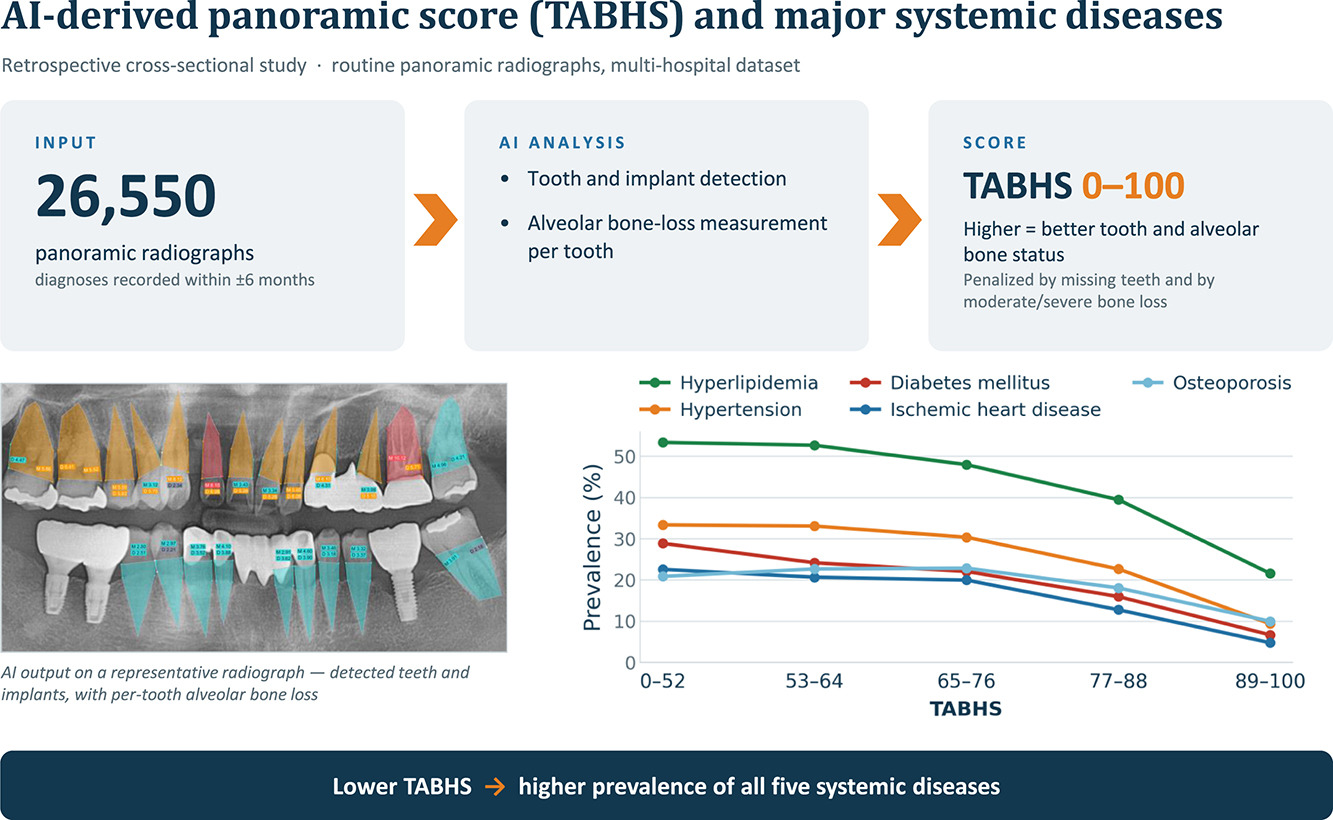
An AI model quantified alveolar bone loss and missing teeth from 26,550 panoramic radiographs to generate a continuous oral health score.
The AI-derived panoramic score was independently and inversely associated with five systemic diseases: diabetes mellitus, hypertension, osteoporosis, ischemic heart disease, and hyperlipidemia.
The score’s highest relative risk discrimination was for ischemic heart disease, and it showed incremental predictive value for diabetes, hypertension, and hyperlipidemia beyond age, sex, and BMI.
This approach offers an automated, quantitative, non-invasive imaging biomarker that could facilitate integrated dental and medical disease management.
Study Background
Oral health has long been recognized as intricately linked to systemic health, with periodontal disease and tooth loss correlated with cardiovascular diseases, metabolic disorders, and osteoporosis. However, routine clinical integration of oral imaging data into systemic disease risk assessment remains underdeveloped. Panoramic radiography is widely used in dental practice and provides comprehensive visualization of teeth and alveolar bone. Advances in artificial intelligence (AI), particularly in automated image analysis, have created opportunities to extract quantifiable features reflective of oral health status on a large scale. This study explores whether an AI-derived panoramic radiograph score capturing missing teeth and alveolar bone loss correlates independently with several major systemic diseases, potentially offering a novel biomarker to support integrated healthcare.
Study Design
This retrospective, cross-sectional analysis involved 26,550 panoramic radiographs collected from two hospitals. An AI model detected individual teeth and dental implants and quantified alveolar bone loss severity. From these parameters, a radiograph-based score was computed on a 0-100 scale, incorporating the number of missing teeth and weighted severity of bone loss. The study evaluated associations between this score and clinical diagnoses of five systemic diseases: diabetes mellitus, hypertension, osteoporosis, ischemic heart disease, and hyperlipidemia.
Methods included between-group comparisons of scores across disease status, prevalence trend analyses across ascending score quintiles, and multivariate logistic regression models adjusted for confounders (age, sex, BMI). The incremental diagnostic discrimination of the AI score over demographic covariates alone was assessed using changes in area under the receiver operating characteristic curve (ΔAUC) and the DeLong test for statistical significance.
Key Findings
Compared to controls, patients with each systemic disease exhibited significantly lower panoramic scores (all P<0.001), indicating worse oral health status. The largest adjusted difference was seen for diabetes mellitus (β coefficient = -6.25). There was a consistent decreasing prevalence trend for all five diseases across ascending score strata (statistically significant by Cochran-Armitage test, P<0.001).
Relative risk for disease comparing lowest to highest score quintiles was highest for ischemic heart disease (4.73). After adjusting for age, sex, and BMI, the AI-derived panoramic score remained independently associated with all studied diseases, achieving area under the curve (AUC) values between 0.74 and 0.80 — indicating moderate discriminatory ability.
Notably, the score significantly improved discrimination beyond demographic factors for diabetes mellitus, hypertension, and hyperlipidemia (ΔAUC ranging from 0.0015 to 0.0154; DeLong P<0.0188), whereas for ischemic heart disease and osteoporosis, incremental discrimination was not statistically significant.
Expert Commentary
This study illuminates the potential of AI-driven analysis of routine dental radiographs to provide quantifiable markers linked to systemic disease states. The inverse relationship between the panoramic score and systemic disease prevalence aligns with established literature connecting poor oral health, particularly alveolar bone loss and tooth loss, to diabetes and cardiovascular disease through mechanisms such as chronic inflammation and shared risk factors.
The moderate predictive performance combined with significant incremental value for metabolic diseases supports the panoramic score’s utility as an adjunct screening or risk stratification tool. However, cross-sectional design limits causality inference. The studied cohort drawn from hospital populations might reduce generalizability. Future prospective longitudinal studies could clarify whether integrating such AI-derived oral health metrics into clinical practice improves early detection or management of systemic conditions.
Moreover, mechanistic insights into how periodontal inflammation and bone loss propagate systemic pathophysiology warrant further investigation to strengthen the biological plausibility underpinning the score’s associations.
Conclusion
An AI-generated panoramic radiograph score reflecting oral health status demonstrated independent associations with five major systemic diseases, with the strongest link to ischemic heart disease and diabetes mellitus. This non-invasive, automated, image-based index represents a promising translational tool to bridge dental and medical healthcare interfaces, potentially aiding integrated management of patients with complex comorbidities.
Future research should focus on prospective validation, refinement of AI models for accuracy enhancement, and implementation studies to evaluate clinical utility and cost-effectiveness of panoramic radiograph-derived systemic disease risk assessment in diverse populations.
Funding and ClinicalTrials.gov
No specific funding sources or clinical trial registration information were reported in the original study.
References
1. Tonetti MS, Jepsen S, Jin L, Otomo-Corgel J. Impact of the global burden of periodontal diseases on health, nutrition and wellbeing of mankind: A call for global action. Journal of Clinical Periodontology. 2017 May;44(5):456-462.
2. Chapple IL, Genco R. Diabetes and periodontal diseases: Consensus report of the joint EFP/AAP Workshop on Periodontitis and Systemic Diseases. J Periodontol. 2013 Apr;84(4-s):S106-12.
3. Preshaw PM, Alba AL, Herrera D, Jepsen S, Konstantinidis A, Makrilakis K, Taylor R. Periodontitis and diabetes: a two-way relationship. Diabetologia. 2012 Jan;55(1):21-31.
4. Tonetti MS, Van Dyke TE. Periodontitis and atherosclerotic cardiovascular disease: Consensus report of the joint EFP/AAP Workshop on Periodontitis and Systemic Diseases. J Periodontol. 2013 Apr;84(4-s):S24-S29.
5. Kinane DF, Stathopoulou PG, Papapanou PN. Periodontal diseases. Nat Rev Dis Primers. 2017 Jun 29;3:17038.
6. DeLong ER, DeLong DM, Clarke-Pearson DL. Comparing the areas under two or more correlated receiver operating characteristic curves: a nonparametric approach. Biometrics. 1988 Sep;44(3):837-45.
7. Lee JH, et al. Artificial intelligence in dental imaging: Assessment and future perspectives. Imaging Sci Dent. 2020 Sep;50(3):169-177.
8. Wu T, et al. Associations between oral health status and systemic conditions: A systematic review. Int J Environ Res Public Health. 2020;17(1):139.
9. The original study citation: Kahm SH, Ko DY, Choi JS, Lee JH, Cho SH, Lee SY. AI-derived panoramic score and its association with major systemic diseases: A retrospective cross-sectional study. Journal of dentistry. 2026-10-17:107104. PMID:42892360.