We use cookies

Our website uses essential cookies and, with your consent, additional cookies to measure performance and improve our services. Cookie Policy.

You can change your choice at any time.

MMedXYNews
HomeVideos
MedXY AI/MedXY News/Section: Neurology

Unraveling the Link Between Alzheimer’s Pathology, Sleep Disturbances, and Cognitive Decline in Late-Onset Unexplained Epilepsy

MedXY Editorial Team•Sep 5, 2026•Neurology
cognitionAlzheimer pathologyp-tau217 biomarkersleep microarchitecturelate-onset unexplained epilepsy
Highlight

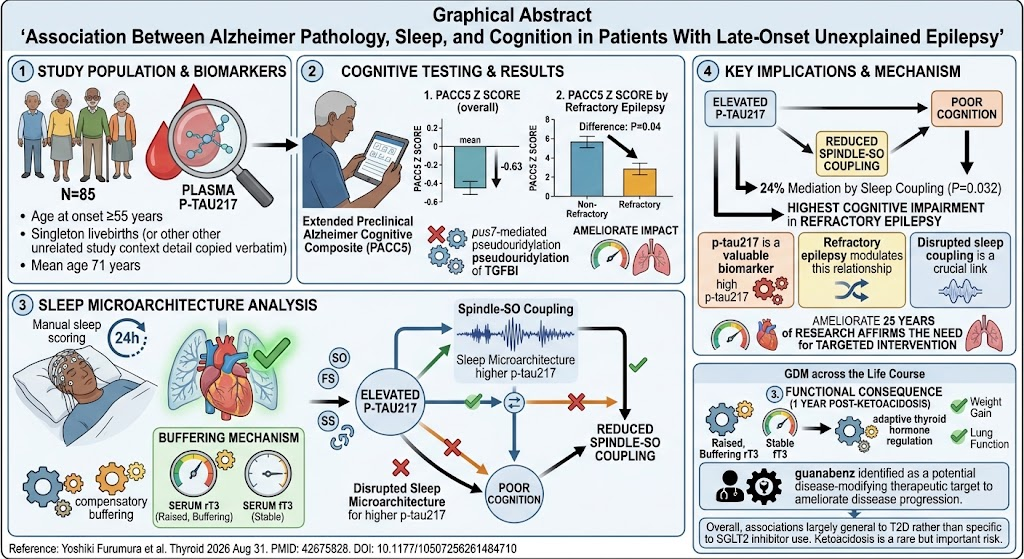
This study demonstrates a significant association between elevated plasma p-tau217, a biomarker reflective of Alzheimer disease pathology, and cognitive decline in late-onset unexplained epilepsy (LOUE). Additionally, it identifies disrupted sleep microarchitecture—specifically reduced spindle-slow oscillation coupling—as a partial mediator of this association. Cognitive deficits were most severe in patients with refractory epilepsy, underscoring epilepsy severity as an important modifier in this relationship.

Study Background

MedXY registered readers

Sign in free to continue reading

Create or use your MedXY account to unlock the complete article.

This article was created using several editorial tools, including AI, as part of the process. Human editors reviewed this content before publication.

Related articles

Open language-specific specialty feeds and department pages.

Bridging Social Determinants of Health and Multidimensional Frailty Among Older Adults: A Domain-Specific Latent Class and Network AnalysisThis study explores how economic, educational, healthcare, neighborhood, and social factors link to multiple frailty dimensions in Chinese older adults, highlighting cognition as a key intermediary.Aug 26, 2026Decoding Sleep’s Role in Cognitive Health and Dementia Risk: Insights from the Sleep and Dementia ConsortiumThis study identifies distinct sleep patterns linked to cognitive performance but finds no significant direct association with dementia risk, highlighting the complexity of sleep-cognition relationships in aging populations.Jul 31, 2026Long-Term Mortality, Cognition, and Quality of Life After Chronic Subdural Hematoma Surgery: A Comprehensive ReviewThis review synthesizes evidence on the long-term survival, excess mortality, and health-related quality of life in patients after chronic subdural hematoma surgery, emphasizing sustained mortality risks and cognitive-physical deficits up tJun 25, 2026
Loading comments...
MedXY briefing

Get the free newsletter

Evidence-led clinical news, trends, and analysis—delivered to your inbox.

Ask MedXY AI

Most popular

Intimate Health
Five Benefits for Women Continuing Sexual Activity After Menopause
Intimate Health
Why Some Women Have a Strong Sex Drive—And Why Men Shouldn't Worry About It
Nursing & care
How often should a couple have sex?
Intimate Health
Classic Intimacy Recommendations: How to Help Women Reach Orgasm and Enjoy Mutual Pleasure
Intimate Health
What Makes a Woman "Physiologically Addicted" Is Never Money, But These Two Relationship Qualities
© 2026 MedXY
Contact usAbout usPrivacy PolicyMedXY story
Long-Term Cognitive Recovery After Stroke: What the Oxford Cognitive Screen Reveals
A long-term stroke study found that cognition improves most within 6 months, with memory and language recovering better than executive function. Early cognitive impairment was the strongest predictor of outcomes years later.
May 20, 2026
Patient-Derived Neuronal Synapse Deficits Predict Brain Network Abnormalities and Cognitive Impairment in SchizophreniaA multimodal translational study links genetically driven synaptic deficits in patient-derived neurons to cortical structure, electrophysiology, and cognition in schizophrenia, supporting biologically informed stratification of cognitive imMay 15, 2026
Polygenic Influences and Anticholinergic Burden: Unraveling Their Joint Impact on Cognition and Brain Structure in Psychosis Spectrum DisordersThis study reveals that genetic predispositions interact with anticholinergic medication burden to influence cognitive deficits and brain gray matter volume reductions in psychosis spectrum disorders, offering new insights into personalizedOct 30, 2025