We use cookies

Our website uses essential cookies and, with your consent, additional cookies to measure performance and improve our services. Cookie Policy.

You can change your choice at any time.

MMedXYNews
HomeVideos
MedXY AI/MedXY News/Section: AI

AI Writing Vocabulary in Ophthalmology: Faster Non-Native Adoption, Unchanged Outcomes
MedXY Editorial Team•Aug 25, 2026•AI
ophthalmologyAI writingnon-native Englishlanguage adoptionpublication outcomes

Introduction

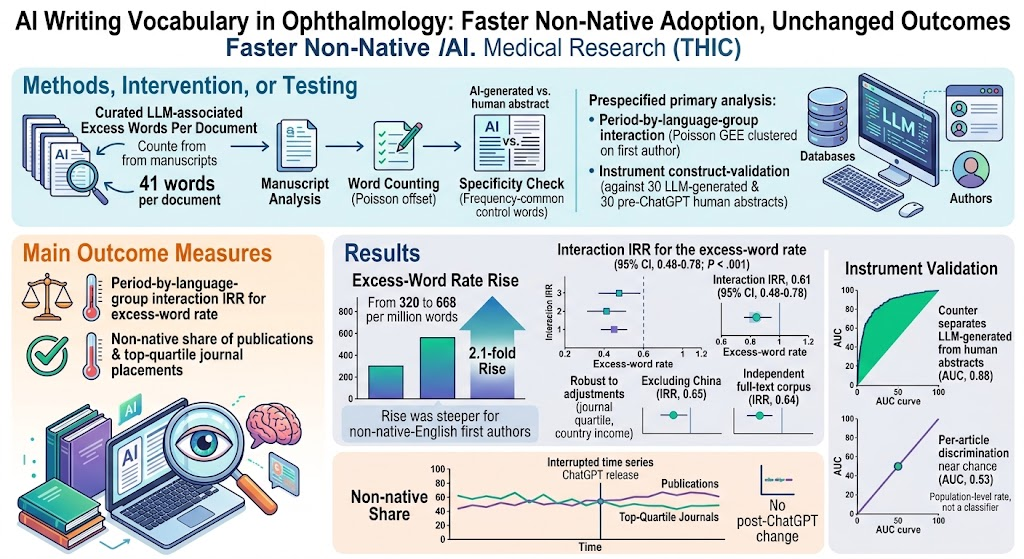
The advent of advanced artificial intelligence (AI), specifically large language models (LLMs) such as ChatGPT, has markedly influenced scientific writing styles across multiple disciplines. Ophthalmology, as a rapidly evolving field involving extensive interdisciplinary research, is no exception. This study aims to quantify how the incorporation of AI-related vocabulary in ophthalmology scholarly articles has changed following the release of ChatGPT, to assess whether this change differs based on the first author’s country affiliation language (native vs. non-native English), and to determine if these linguistic shifts have affected publication outcomes.

Study Design and Data Collection

MedXY registered readers

Sign in free to continue reading

Create or use your MedXY account to unlock the complete article.

This article was created using several editorial tools, including AI, as part of the process. Human editors reviewed this content before publication.

Related articles

Open language-specific specialty feeds and department pages.

Distinct Molecular and Clinical Profiles of USH2A-Associated Retinitis Pigmentosa in Korean Patients: Implications for Targeted TherapyThis study elucidates the unique East Asian-specific genetic variants and clinical progression of USH2A-associated retinitis pigmentosa in Koreans, highlighting the potential for exon 13-targeted treatments.Sep 19, 2026Evolving Microbial Landscape and Clinical Profiles in Postcataract Endophthalmitis: Insights from a 23-Year Retrospective Cohort StudyThis study reveals significant shifts in the bacterial spectrum, antimicrobial resistance, and clinical presentation of acute postcataract endophthalmitis over 23 years, underscoring the need for updated surveillance and tailored treatmentSep 13, 2026Widening the Spectrum of Disease Expression due to Heterozygous Variants in EFEMP1A case series delineating a novel EFEMP1 variant, p.Arg140Trp, associated with late-onset peripheral retinal degeneration distinct from classic DHRD/ML, highlighting rod dysfunction precedes structural changes.Sep 13, 2026
Loading comments...
MedXY briefing

Get the free newsletter

Evidence-led clinical news, trends, and analysis—delivered to your inbox.

Ask MedXY AI

Most popular

Intimate Health
Five Benefits for Women Continuing Sexual Activity After Menopause
Intimate Health
Why Some Women Have a Strong Sex Drive—And Why Men Shouldn't Worry About It
Nursing & care
How often should a couple have sex?
Intimate Health
Classic Intimacy Recommendations: How to Help Women Reach Orgasm and Enjoy Mutual Pleasure
Intimate Health
What Makes a Woman "Physiologically Addicted" Is Never Money, But These Two Relationship Qualities
© 2026 MedXY
Contact usAbout usPrivacy PolicyMedXY story
Ultra-Long-Distance Robotic-Assisted Subretinal Injection for Submacular Hemorrhage: A Case Report
This report describes the successful ultra-long-distance robotic-assisted subretinal injection of recombinant tissue plasminogen activator for submacular hemorrhage, demonstrating procedural feasibility and safety across 4000 km.
Aug 23, 2026
Innovative Prosthetic Capsular Bag Enables Secure Scleral Fixation of Intraocular Lenses Without Capsular SupportA first-in-human study demonstrates the safety and efficacy of a novel prosthetic capsular bag for scleral fixation of intraocular lenses in eyes lacking capsular or zonular support, showing promising visual outcomes and low complication raAug 23, 2026
Predicting the Future of Uveitis: Bridging Subspecialty Divides Through Knowledge Dissemination and TechnologyThis article examines the evolving landscape of uveitis care, emphasizing the need to unify ophthalmologic subspecialties through education and artificial intelligence to improve outcomes for this vision-threatening condition.Aug 17, 2026