Advancing Prognostication in Transthyretin Amyloid Cardiomyopathy: A Machine Learning Risk Prediction Model
Highlight
The development of a machine learning (ML)-driven prognostic model provides refined risk stratification for patients with transthyretin amyloid cardiomyopathy (ATTR-CM), improving prediction of adverse outcomes beyond established staging systems. This model integrates multi-dimensional clinical and imaging data to forecast all-cause mortality and heart failure hospitalization with enhanced accuracy and consistency across international cohorts.
Study Background
Transthyretin amyloid cardiomyopathy (ATTR-CM) is an increasingly recognized infiltrative cardiomyopathy characterized by extracellular deposition of transthyretin amyloid fibrils within the myocardium, leading to progressive heart failure and arrhythmias. Despite advances in diagnostic modalities and emerging disease-modifying therapies, prognosis remains poor, especially when diagnosis occurs late. Traditional risk stratification tools such as the National Amyloidosis Centre and Mayo Clinic staging systems rely on a limited set of clinical and biochemical parameters, resulting in suboptimal predictive performance in diverse modern patient cohorts.
Given the heterogeneity of ATTR-CM clinical presentation and progression, there is a pressing need for individualized prognostic models that can assimilate a broad array of patient-specific data. Machine learning techniques, particularly random survival forests, have shown promise in integrating high-dimensional datasets to predict time-to-event outcomes more effectively than classical approaches.
Study Design and Methods
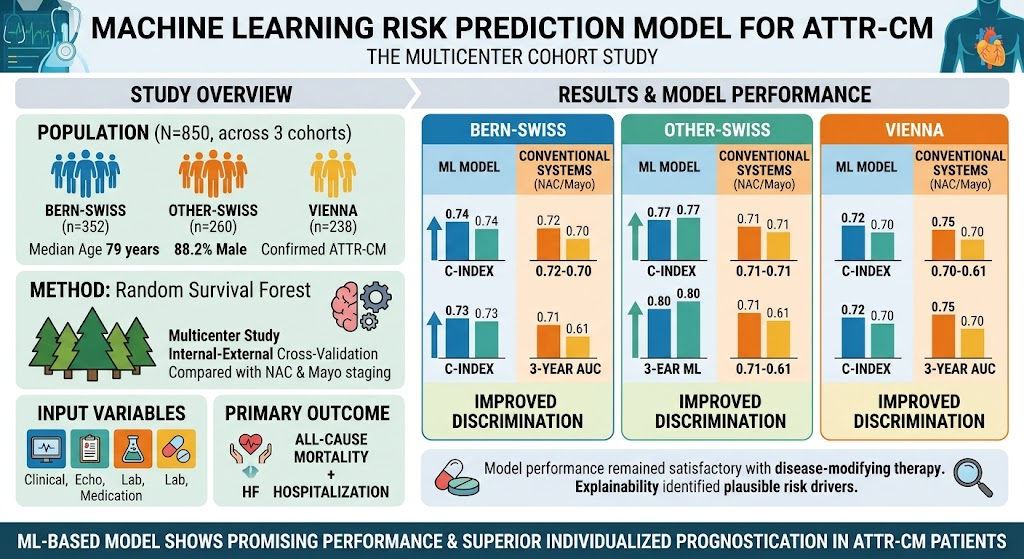
This multicenter cohort study pooled data from three cohorts: the Bern-Swiss cohort, other Swiss centers combined, and the Vienna cohort. The study population included 850 patients with confirmed ATTR-CM enrolled from specialized cardiac amyloidosis referral centers — the Swiss Cardiac Amyloidosis Registry and the Cardiac Amyloidosis Registry of the Medical University of Vienna — covering the period from 2014 to 2025.
The modeling approach involved training a random survival forest to predict a composite primary outcome of all-cause mortality or hospitalization for heart failure. Input variables comprised demographic information, clinical data, medication use, laboratory values including biomarkers, and echocardiographic parameters. The model underwent robust internal-external cross-validation by sequentially leaving out each cohort as a validation set to assess generalizability.
Comparative performance against established prognostic systems — the National Amyloidosis Centre staging and Mayo Clinic staging — was assessed using Harrell’s concordance indices and time-dependent area under the curve (AUC) metrics. Calibration and model explainability analyses were also performed to evaluate clinical plausibility and utility.
Key Findings
The ML-based random survival forest model exhibited good to excellent discrimination across all cohorts: Harrell concordance indices ranged from 0.72 to 0.77 and 3-year AUCs from 0.73 to 0.80, figures that outperform the National Amyloidosis Centre and Mayo Clinic staging systems by 2% to 10% in concordance indices and 3% to 19% in AUC improvements depending on the cohort.
The model showed consistent calibration across time points, supporting reliability in risk estimation. Importantly, its performance remained robust in subgroups receiving contemporary disease-modifying treatments, highlighting potential applicability in guiding modern management decisions.
Explainability analyses identified known and biologically plausible predictors of poor outcomes, including advanced age, biomarkers reflecting cardiac stress and injury, echocardiographic measures of cardiac structure and function, and clinical markers such as medication profiles. This enhances confidence in the model’s clinical interpretability.
Expert Commentary
The integration of machine learning models represents a paradigm shift in the prognostication of infiltrative cardiomyopathies like ATTR-CM. Traditional staging systems have inherent limitations due to their simplified input parameters and discrete risk group categories. In contrast, ML algorithms can handle complex, nonlinear relationships and interactions inherent in multidimensional clinical data, thereby providing individualized predictions with higher granularity.
Nonetheless, challenges remain before widespread clinical adoption. Although the multicenter validation is a strength, further external validation in geographically and ethnically diverse populations is warranted to confirm generalizability. Additionally, practical implementation requires seamless integration into clinical workflows with user-friendly interfaces and ongoing assessment of clinical impact on decision-making and patient outcomes.
Future research is needed to explore the model’s utility in tailoring therapeutic interventions, monitoring disease progression longitudinally, and potentially incorporating novel biomarker or imaging techniques as they emerge.
Conclusion
This study presents a state-of-the-art machine learning-derived risk prediction tool that surpasses established staging systems in accuracy for patients with transthyretin amyloid cardiomyopathy. By leveraging comprehensive clinical and echocardiographic data, it supports enhanced individualized prognostication. Adoption of such advanced prognostic models holds promise to refine clinical risk assessment, optimize therapeutic decision-making, and ultimately improve patient outcomes in this challenging disease.
Funding and ClinicalTrials.gov
Funding details were not specified in the available data. The study utilized registries including the Swiss Cardiac Amyloidosis Registry and the Cardiac Amyloidosis Registry of the Medical University of Vienna. No ClinicalTrials.gov identifier was provided, suggesting an observational cohort design rather than a registered interventional trial.
References
1. Baj G, Ciocca N, Mohammadi Kazaj P, et al. Machine Learning-Driven Risk Prediction Model in Transthyretin Amyloid Cardiomyopathy. JAMA Cardiol. 2026;Aug 28. PMID: 42663418.
2. Gillmore JD, Damy T, Fontana M, et al. A new staging system for transthyretin amyloid cardiomyopathy: the National Amyloidosis Centre experience. Eur Heart J. 2018;39(30):2799–2806.
3. Grogan M, Scott CG, Kyle RA, et al. Natural history of wild-type transthyretin cardiac amyloidosis and risk stratification using a novel staging system. J Am Coll Cardiol. 2016;68(10):1014–1020.
4. Krittanawong C, Zhang H, Wang Z, et al. Artificial Intelligence in Precision Cardiovascular Medicine. J Am Coll Cardiol. 2017;69(21):2657–2664.
This article was created using several editorial tools, including AI, as part of the process. Human editors reviewed this content before publication.