ADAMTS14 Identified as a Novel Regulator of Fibroblast Mechanoactivation in Pulmonary Fibrosis
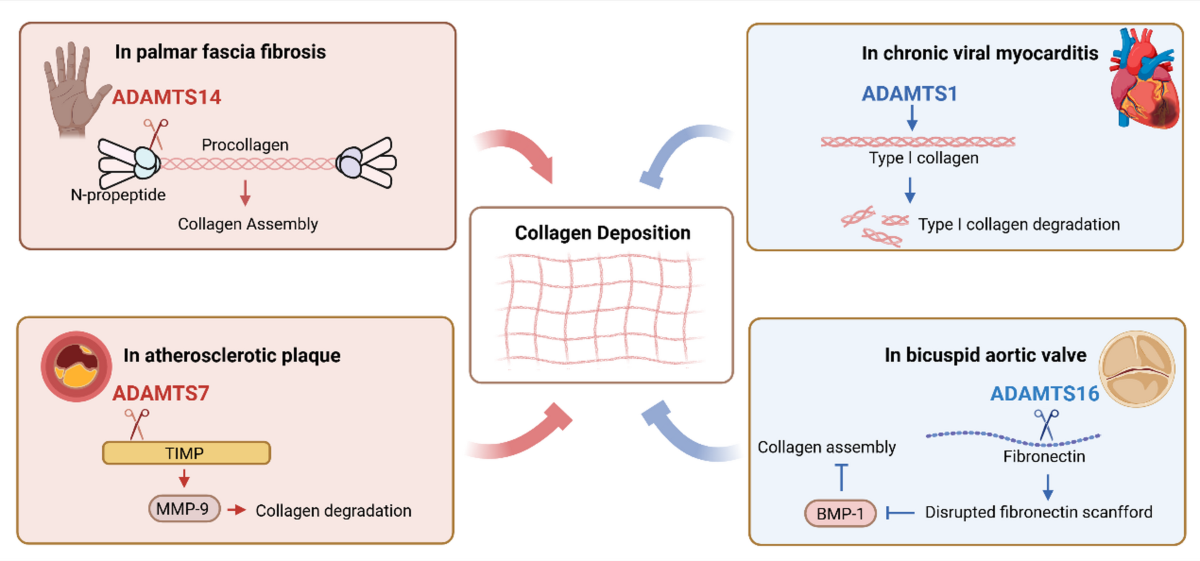
ADAMTS14 was identified via unbiased siRNA screen as a regulator of YAP nuclear translocation and fibroblast activation in idiopathic pulmonary fibrosis (IPF).
Transcriptomic analyses of IPF patient samples revealed an ADAMTS14-expressing fibroblast population located within fibroblastic foci and associated with excessive collagen matrix synthesis.
Disrupting ADAMTS14 in patient-derived lung fibroblasts reduced pro-fibrotic gene expression and attenuated TGFβ responses.
Mechanistically, collagen V was identified as a novel ADAMTS14 substrate; ADAMTS14 deficiency led to unstable extracellular matrix, disorganized focal adhesions, impaired force transmission, and reduced FAK–AKT signaling.
The study delineates a feed-forward ADAMTS14–collagen V–focal adhesion axis driving YAP-mediated mechanoactivation, providing potential new therapeutic targets for IPF.
Study Snapshot | |
Study Design | Mechanistic translational study combining in vitro siRNA screening, transcriptomic analysis of patient lung tissue, and functional mechanobiology assays. |
|---|---|
Population | Primary human lung fibroblasts (HLFs) from IPF patients and non-IPF controls; transcriptomic data from an IPF patient cohort. |
Methods | siRNA screen, YAP nuclear translocation assays, RNA sequencing, proteomics, co-immunoprecipitation, advanced microscopy, and mechanobiology assays (traction force, focal adhesion analysis). |
Key Findings | ADAMTS14 is required for YAP nuclear translocation and fibroblast activation; ADAMTS14-expressing fibroblasts reside in fibroblastic foci; ADAMTS14 deficiency reduces pro-fibrotic genes and impairs matrix stability via collagen V cleavage, disrupting focal adhesion–FAK–AKT signaling. |
Limitations | Primarily in vitro and ex vivo; in vivo validation in animal models and assessment of clinical translatability are needed; mechanistic steps inferred from cultured cell systems. |
Why This Study Matters
Idiopathic pulmonary fibrosis (IPF) is a progressive, lethal lung disease characterized by excessive deposition of extracellular matrix by activated fibroblasts. Mechanical cues within the stiff fibrotic microenvironment drive fibroblast activation through the transcriptional coactivator YAP. Identifying upstream regulators of YAP mechanoactivation could reveal new therapeutic targets. In this study, investigators from Massachusetts General Hospital and Harvard Medical School identify ADAMTS14, a secreted metalloprotease, as a novel modulator of YAP-mediated fibroblast mechanoactivation in IPF.
How the Study Was Conducted
The research team performed an unbiased siRNA screen targeting extracellular matrix–related genes in primary human lung fibroblasts and measured YAP nuclear translocation as a readout of mechanoactivation. They then disrupted ADAMTS14 expression using CRISPR and RNA interference in IPF patient–derived fibroblasts and assessed fibrotic gene expression, TGFβ responsiveness, and matrix production. Transcriptomic analyses of IPF lung tissue were used to map ADAMTS14 expression to specific fibroblast populations. Mechanistic studies combined proteomics, co-immunoprecipitation, and functional mechanobiology assays—including traction force microscopy and focal adhesion quantification—to define ADAMTS14 substrates and downstream signaling.
What the Researchers Found
The screen singled out ADAMTS14 as a top hit required for YAP nuclear localization. In IPF patient–derived fibroblasts, loss of ADAMTS14 significantly reduced expression of pro-fibrotic genes such as COL1A1, ACTA2 (α-SMA), and CTGF, and blunted the activating response to TGFβ. Transcriptomic profiling of IPF lungs identified a distinct ADAMTS14high fibroblast subpopulation localized within fibroblastic foci—hallmark lesions of IPF—that was enriched for collagen synthesis pathways. Mechanistically, the authors discovered that ADAMTS14 cleaves collagen V, a minor fibrillar collagen critical for matrix integrity. ADAMTS14-deficient fibroblasts deposited an unstable extracellular matrix that lacked organized collagen V fibrils, leading to aberrant focal adhesion formation, reduced force transmission from the matrix to the cytoskeleton, and diminished signaling through the focal adhesion kinase (FAK)–AKT pathway. This disruption prevented YAP nuclear translocation, breaking the feed-forward mechanoactivation loop.
Strengths and Limitations
Strengths include the unbiased screening approach, use of patient-derived cells and tissue, and multi-modal mechanistic validation combining proteomics, microscopy, and functional assays. The study identifies a previously unrecognized extracellular–intracellular signaling axis. Limitations include its reliance on cultured fibroblasts and ex vivo tissue; in vivo animal models of pulmonary fibrosis have not yet been tested. The specificity of ADAMTS14 inhibition and potential off-target effects also require further investigation. As a translational study, the findings establish a mechanistic framework but do not yet demonstrate therapeutic efficacy in a living system.
Implications for Practice and Research
This work uncovers a new node—the ADAMTS14–collagen V–focal adhesion axis—in the mechanosignaling circuit that sustains fibroblast activation in IPF. Targeting ADAMTS14 or its downstream effectors may offer a strategy to ‘soften’ the fibrotic response by interrupting the matrix-driven positive feedback loop. Future studies are needed to evaluate ADAMTS14 inhibition in preclinical fibrosis models, assess its role in other fibrotic diseases, and determine whether ADAMTS14 expression correlates with disease progression or treatment response in IPF patients.
References
Ganzleben I, Jaiswal A, Yang Y, et al. ADAMTS14 is a Novel Modulator of Fibroblast Mechanoactivation in Pulmonary Fibrosis. Am J Respir Crit Care Med. 2026 Jul 28. PMID: 42518202. DOI: not provided.
This article was created using several editorial tools, including AI, as part of the process. Human editors reviewed this content before publication.