We use cookies

Our website uses essential cookies and, with your consent, additional cookies to measure performance and improve our services. Cookie Policy.

You can change your choice at any time.

MMedXYNews
HomeVideos
MedXY AI/MedXY News/Section: Clinical Updates

Early Biologic Initiation in Severe Asthma: Enhancing Remission and Clinical Outcomes from Global Real-World Cohorts
MedXY Editorial Team•Sep 17, 2026•Clinical Updates
early interventionClinical Remissionbiologic therapy重症喘息

Highlights

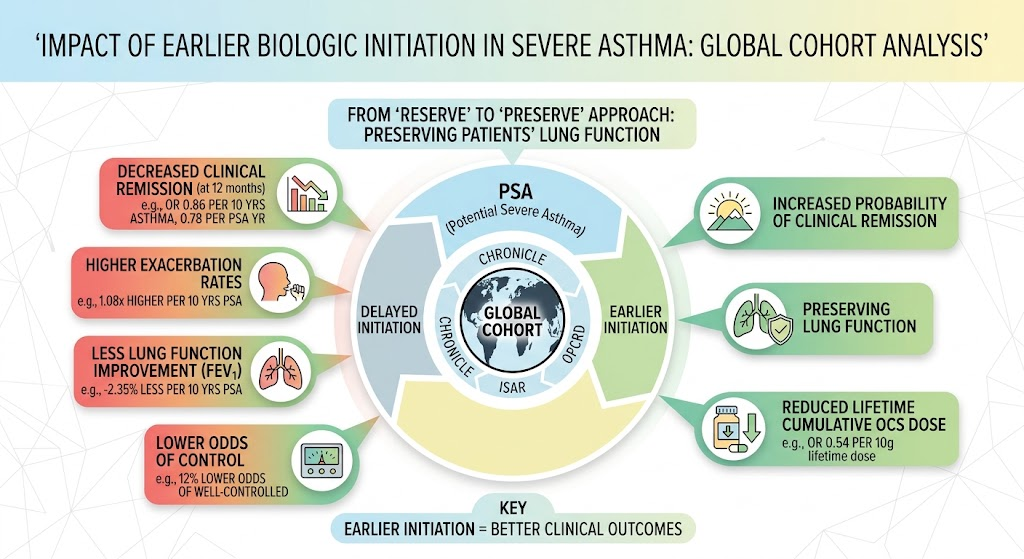
  • Earlier initiation of biologics in severe asthma (SA) is associated with higher rates of clinical remission and improved asthma control.
  • Delays in biologic treatment correlate with increased exacerbations, worsened lung function, and higher oral corticosteroid (OCS) burden.
  • Real-world global data from CHRONICLE, ISAR, and OPCRD cohorts reinforce the importance of timely biologic accessibility and prescription policy reforms.
  • Shifting asthma management from a ‘reserve’ to a ‘preserve’ approach could better maintain lung function and quality of life in patients with SA.

Background

MedXY registered readers

Sign in free to continue reading

Create or use your MedXY account to unlock the complete article.

This article was created using several editorial tools, including AI, as part of the process. Human editors reviewed this content before publication.

Related articles

Open language-specific specialty feeds and department pages.

Tezepelumab Demonstrates Robust Efficacy and Safety Across Diverse Severe Asthma Phenotypes: Insights from the Phase 4 PASSAGE StudyThe PASSAGE phase 4 study reveals tezepelumab significantly reduces exacerbation rates and improves lung function and quality of life in a broad US severe asthma population, including underrepresented groups and varied phenotypes.Sep 12, 2026Comparing Long-Term Systemic Risks of Biologic Versus Conventional Therapy in Non-Infectious UveitisA multicenter retrospective study evaluates five-year risks of systemic complications in non-infectious uveitis patients receiving biologic versus conventional therapies, highlighting infection and cytopenia risks with biologics but comparaJul 11, 20262/20/20 Model Outperforms AQUILA Criteria in Identifying High-Risk Smoldering Multiple MyelomaThe 2/20/20 risk stratification model identifies a smaller, truly high-risk SMM group with higher progression rates than the AQUILA trial criteria, suggesting better targeting for early intervention.Apr 24, 2026Myocardial Fibrosis Predicts Outcomes in Asymptomatic Severe Aortic Stenosis, But Early Valve Replacement May Not Offer Universal Benefit
Loading comments...
MedXY briefing

Get the free newsletter

Evidence-led clinical news, trends, and analysis—delivered to your inbox.

Ask MedXY AI

Most popular

Intimate Health
Five Benefits for Women Continuing Sexual Activity After Menopause
Intimate Health
Why Some Women Have a Strong Sex Drive—And Why Men Shouldn't Worry About It
Nursing & care
How often should a couple have sex?
Intimate Health
Classic Intimacy Recommendations: How to Help Women Reach Orgasm and Enjoy Mutual Pleasure
Intimate Health
What Makes a Woman "Physiologically Addicted" Is Never Money, But These Two Relationship Qualities
© 2026 MedXY
Contact usAbout usPrivacy PolicyMedXY story
The EVOLVED trial reveals that higher myocardial fibrosis burden associates with adverse events in asymptomatic severe aortic stenosis patients, yet early intervention benefits appear nuanced—showing promise for reducing hospitalizations in
Apr 17, 2026
Beyond Clinical Remission: Why Diet and Gut Signatures Remain Perturbed in Crohn’s DiseaseA multi-omic study reveals that despite effective immune suppression, Crohn’s disease patients in remission exhibit persistent dietary, microbial, and metabolic abnormalities. This research highlights the critical role of ultraprocessMar 10, 2026
Tezepelumab Enables Complete Oral Corticosteroid Discontinuation in 50% of Patients with Severe, Uncontrolled Asthma: Results from the WAYFINDER Phase 3b TrialThe WAYFINDER study reveals that tezepelumab significantly reduces OCS dependence in severe asthma, with over half of patients achieving complete discontinuation by week 52 while maintaining asthma control, regardless of baseline inflammatoFeb 19, 2026